


























Views
Downloads


Printable Active and Passive Voice Worksheet | Grade 8 ELA
Paste this activity's link or code into your existing LMS (Google Classroom, Canvas, Teams, Schoology, Moodle, etc.).
Students can open and work on the activity right away, with no student login required.
You'll still be able to track student progress and results from your teacher account.
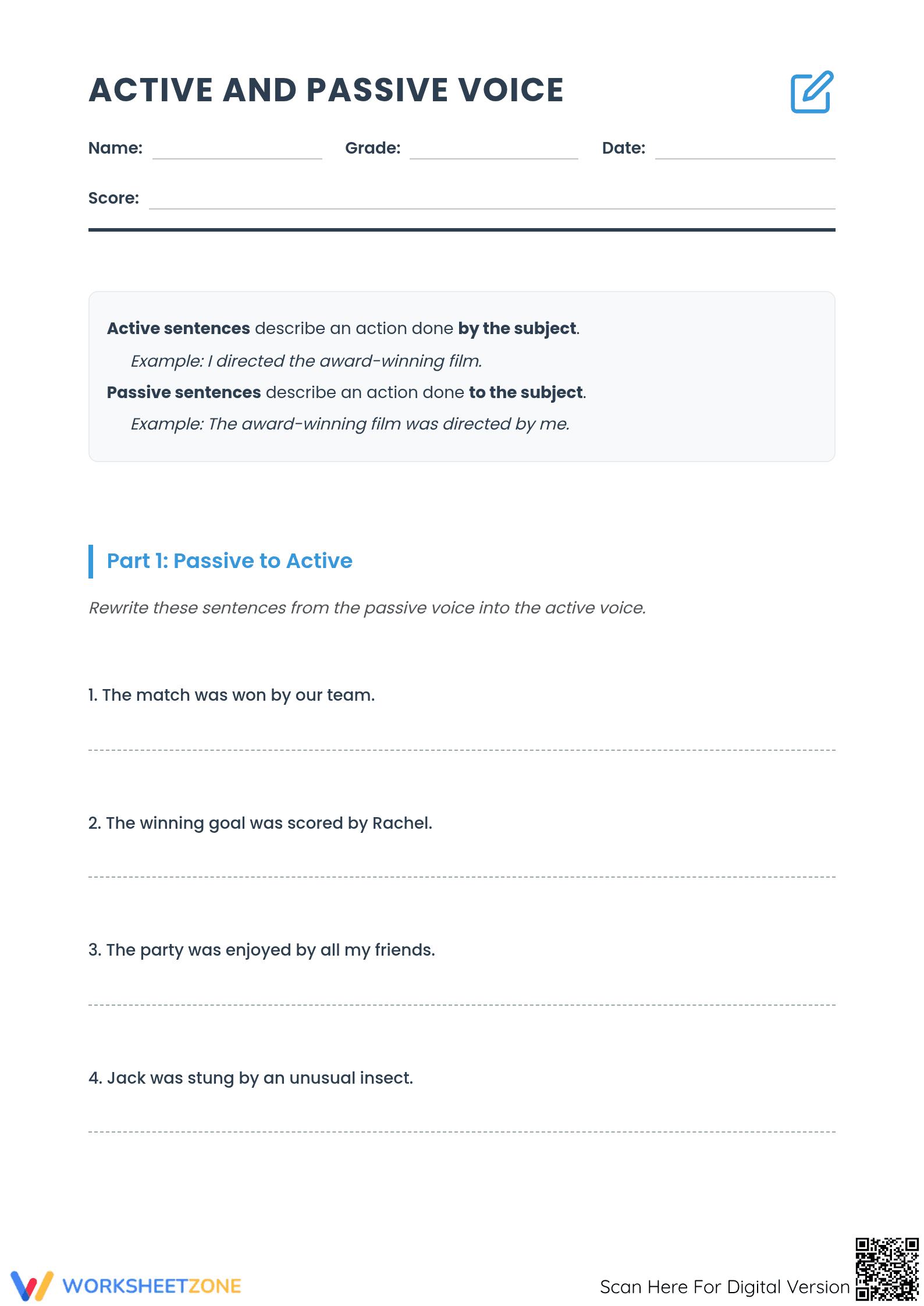
This comprehensive active and passive voice worksheet helps middle school students master sentence structure by identifying and converting verb voices. By working through these targeted exercises, students will learn how to manipulate sentence focus, improving both their reading comprehension and their ability to write with clarity and precision.
At a Glance
- Grade: 8 · Subject: ELA
- Standard:
CCSS.ELA-LITERACY.L.8.1.B— Form and use verbs in the active and passive voice- Skill Focus: Active and Passive Voice
- Format: 4 pages · 21 problems · Answer key included · PDF
- Best For: Independent practice and grammar review
- Time: 25–35 minutes
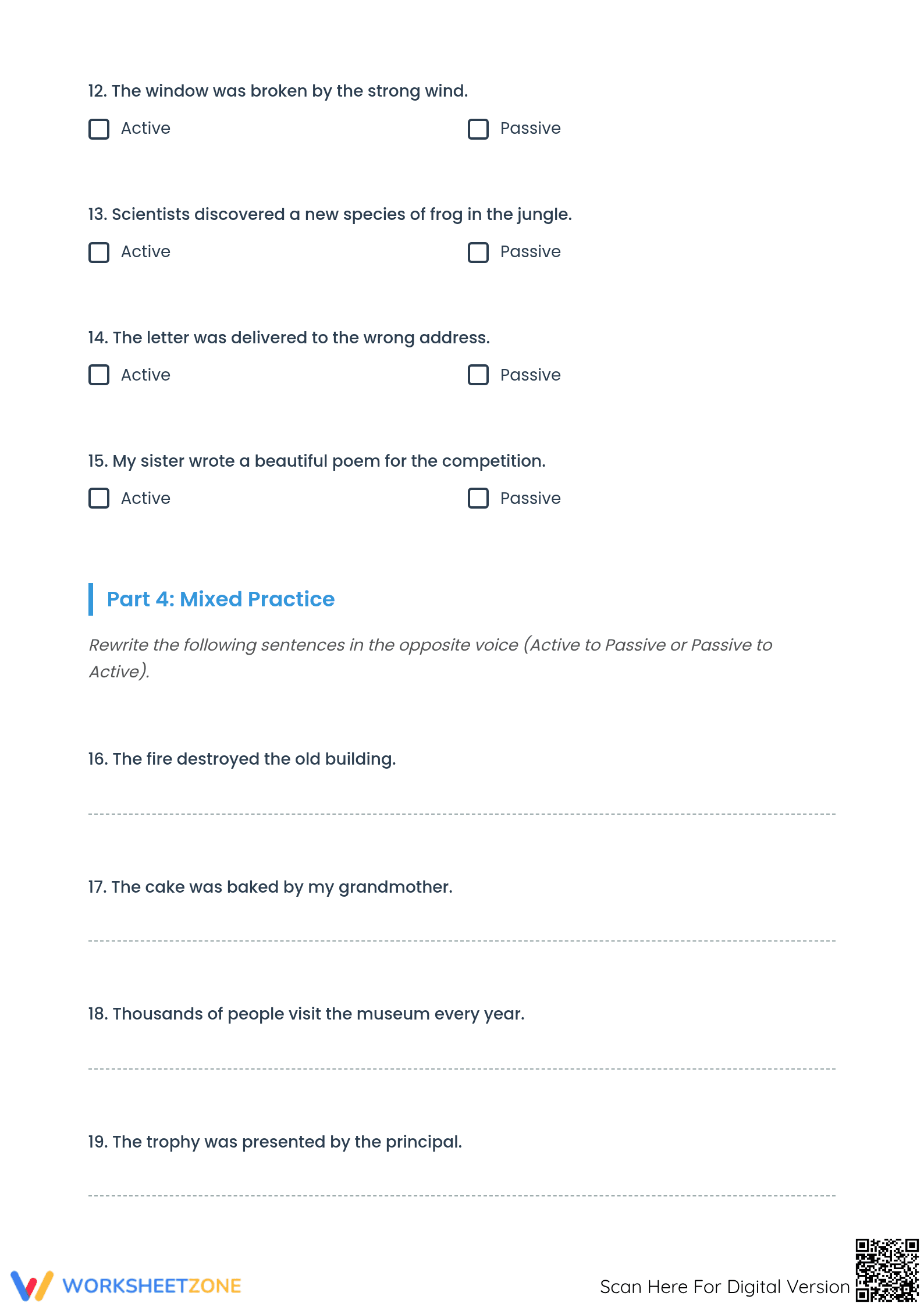
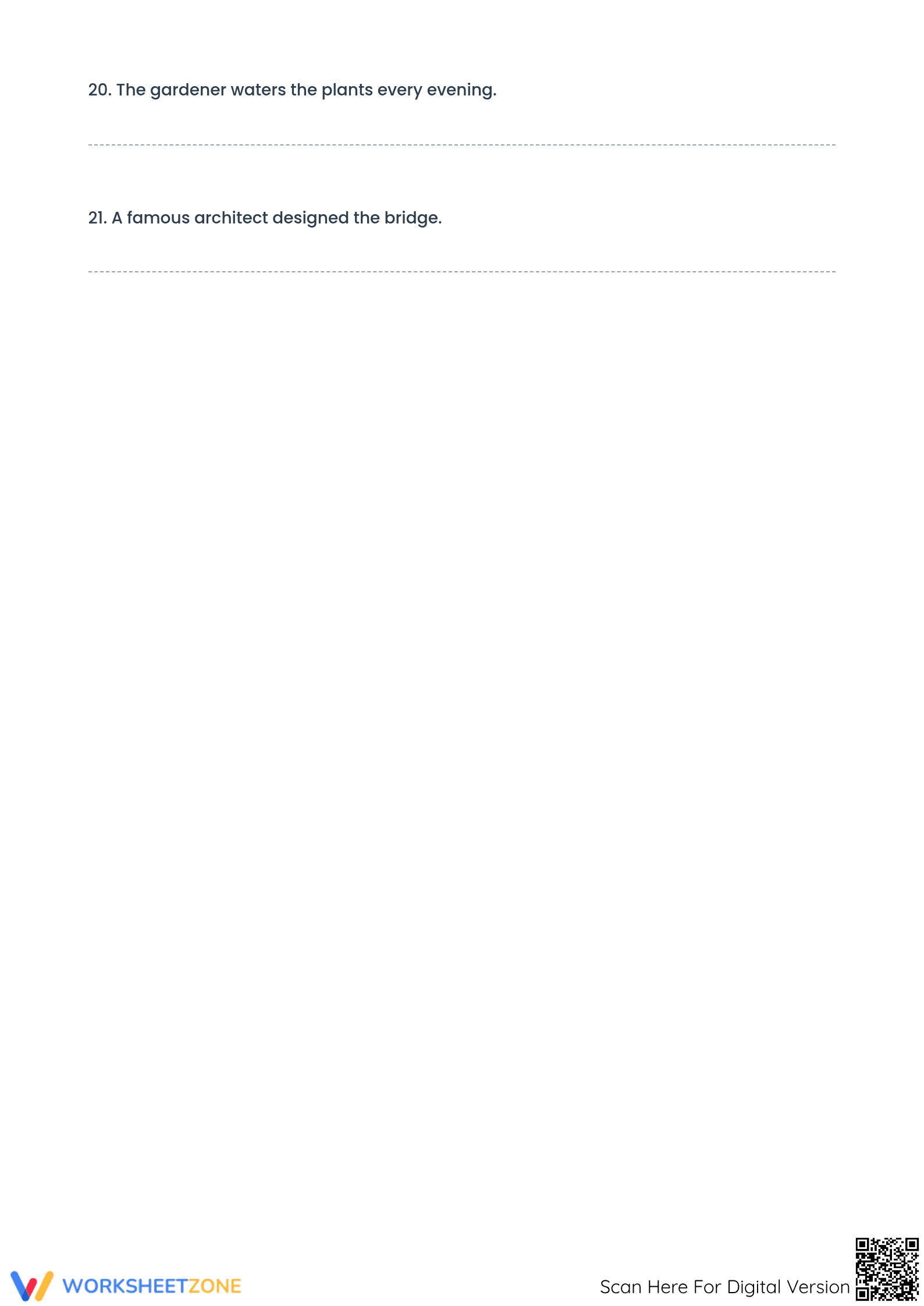
This resource features four distinct sections designed to build grammar proficiency step-by-step. It begins with a helpful reference box defining both voices with clear examples. Students then progress through 21 total questions, including converting passive sentences to active, changing active sentences to passive, identifying the voice of given sentences, and completing a mixed practice section. A complete four-page answer key is provided to ensure accurate grading and immediate feedback.
Skill Progression
- Guided practice: The worksheet opens with definitions and examples, followed by five questions requiring students to rewrite passive sentences into active voice.
- Supported practice: The next ten questions ask students to reverse the process and identify the voice in isolated sentences, reinforcing recognition.
- Independent practice: The final six questions offer mixed practice, challenging students to determine the current voice and rewrite it without explicit section prompts.
This gradual-release approach follows the proven I Do, We Do, You Do model, ensuring students build confidence before tackling complex mixed conversions.
Standards Alignment
This resource is directly aligned to CCSS.ELA-LITERACY.L.8.1.B, requiring students to form and use verbs in the active and passive voice. It also supports broader writing standards by encouraging students to choose language that expresses ideas precisely and concisely. Both standard codes can be copied directly into lesson plans, IEP goals, or district curriculum mapping tools.
How to Use It
Use this worksheet during grammar instruction after a mini-lesson on verb voice. It works well as independent practice or a collaborative partner activity where students can discuss their sentence rewrites. As a formative assessment tip, walk around the room during the mixed practice section to observe if students are correctly identifying the subject and object before attempting the conversion. Most students will complete the full packet in 25 to 35 minutes.
Who It's For
This packet is designed for 8th-grade ELA students, though it serves as excellent review for high schoolers needing foundational grammar reinforcement. For students requiring differentiation, teachers can assign only the identification section or provide sentence frames for the rewriting tasks. Pair this worksheet with a mentor text analysis activity where students highlight active and passive sentences in published articles.
Mastering the distinction between active and passive voice is a critical component of advanced literacy and effective communication. According to an EdReports 2024 analysis of middle school ELA curricula, explicit grammar instruction requiring students to manipulate sentence structures significantly improves overall writing quality and reading comprehension. When students practice with targeted resources aligned to CCSS.ELA-LITERACY.L.8.1.B, they learn to form and use verbs in the active and passive voice with greater intentionality. This specific skill allows writers to control pacing, emphasize specific information, and maintain reader engagement. By transitioning from simple identification to complex sentence conversion, learners develop the syntactic flexibility necessary for high school and college-level writing. Providing structured practice ensures these grammatical concepts transfer into students' independent drafting processes.


