


























Views
Downloads

Acts of Kindness Printable Worksheet | Grade 6-9
Paste this activity's link or code into your existing LMS (Google Classroom, Canvas, Teams, Schoology, Moodle, etc.).
Students can open and work on the activity right away, with no student login required.
You'll still be able to track student progress and results from your teacher account.
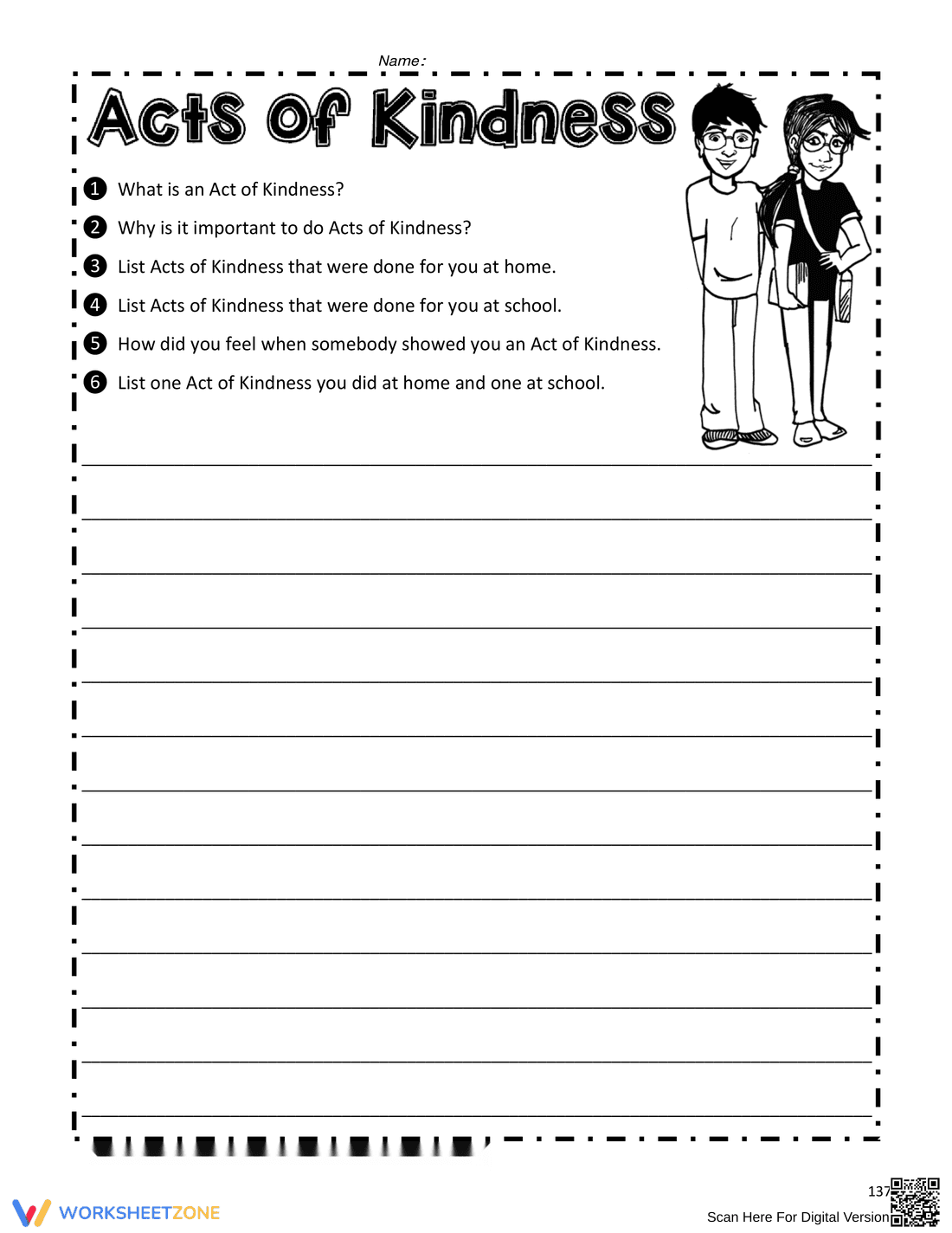
This reflective writing worksheet prompts middle and high school students to explore the impact of positive behavior. By answering six targeted questions about acts of kindness, learners develop social-emotional awareness while practicing clear, coherent written expression. The structured format encourages thoughtful self-reflection on personal experiences at home and school.
At a Glance
- Grade: 6-9 · Subject: English
- Standard:
CCSS.ELA-LITERACY.W.6.4— Produce clear and coherent writing appropriate to task.- Skill Focus: Reflective Writing
- Format: 1 page · 6 problems · No answer key · PDF
- Best For: Morning work or advisory periods
- Time: 15–20 minutes
This single-page resource features six short-answer prompts guiding students through meaningful reflection. Questions begin by defining kindness, then transition to personal application by asking students to recall specific instances of kindness received or performed. Ample lined space is provided for drafting responses. Because the focus is subjective, an answer key is not included, allowing for authentic expression.
This resource offers an efficient zero-prep workflow:
- Print (1 minute): The single-page layout is optimized for quick, high-quality black-and-white copying.
- Distribute (1 minute): Hand out the sheets at the start of class, during homeroom, or as part of an advisory period.
- Review (3 minutes): Briefly read the six prompts aloud to ensure students understand expectations for complete sentences.
With teacher preparation under two minutes, this activity fits perfectly into emergency sub plans.
This activity aligns with CCSS.ELA-LITERACY.W.6.4: Produce clear and coherent writing in which the development, organization, and style are appropriate to task, purpose, and audience. It also supports broader social-emotional learning objectives by encouraging self-awareness. Both standard codes can be copied directly into lesson plans, IEP goals, or district curriculum mapping tools.
This worksheet serves as an excellent bell-ringer during morning advisory, setting a positive tone while students practice writing. Alternatively, use it after a direct instruction lesson on empathy. As a formative assessment observation tip, educators can circulate while students write, noting their ability to construct complete sentences. Expected completion time ranges from 15 to 20 minutes.
This resource is primarily designed for middle and early high school students in grades 6 through 9. The straightforward prompts make it accessible for diverse learners, while the open-ended nature allows advanced students to provide more sophisticated, detailed reflections. For differentiation, teachers can offer sentence starters for students who need additional writing support. This worksheet pairs naturally with a reading passage about community service or a classroom anchor chart detailing positive character traits.
Integrating social-emotional learning tasks like this acts of kindness reflection into the regular academic schedule yields significant benefits for student development. By addressing CCSS.ELA-LITERACY.W.6.4, educators ensure students practice how to produce clear and coherent writing appropriate to task within a meaningful context. According to a comprehensive EdReports 2024 analysis, embedding character education prompts into standard English language arts practice increases student engagement and fosters a more supportive classroom environment. When students regularly articulate their feelings and document positive behaviors, they build essential communication skills alongside emotional intelligence. This dual-purpose approach maximizes instructional minutes, allowing teachers to meet rigorous academic standards while simultaneously nurturing the whole child. Consistent practice with reflective writing tasks ultimately strengthens both personal resilience and academic stamina.


