


























Views
Downloads
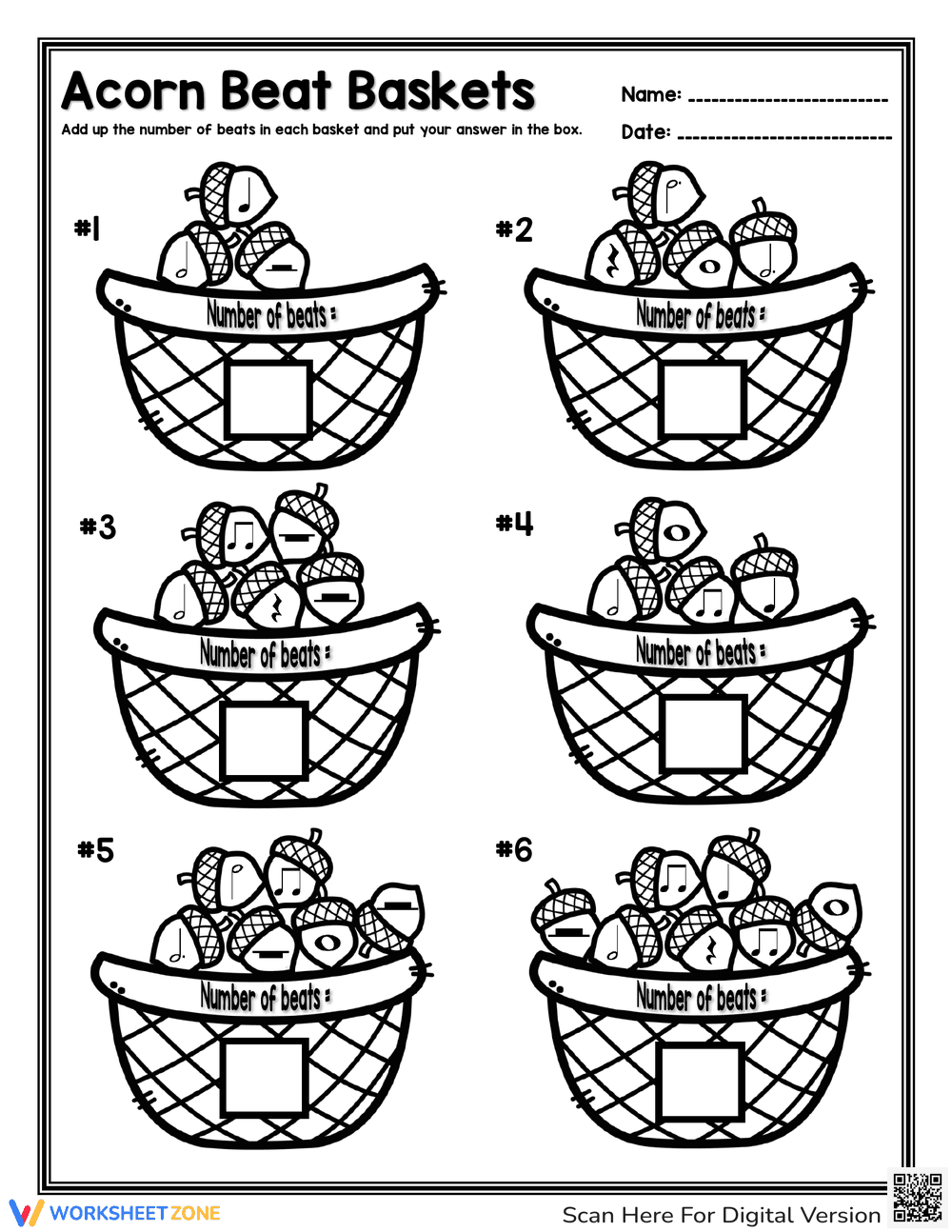
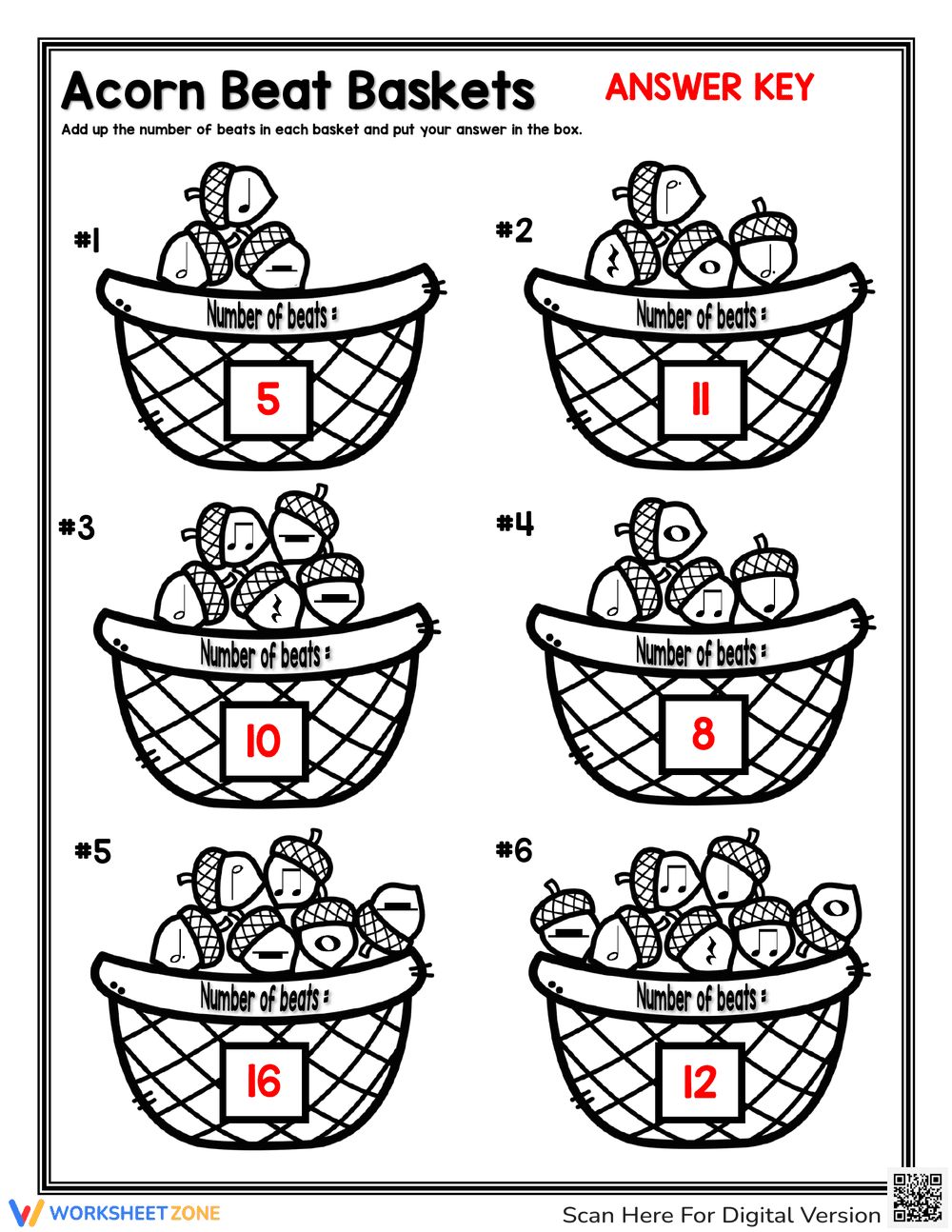

Grade 3-6 Acorn Beat Baskets — Printable No-Prep Worksheet
Paste this activity's link or code into your existing LMS (Google Classroom, Canvas, Teams, Schoology, Moodle, etc.).
Students can open and work on the activity right away, with no student login required.
You'll still be able to track student progress and results from your teacher account.
Master Rhythm Counting with Seasonal Math
This Acorn Beat Baskets worksheet integrates music theory with mathematical addition to help students master rhythm values. By calculating the total number of beats in various baskets of notes and rests, learners strengthen their understanding of time signatures and note durations. It is an ideal seasonal activity for elementary and middle school music classrooms.
At a Glance
- Grade: 3-6 · Subject: Music & Math
- Standard:
CCSS.MATH.CONTENT.3.NBT.A.2— Fluently add and subtract within 1000 using strategies and algorithms- Skill Focus: Rhythm Note Value Addition
- Format: 2 pages · 6 problems · Answer key included · PDF
- Best For: Fall music centers or sub plans
- Time: 10–15 minutes
What's Inside
This resource features a single-page student activity and a corresponding full-color answer key. Students encounter six distinct baskets filled with acorns representing different musical symbols, including whole notes, dotted half notes, quarter notes, and various rests. The layout provides clear boxes for students to record their final sums, ensuring easy grading for the instructor.
Zero-Prep Workflow
- Print: Select the student page and print the required number of copies for your class (30 seconds).
- Distribute: Hand out the sheets as a warm-up, bell-ringer, or independent practice task (1 minute).
- Review: Use the included answer key to review results or allow students to self-correct their work (1 minute).
Total teacher preparation time is under two minutes, making this an excellent choice for emergency sub plans.
Standards Alignment
The primary standard addressed is CCSS.MATH.CONTENT.3.NBT.A.2, which focuses on fluently adding and subtracting within 1000. While the context is musical, the cognitive task requires students to assign numerical values to symbols and perform multi-addend addition. This standard code can be copied directly into lesson plans, IEP goals, or district curriculum mapping tools.
How to Use It
Assign this worksheet during the independent practice phase of a lesson on rhythm values to assess individual student comprehension. It also serves as an excellent formative assessment tool; observe if students correctly identify the difference between a half note and a dotted half note. Expected completion time ranges from 10 to 15 minutes depending on student familiarity with note values.
Who It's For
This resource is tailored for general music students in grades 3 through 6, as well as beginning band or orchestra members. It provides necessary scaffolding for students who struggle with abstract math by providing a visual, thematic context. Pair this with a rhythm anchor chart or a physical metronome demonstration for maximum impact.
According to the RAND AIRS 2024 report on interdisciplinary curriculum, integrating mathematical operations with arts-based content significantly increases student engagement and retention of abstract concepts. This Acorn Beat Baskets worksheet applies this principle by requiring students to perform multi-step addition within the context of musical rhythm values. By identifying symbols like the whole note (4 beats) and the quarter rest (1 beat), students practice the CCSS.MATH.CONTENT.3.NBT.A.2 standard in a novel environment. Research from Fisher & Frey (2014) suggests that such cross-curricular applications help solidify fluency by moving skills out of isolation and into practical, albeit simulated, scenarios. This 2-page PDF provides a structured, 6-task assessment that allows educators to quickly gauge both musical literacy and computational accuracy. The inclusion of a clear answer key supports immediate feedback, a critical component of effective formative assessment in the modern elementary classroom.


