


























Views
Downloads


Achoo! Reading Comprehension | Essential Grade 6-10 ELA
Paste this activity's link or code into your existing LMS (Google Classroom, Canvas, Teams, Schoology, Moodle, etc.).
Students can open and work on the activity right away, with no student login required.
You'll still be able to track student progress and results from your teacher account.
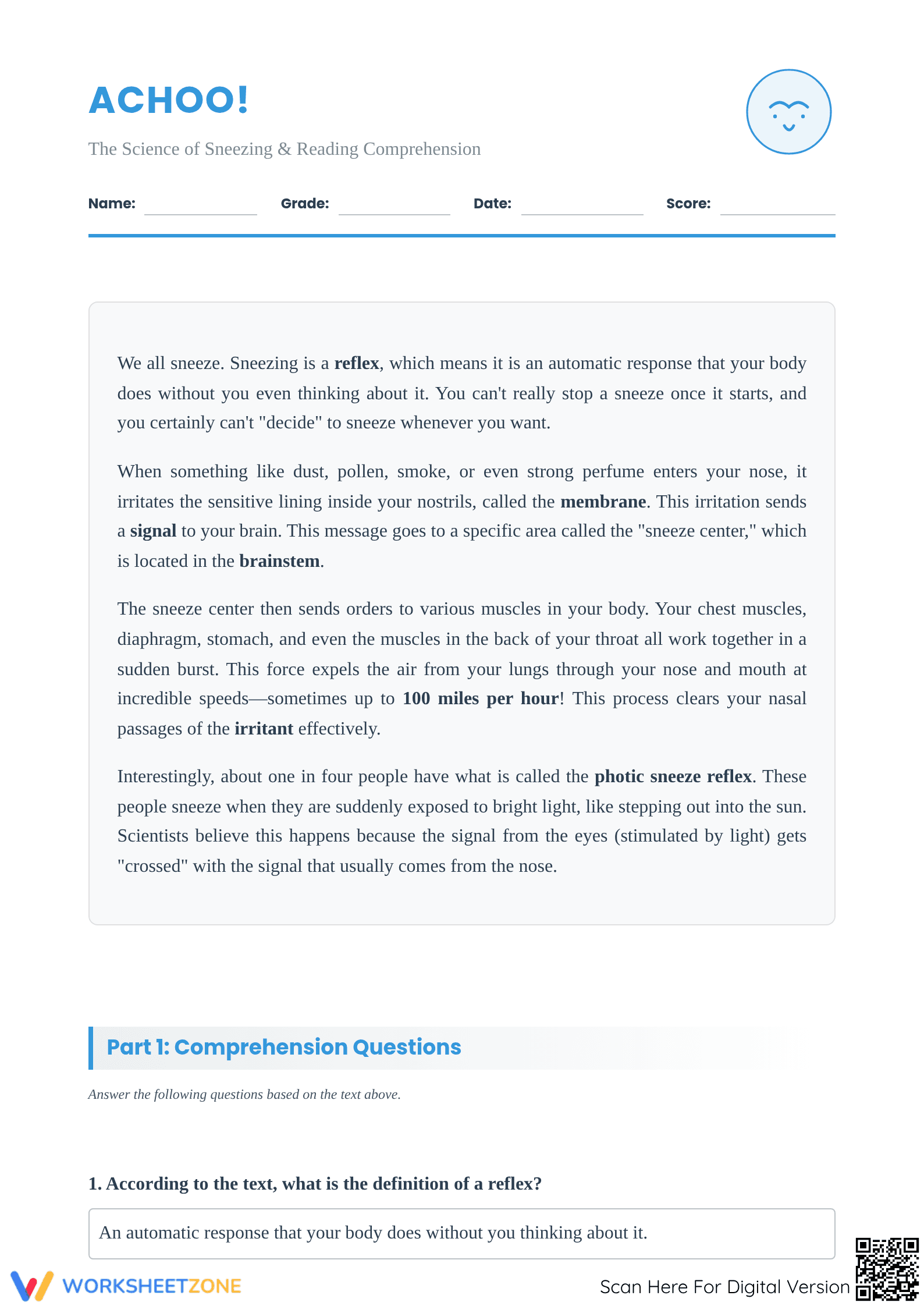
This Grade 6-10 reading comprehension worksheet uses the science of sneezing to build critical literacy skills. Students analyze informational text to understand biological reflexes while practicing evidence-based answering. It provides a comprehensive look at the "Achoo!" phenomenon, ensuring students can identify key details and technical vocabulary in a scientific context.
At a Glance
- Grade: 6-10 · Subject: ELA
- Standard:
CCSS.ELA-LITERACY.RI.6.1— Cite textual evidence to support analysis of what the text says explicitly- Skill Focus: Informational Text Analysis
- Format: 4 pages · 18 problems · Answer key included · PDF
- Best For: Sub plans or independent practice
- Time: 30–45 minutes
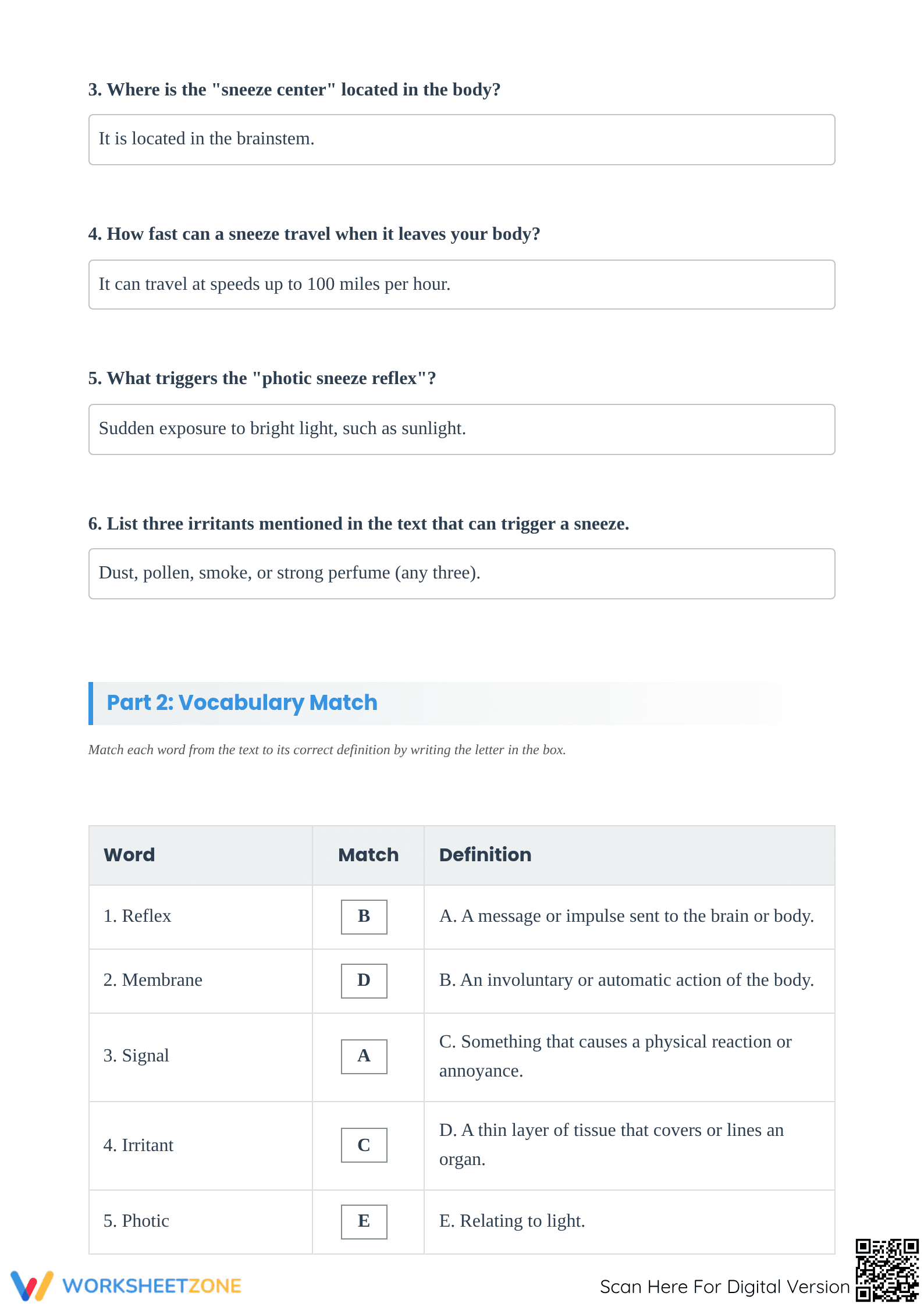
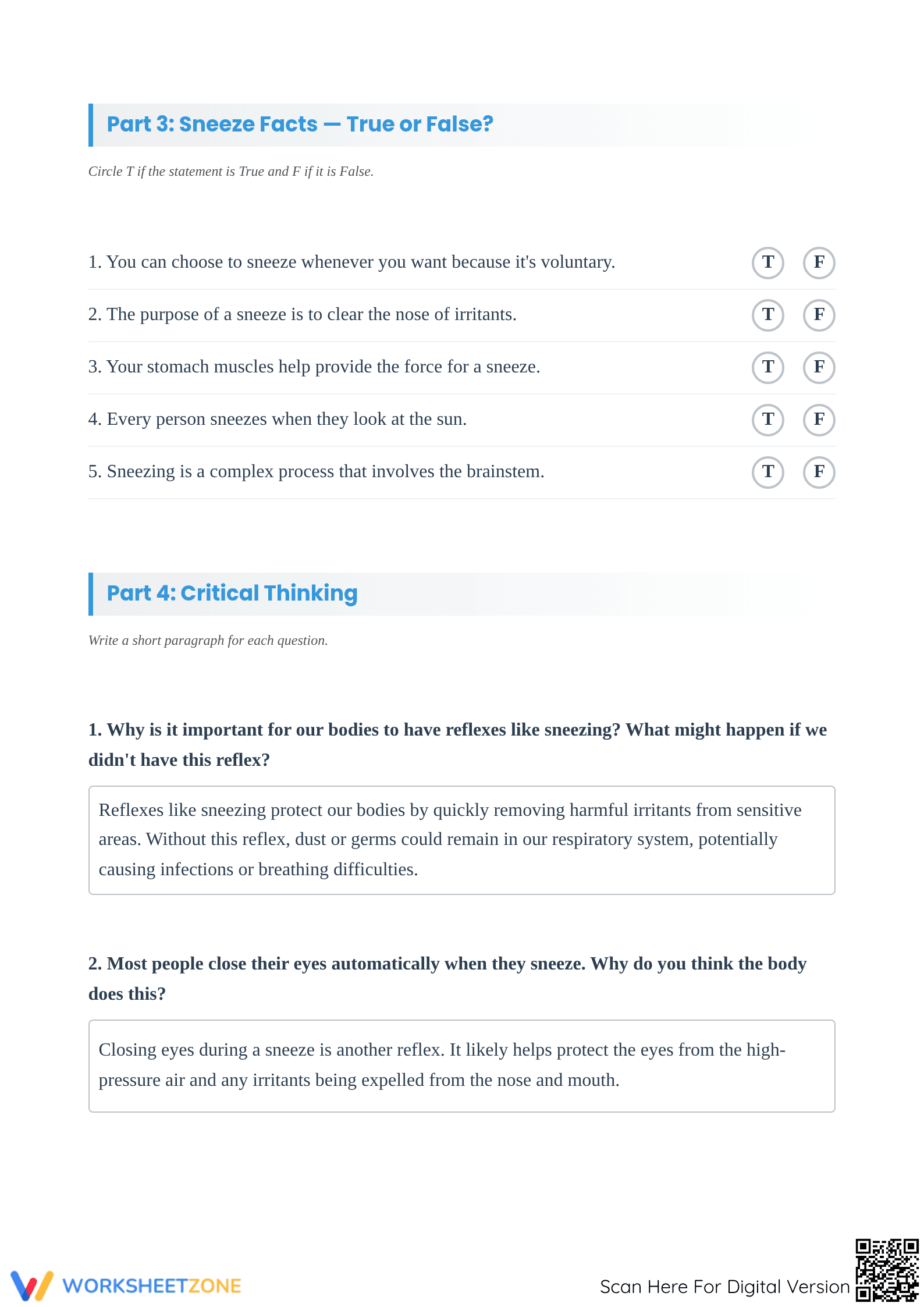
The 4-page PDF includes a detailed reading passage followed by four distinct assessment sections. Students encounter 6 direct comprehension questions, a 5-word vocabulary matching grid, 5 true/false statements for quick fact-checking, and 2 critical thinking prompts requiring paragraph-length responses. A full answer key is provided for immediate feedback and grading efficiency.
The workflow for this resource is designed for maximum efficiency. First, print the 4-page set (30 seconds). Next, distribute to students for independent or paired reading (1 minute). Finally, review the answers using the included key or collect for formative assessment (5 minutes). Total teacher preparation time is under 2 minutes, making it an ideal emergency sub plan or Friday filler.
The primary focus is `CCSS.ELA-LITERACY.RI.6.1`, which requires students to cite textual evidence to support analysis of what the text says explicitly. It also supports RI.6.4 by challenging students to determine the meaning of domain-specific words like "brainstem" and "membrane." Both standard codes can be copied directly into lesson plans, IEP goals, or district curriculum mapping tools.
Use this worksheet during a unit on informational text structures or as a cross-curricular ELA/Science activity. It works best after direct instruction on identifying main ideas. Teachers should observe students during the "Critical Thinking" section to assess their ability to synthesize information. Completion typically takes 30 to 45 minutes depending on reading speed and depth of response.
This resource is designed for middle and early high school students (Grades 6-10) who need practice with non-fiction text. It is particularly effective for students who benefit from structured, multi-part assessments. Pair this with a short video on the human nervous system or an anchor chart about citing evidence for a complete lesson that meets diverse learning needs.
According to the RAND AIRS 2024 report, high-quality informational text practice is vital for developing secondary literacy. This worksheet aligns with CCSS.ELA-LITERACY.RI.6.1 by requiring students to extract specific facts about the sneezing reflex and apply them to complex questions. By engaging with technical vocabulary and critical thinking prompts, students move beyond surface-level reading to achieve deeper comprehension. Research from Fisher & Frey (2014) emphasizes that gradual release of responsibility, supported by clear task structures like those found in this 18-problem set, significantly improves student retention of scientific concepts within ELA frameworks. The inclusion of a dedicated answer key ensures that the resource remains a reliable tool for both classroom teachers and substitutes seeking to maintain instructional rigor without extensive preparation. This worksheet provides the necessary scaffolding to bridge the gap between basic literacy and academic mastery.


