




























0
Views
0
Downloads

0.0
0
Save
0 Likes
Share
Abiotic Factors Practice Worksheet
0 Views
0 Downloads

Paste this activity's link or code into your existing LMS (Google Classroom, Canvas, Teams, Schoology, Moodle, etc.).
Students can open and work on the activity right away, with no student login required.
You'll still be able to track student progress and results from your teacher account.
Information
Description
What It Is:
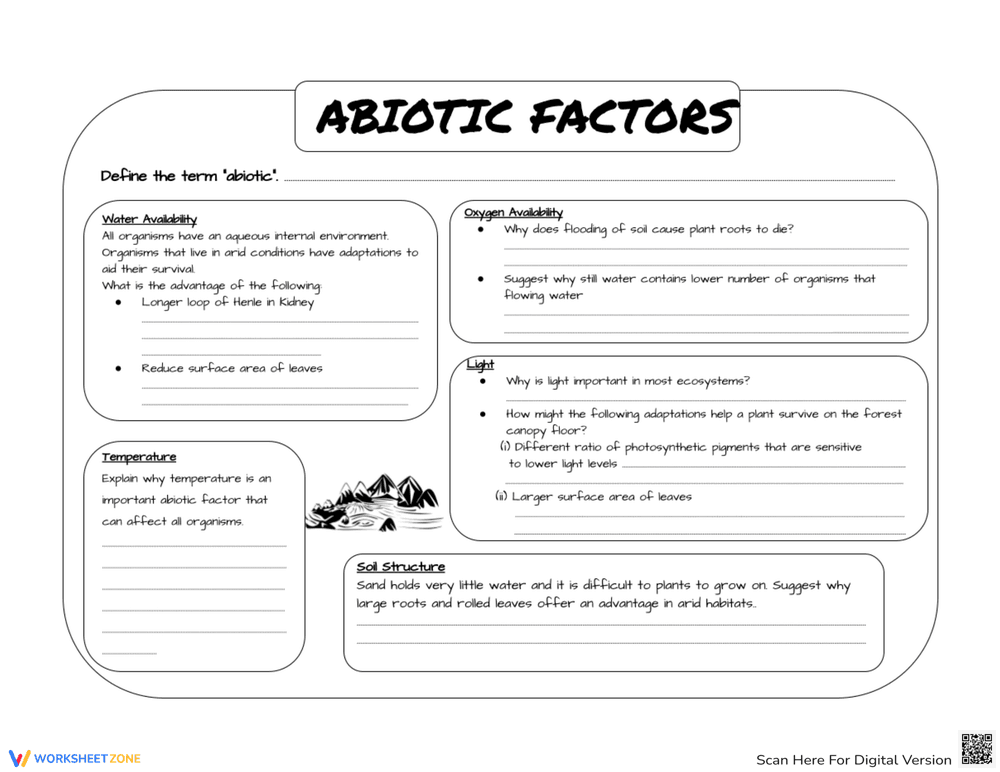
This is an educational worksheet focused on Abiotic Factors. It includes definition prompts, and questions related to water availability, oxygen availability, light, temperature, and soil structure. Students are prompted to define 'abiotic,' explain the importance of temperature, and answer questions related to plant and organism survival based on the abiotic factors listed.
Grade Level Suitability:
This worksheet is suitable for grades 6-9, particularly middle school life science or introductory biology. The concepts are foundational and the questions require some critical thinking but are not overly complex.
Why Use It:
This worksheet helps students understand the concept of abiotic factors and their impact on living organisms. It promotes critical thinking skills by asking students to analyze how different abiotic factors affect survival and adaptation in various environments. It encourages students to define key terms and apply their knowledge to specific examples.
How to Use It:
Students can complete the worksheet individually or in small groups. They should first define 'abiotic' and then read the prompts related to each abiotic factor. They should use their understanding of science concepts to answer the questions, providing explanations and examples where necessary. The worksheet can be used as a review activity, a formative assessment, or a homework assignment.
Target Users:
This worksheet is ideal for middle school students learning about ecosystems and environmental science. It can also be used by high school students as a review of basic ecological concepts. It is beneficial for students who need practice with defining terms and applying their knowledge to real-world scenarios.
This is an educational worksheet focused on Abiotic Factors. It includes definition prompts, and questions related to water availability, oxygen availability, light, temperature, and soil structure. Students are prompted to define 'abiotic,' explain the importance of temperature, and answer questions related to plant and organism survival based on the abiotic factors listed.
Grade Level Suitability:
This worksheet is suitable for grades 6-9, particularly middle school life science or introductory biology. The concepts are foundational and the questions require some critical thinking but are not overly complex.
Why Use It:
This worksheet helps students understand the concept of abiotic factors and their impact on living organisms. It promotes critical thinking skills by asking students to analyze how different abiotic factors affect survival and adaptation in various environments. It encourages students to define key terms and apply their knowledge to specific examples.
How to Use It:
Students can complete the worksheet individually or in small groups. They should first define 'abiotic' and then read the prompts related to each abiotic factor. They should use their understanding of science concepts to answer the questions, providing explanations and examples where necessary. The worksheet can be used as a review activity, a formative assessment, or a homework assignment.
Target Users:
This worksheet is ideal for middle school students learning about ecosystems and environmental science. It can also be used by high school students as a review of basic ecological concepts. It is beneficial for students who need practice with defining terms and applying their knowledge to real-world scenarios.


