


























Views
Downloads
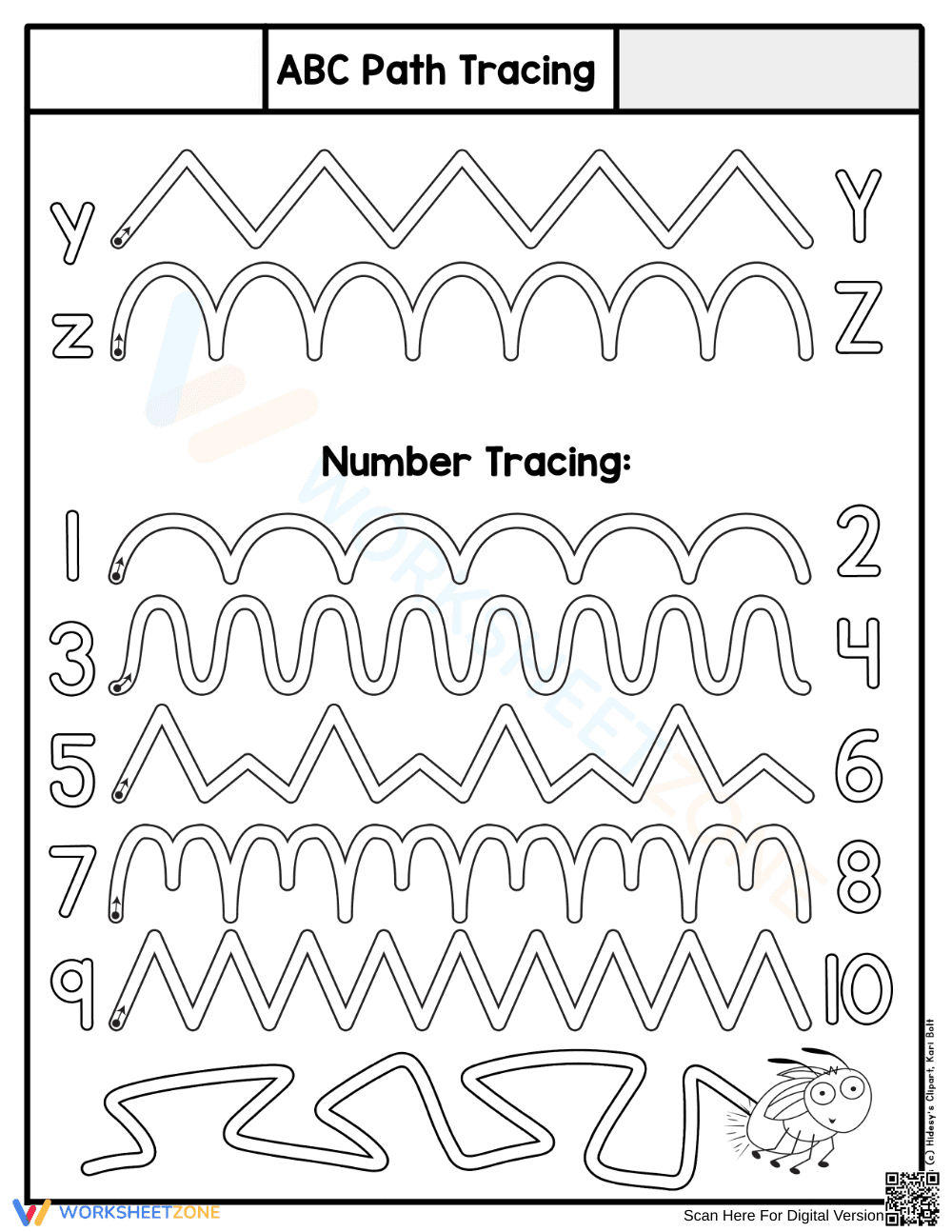

Printable ABC Path Tracing Worksheet for Kindergarten
Paste this activity's link or code into your existing LMS (Google Classroom, Canvas, Teams, Schoology, Moodle, etc.).
Students can open and work on the activity right away, with no student login required.
You'll still be able to track student progress and results from your teacher account.
This printable fine motor worksheet helps early learners build essential pencil control and coordination through path tracing. Students trace eight distinct patterns connecting letters y to Y, z to Z, and numbers 1 through 10. This activity strengthens the hand muscles required for writing while reinforcing letter and number recognition.
At a Glance
- Grade: Kindergarten · Subject: English Language Arts
- Standard:
CCSS.ELA-LITERACY.L.K.1.A— Print uppercase and lowercase letters.- Skill Focus: Fine motor pencil control and path tracing
- Format: 1 page · 8 problems · Answer key not applicable · PDF
- Best For: Morning work and fine motor practice
- Time: 10–15 minutes
The worksheet features a clean, engaging layout designed specifically for young learners. It contains eight horizontal tracing tracks with varying line styles, including sharp zigzags, smooth loops, and complex waves. The top section focuses on lowercase to uppercase letter connections for Y and Z, while the middle section provides five tracks for number pairs from 1 to 10. A final playful track at the bottom guides a bug through a winding path, offering a fun concluding challenge.
This resource is designed for immediate classroom deployment with a three-step workflow. First, print the single-page PDF in under 1 minute. Second, distribute the sheets to students, which takes less than 30 seconds. Third, review student progress during or after the activity, requiring zero grading time. The entire setup takes under 2 minutes, making this an ideal option for emergency sub plans, morning warm-ups, or independent station work.
This activity aligns directly with the Common Core State Standard CCSS.ELA-LITERACY.L.K.1.A, which requires students to print many uppercase and lowercase letters. By tracing paths that connect lowercase letters to their uppercase counterparts, students build the muscle memory and spatial awareness necessary for letter formation. Both standard codes can be copied directly into lesson plans, IEP goals, or district curriculum mapping tools.
Use this worksheet during small-group intervention or as an independent center activity after direct instruction on pencil grip. Teachers can observe students during the activity to check for proper tripod grasp and left-to-right tracking directionality. The worksheet typically takes 10 to 15 minutes to complete, making it a flexible tool for transitions or early finishers.
This resource is ideal for preschool, kindergarten, and first-grade students who need targeted practice with fine motor control. It serves as an excellent intervention tool for students receiving occupational therapy support. Pair this worksheet with physical letter tiles or a sensory writing tray to create a comprehensive multi-sensory learning experience.
Early childhood writing development relies heavily on the integration of fine motor control and visual-spatial skills. According to research from Fisher & Frey (2014) on the gradual release of responsibility, scaffolded motor tasks like path tracing provide the necessary support for young learners before they transition to independent letter formation. This worksheet targets CCSS.ELA-LITERACY.L.K.1.A by bridging the gap between basic pencil grip and formal handwriting. By practicing controlled movements along structured paths, students develop the hand strength and coordination required for writing uppercase and lowercase letters. Incorporating these targeted tracing exercises into daily routines helps solidify the neural pathways associated with fine motor precision. Educators can confidently integrate this resource into early literacy curricula to support foundational writing readiness and ensure students meet key developmental milestones in early childhood education.


