




























Views
Downloads
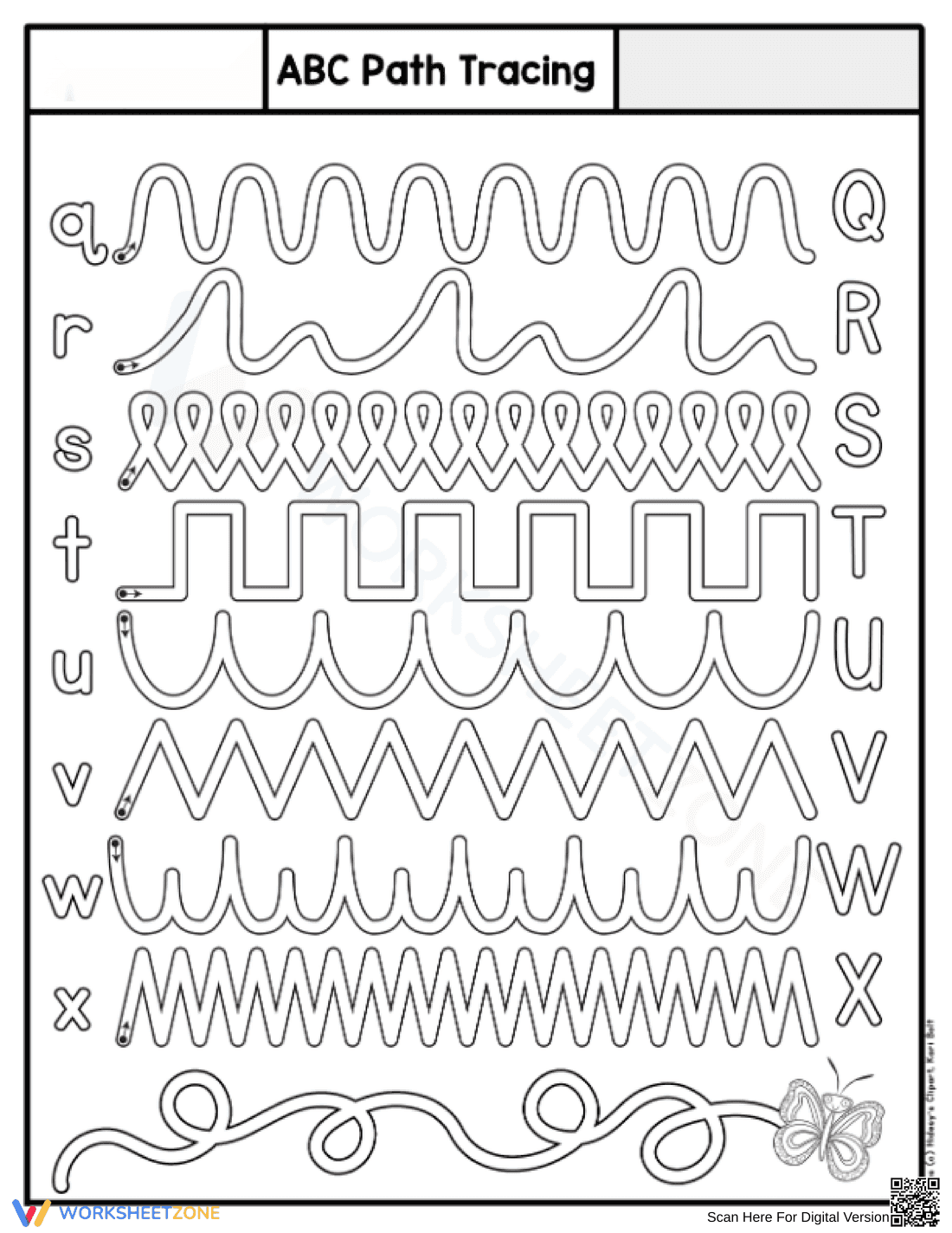

Printable ABC Path Tracing Worksheet for Kindergarten

Paste this activity's link or code into your existing LMS (Google Classroom, Canvas, Teams, Schoology, Moodle, etc.).
Students can open and work on the activity right away, with no student login required.
You'll still be able to track student progress and results from your teacher account.
This kindergarten alphabet tracing worksheet builds fine motor control and letter recognition. Students trace complex lines to connect lowercase letters to uppercase counterparts, reinforcing print awareness and hand-eye coordination for writing success.
At a Glance
- Grade: Kindergarten · Subject: ELA & Writing
- Standard:
CCSS.ELA-LITERACY.L.K.1.A— Print lowercase and uppercase letters- Skill Focus: Fine motor pencil control
- Format: 1 page · 9 paths · No key · PDF
- Best For: Morning work
- Time: 10–15 minutes
This single-page PDF features nine tracing tracks to develop writing muscles. Each line presents a unique pattern, including waves, loops, zig-zags, and square steps. Lowercase letters (q to x) connect to uppercase letters, ending with a decorative butterfly path.
Zero-Prep Classroom Workflow
Integrate this resource into your routine with under two minutes of prep. First, print the single-page PDF (one minute). Second, distribute sheets with pencils or crayons (thirty seconds). Third, review student progress by checking line accuracy (one minute). This layout is ideal for emergency sub plans or independent centers.
Standards Alignment
This activity aligns with `CCSS.ELA-LITERACY.L.K.1.A` for printing upper- and lowercase letters. Tracing paths builds muscle memory for character formation. It also supports `CCSS.ELA-LITERACY.RF.K.1.A` by reinforcing left-to-right tracking. Both codes copy directly into lesson plans, IEP goals, or curriculum tools.
How to Use It
Use this worksheet as a warm-up before handwriting instruction to prepare students' hands. Alternatively, assign it as an independent center after teaching letters Q through X. Observe pencil grip and tracing directionality to identify students needing fine motor support. Completion takes ten to fifteen minutes.
Who It's For
This worksheet is designed for preschool, kindergarten, and first-grade students developing fine motor control. It serves as an intervention tool for students receiving occupational therapy. Pair this sheet with an alphabet anchor chart for a multi-sensory learning experience.
This early childhood writing resource targets `CCSS.ELA-LITERACY.L.K.1.A` by helping students develop the fine motor control and letter recognition necessary to print uppercase and lowercase letters. By tracing diverse line paths from left to right, young learners build the hand strength and coordination required for formal handwriting. According to research by Fisher & Frey (2014) on the gradual release of responsibility, structured visual scaffolds like tracing paths allow students to practice motor skills independently before transitioning to freehand letter formation. This worksheet provides nine distinct tracing paths that bridge the gap between simple scribbling and controlled writing. Educators can utilize this tool to assess grip, tracking, and letter association in early childhood classrooms, ensuring students meet foundational literacy milestones. The clear layout makes it a reliable resource for daily handwriting practice, morning work, or targeted occupational therapy interventions.


