


























Views
Downloads
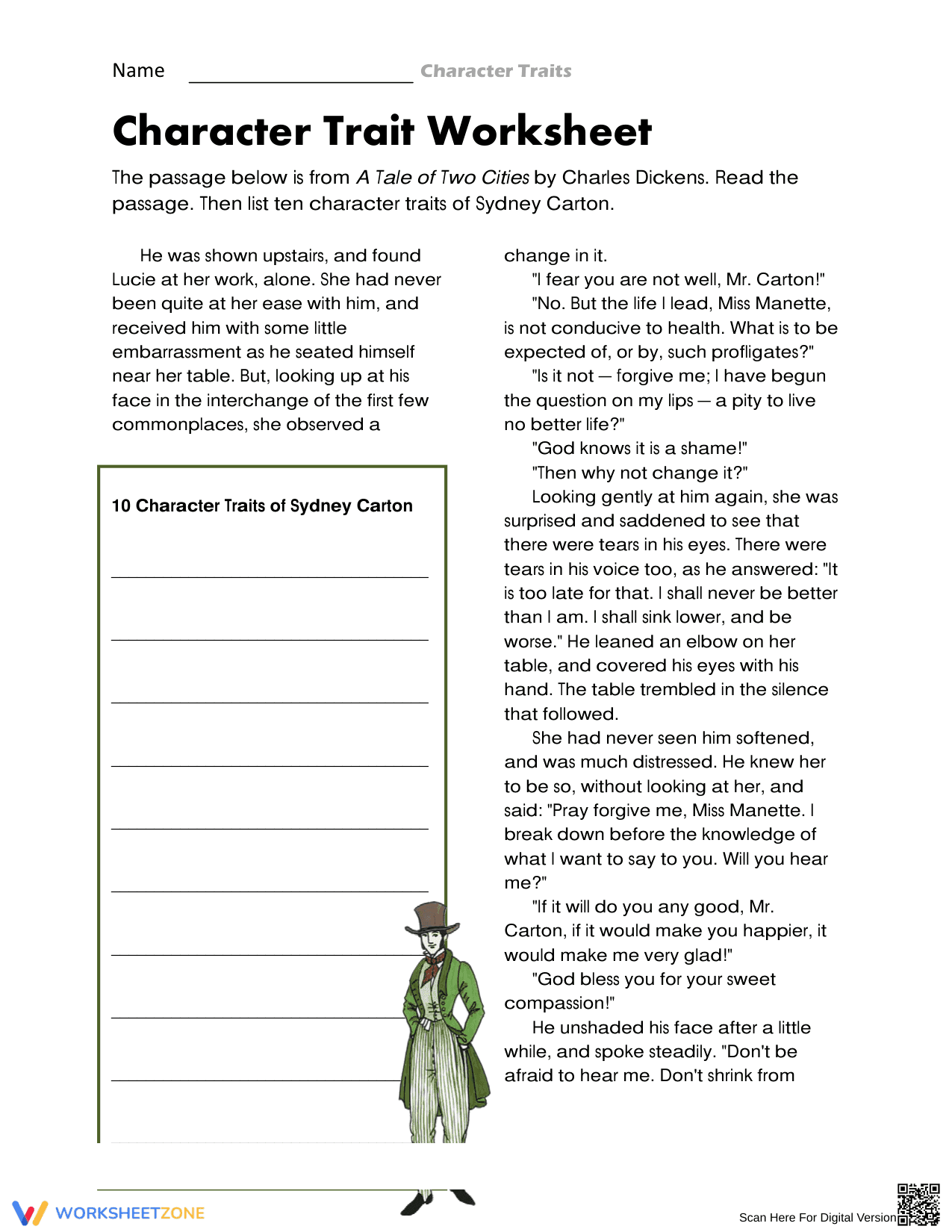

A Tale of Two Cities: Essential Grade 4 ELA Character Traits
Paste this activity's link or code into your existing LMS (Google Classroom, Canvas, Teams, Schoology, Moodle, etc.).
Students can open and work on the activity right away, with no student login required.
You'll still be able to track student progress and results from your teacher account.
This character analysis worksheet uses a rich passage from Charles Dickens’ A Tale of Two Cities to help Grade 4 students identify complex character traits. By examining the dialogue and interactions between Sydney Carton and Lucie Manette, learners extract ten specific descriptors to deepen their comprehension of literary characters and narrative evidence.
At a Glance
- Grade: 4 · Subject: English Language Arts
- Standard:
CCSS.ELA-LITERACY.RL.4.3— Describe in depth a character in a story drawing on specific text details- Skill Focus: Character Trait Identification
- Format: 1 page · 10 tasks · Answer key included · PDF
- Best For: Literary analysis and reading comprehension practice
- Time: 15–20 minutes
What's Inside
This single-page PDF includes a carefully excerpted passage from a classic literary text, focusing on the emotional exchange between Sydney Carton and Lucie Manette. Below the text, a structured graphic organizer provides ten numbered lines for students to record their observations. The layout includes an illustrative character sketch and a clear workspace, ensuring that the visual focus remains on the textual analysis rather than complex formatting.
Zero-Prep Workflow
The zero-prep design makes this worksheet ideal for busy educators or sudden sub plans. Step 1: Print the single-sided PDF (30 seconds). Step 2: Distribute to students for individual or partner reading (1 minute). Step 3: Review student responses during a whole-class discussion to confirm text-based evidence (5 minutes). Total teacher preparation time is under two minutes, allowing for immediate instructional impact without the need for additional materials.
Standards Alignment
The primary focus is CCSS.ELA-LITERACY.RL.4.3, which requires students to describe a character in depth, drawing on specific details in the text such as thoughts, words, or actions. By listing ten distinct traits, students are forced to look past surface-level adjectives and find nuanced evidence within Dickens’ prose. This standard code can be copied directly into lesson plans, IEP goals, or district curriculum mapping tools.
How to Use It
Use this worksheet during the "independent practice" phase of a lesson on characterization or as a formative assessment after a direct instruction session on inferring traits. For a deeper look, observe how students handle Carton’s self-deprecating dialogue; this provides a perfect observation tip for identifying those who can infer internal conflict versus those who only see external actions. Completion typically takes 20 minutes.
Who It's For
This resource is designed for upper elementary students (Grades 3-4) who are moving from basic plot recall to complex literary analysis. It works exceptionally well for gifted and talented learners in lower grades or as a scaffolding tool for middle schoolers. Pair this naturally with an anchor chart on character adjectives or a short biography of Charles Dickens to provide historical context for the narrative setting.
Character analysis is a foundational pillar of literacy that bridges the gap between basic decoding and high-level critical thinking. Identifying specific traits within a classic text like A Tale of Two Cities aligns with the CCSS.ELA-LITERACY.RL.4.3 mandate for students to cite evidence when describing character depth. Research from Fisher & Frey (2014) emphasizes that close reading of complex texts requires students to interact with the author's words to build a mental model of character motivation. This worksheet facilitates that interaction by providing a focused space for trait extraction. By grounding the activity in Dickens' prose, educators ensure students are exposed to high-quality vocabulary and sophisticated emotional arcs. This extractable summary confirms that the resource meets standard rigor while remaining accessible for classroom use, making it an essential tool for ELA curriculum alignment and measurable student progress in literary analysis.


