


























Views
Downloads
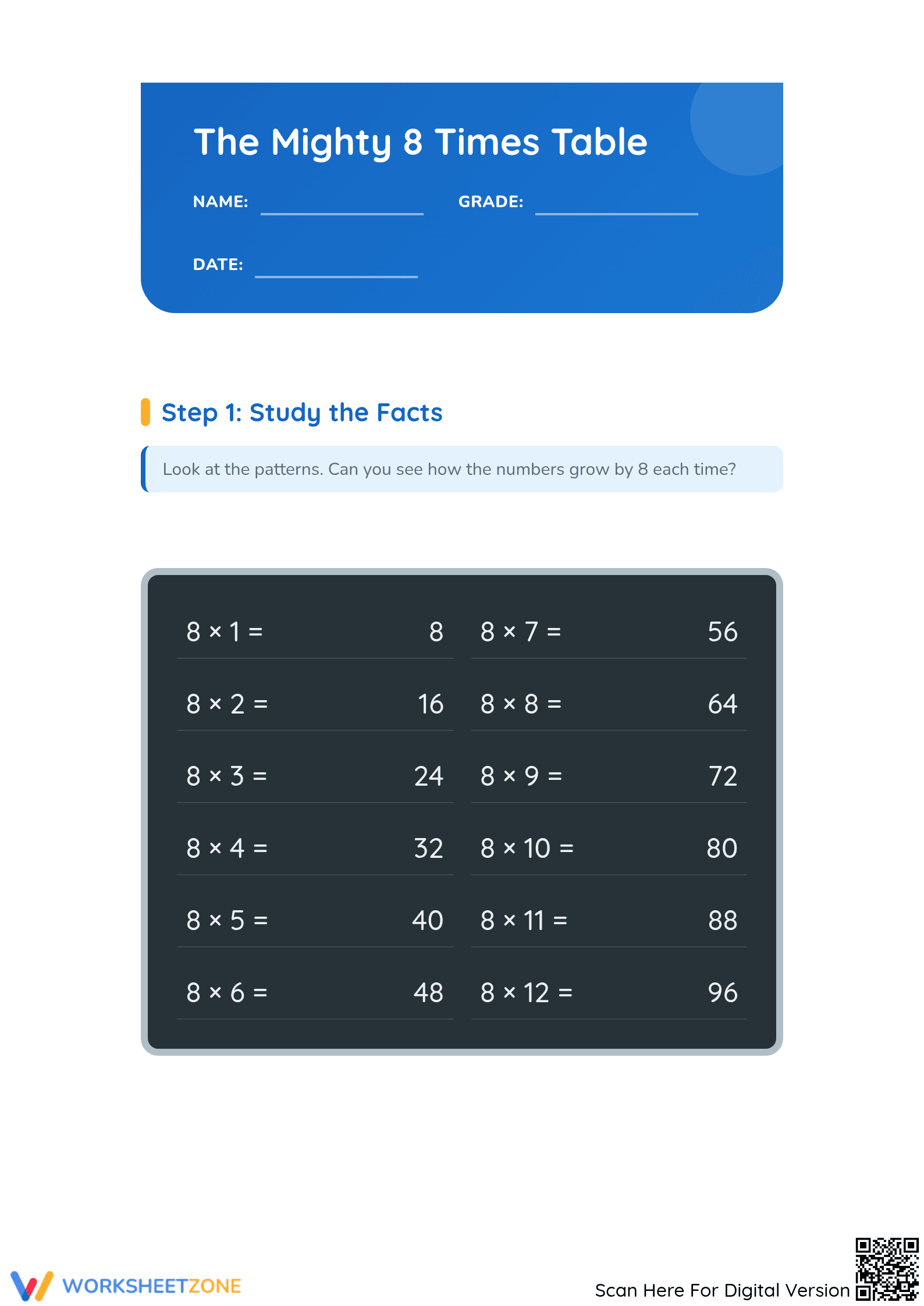


Printable 8 Times Table Worksheet | Grade 2-3 Math
Paste this activity's link or code into your existing LMS (Google Classroom, Canvas, Teams, Schoology, Moodle, etc.).
Students can open and work on the activity right away, with no student login required.
You'll still be able to track student progress and results from your teacher account.
The Mighty 8 Times Table worksheet provides a comprehensive, multi-step approach to mastering multiplication facts. Students transition from conceptual understanding through repeated addition to automaticity with fast facts and real-world application. This 5-page packet ensures deep retention of the 8s through structured practice and pattern recognition, helping learners build math confidence and fluency.
At a Glance
- Grade: 3 · Subject: Math
- Standard:
3.OA.C.7— Fluently multiply and divide within 100 using strategies such as the relationship between multiplication and division.- Skill Focus: 8 Times Table Mastery
- Format: 5 pages · 34 problems · Answer key included · PDF
- Best For: Small group instruction and independent practice
- Time: 25–35 minutes
What's Inside
This extensive 5-page practice packet is organized into six logical steps. It includes a facts study guide, repeated addition exercises, fast-fact drills, missing factor boxes, and four contextual story problems. The clean layout features large text and clear section headers, supplemented by a final mastery check and a skip-counting number pattern sequence. A full 5-page answer key is provided for immediate grading.
Skill Progression
- Guided Practice: Steps 1 and 2 focus on building the conceptual bridge between addition and multiplication, using visual patterns to show how numbers grow by 8.
- Supported Practice: Steps 3 and 4 provide 18 mid-level problems where students fill in products and identify "secret factors" in a scaffolded environment.
- Independent Practice: Step 5 requires students to solve 4 multi-sentence word problems, translating real-world scenarios into multiplication equations independently.
This structure follows the gradual-release model, moving from observation to conceptualization and finally to abstract application.
Standards Alignment
This resource is primarily aligned with 3.OA.C.7, focusing on fluency for the 8 times table. It also supports 2.OA.C.4 by emphasizing multiplication as repeated addition. Both standard codes can be copied directly into lesson plans, IEP goals, or district curriculum mapping tools.
How to Use It
Introduce this packet during the "We Do" phase of a multiplication unit. Use the story problems in Step 5 as a formative assessment to observe if students can translate language into math operations. Expect a completion time of roughly 30 minutes. It works exceptionally well as a focused homework assignment or a ready-to-use substitute teacher plan.
Who It's For
This worksheet is designed for third-grade students working toward fluency, or second-grade learners ready for extension. It provides necessary scaffolding for students with IEPs through the repeated addition section. Pair this with a 8s skip-counting song or a multiplication anchor chart for maximum instructional impact.
Consistent with the instructional scaffolding theories discussed by Fisher & Frey (2014), this worksheet employs a purposeful shift from high-support study phases to independent word problem resolution. Research suggests that interleaving conceptual models, such as repeated addition, with traditional fact drills significantly improves long-term memory retrieval for multiplication facts. By requiring students to identify missing factors (Step 4) alongside standard products, the resource builds the algebraic thinking required for later division mastery. The inclusion of pattern-based number sequences further reinforces the rhythmic nature of the 8 times table, which is statistically one of the more difficult sets for elementary learners to memorize. This multi-modal approach ensures that students do not just memorize digits but understand the underlying numerical relationships, fulfilling the rigor demanded by 3.OA.C.7 standards while providing a classroom-ready tool for daily mathematics instruction.


