


























Views
Plays
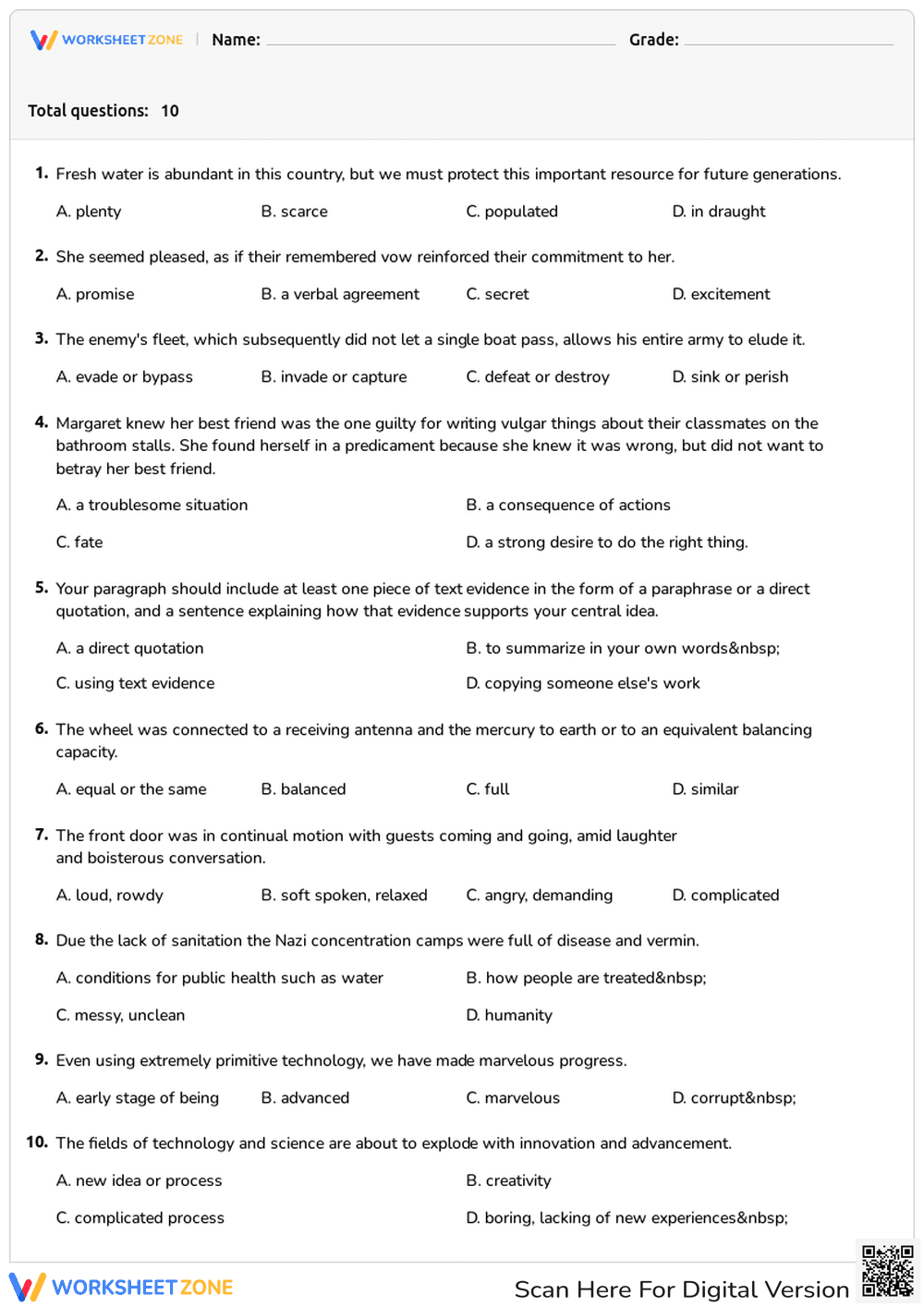

Essential 6th Grade Vocabulary Practice Worksheet
Paste this activity's link or code into your existing LMS (Google Classroom, Canvas, Teams, Schoology, Moodle, etc.).
Students can open and work on the activity right away, with no student login required.
You'll still be able to track student progress and results from your teacher account.
This Grade 6 vocabulary practice worksheet provides students with 10 targeted multiple-choice questions designed to strengthen context clue application. By analyzing complex sentences, learners identify the meaning of high-frequency academic words, ensuring they can interpret sophisticated texts independently. This resource bridges the gap between simple word recognition and deep reading comprehension.
At a Glance
- Grade: 6 · Subject: ELA
- Standard:
CCSS.ELA-LITERACY.L.6.4.A— Use context clues to determine the meaning of unknown words or phrases- Skill Focus: Context Clues & Academic Vocabulary
- Format: 1 page · 10 problems · Answer key included · PDF
- Best For: Bell ringers or formative assessment
- Time: 10–15 minutes
The worksheet features a single-page layout containing 10 rigorous multiple-choice items. Each question presents a complete sentence or short paragraph containing a bolded vocabulary word, such as abundant, innovation, or sanitation. Students must evaluate the surrounding text to select the most accurate definition from four options. The clear formatting and direct instructions minimize student confusion and maximize instructional time.
This resource is designed for a zero-prep workflow. Teachers can print the PDF in seconds. Distribution takes one minute, and students begin working immediately without modeling. Reviewing the 10 answers takes five minutes, making total teacher prep time under two minutes. This efficiency makes it an ideal choice for emergency sub plans or transition periods between core lessons.
The primary focus is CCSS.ELA-LITERACY.L.6.4.A, which requires students to use context as a clue to the meaning of a word or phrase. This worksheet also supports L.6.6 by building a portfolio of academic and domain-specific vocabulary. Both standard codes can be copied directly into lesson plans, IEP goals, or district curriculum mapping tools to ensure compliance with state frameworks.
Use this worksheet as a formative assessment after a lesson on context clue types like synonyms or examples. It serves as an excellent Do Now activity to settle the class at the start of a period. Teachers should observe which students struggle with words like equivalent or boisterous to identify who may need additional small-group support. Completion typically ranges from 10 to 15 minutes.
This practice is ideal for general education 6th-grade students, but it also provides excellent scaffolding for English Language Learners who need exposure to Tier 2 academic vocabulary. It pairs naturally with a direct instruction lesson on Greek and Latin roots or as a supplementary resource alongside a complex informational text passage in science or social studies.
Research by Fisher & Frey (2014) emphasizes that vocabulary acquisition is most effective when students encounter words within meaningful contexts. This worksheet applies this principle by requiring students to decode 10 academic terms using textual evidence. By engaging with CCSS.ELA-LITERACY.L.6.4.A, students develop the linguistic flexibility needed for middle school literacy. The structured format provides immediate feedback, a critical component of the gradual release model. According to the NAEP, students who demonstrate proficiency in using context clues score higher on overall reading comprehension. This resource provides the necessary repetition to move these skills toward automaticity, ensuring learners are prepared for the lexical demands of higher-grade levels and standardized testing. The inclusion of words like innovation and sanitation also supports cross-curricular literacy in science and health contexts.


