


























Views
Downloads

Printable 6th Grade Reading Comprehension Worksheet
Paste this activity's link or code into your existing LMS (Google Classroom, Canvas, Teams, Schoology, Moodle, etc.).
Students can open and work on the activity right away, with no student login required.
You'll still be able to track student progress and results from your teacher account.
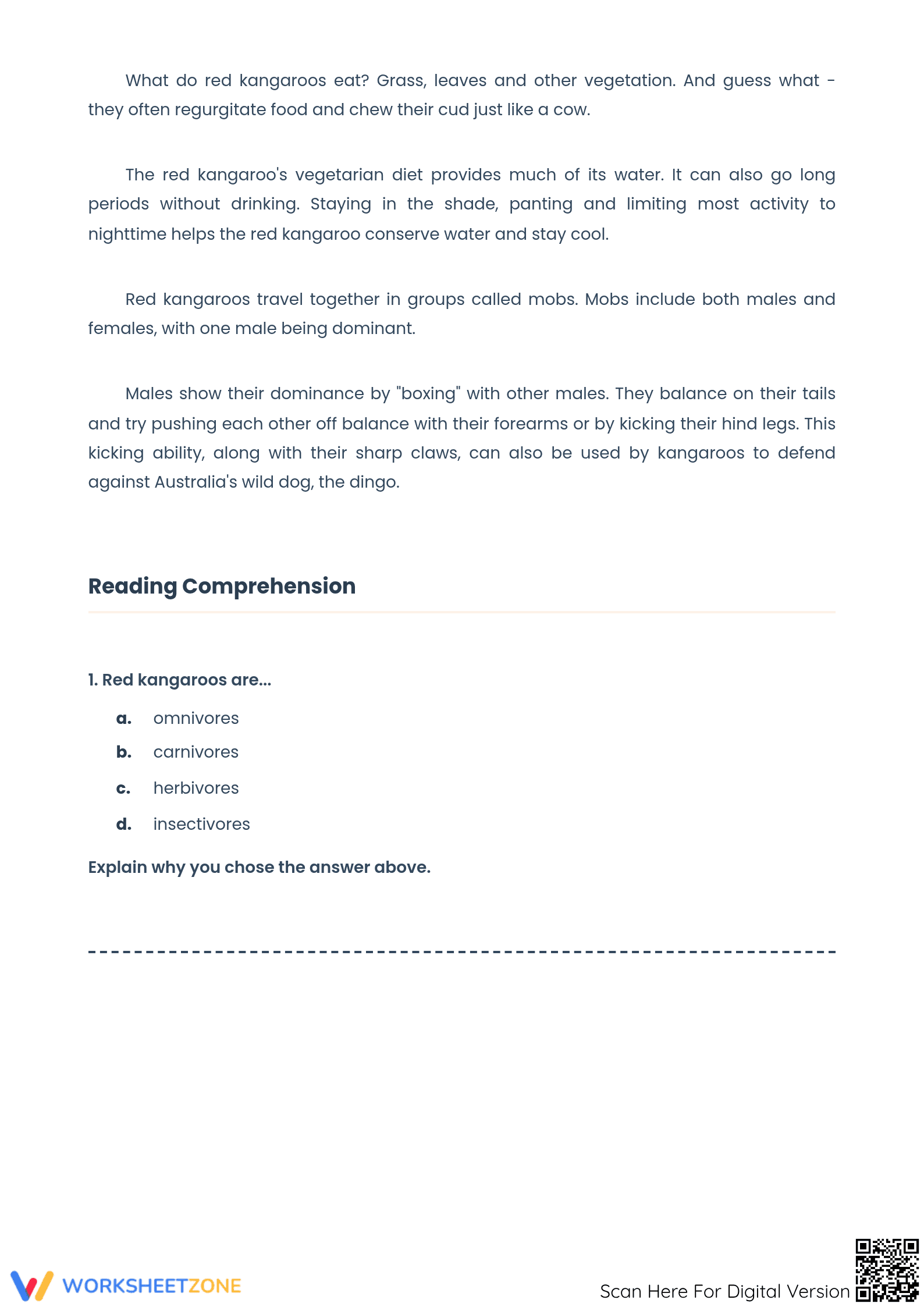
This Grade 6 reading comprehension worksheet gives students targeted practice with informational texts. By reading an engaging passage about the world's largest marsupial, students will extract key details, complete a graphic organizer, and cite textual evidence to support their answers.
At a Glance
- Grade: 6 · Subject: ELA
- Standard:
CCSS.ELA-LITERACY.RI.6.1— Cite textual evidence to support analysis of explicit text details- Skill Focus: Reading Comprehension
- Format: 3 pages · 5 problems · Answer key included · PDF
- Best For: Independent practice and sub plans
- Time: 20–30 minutes
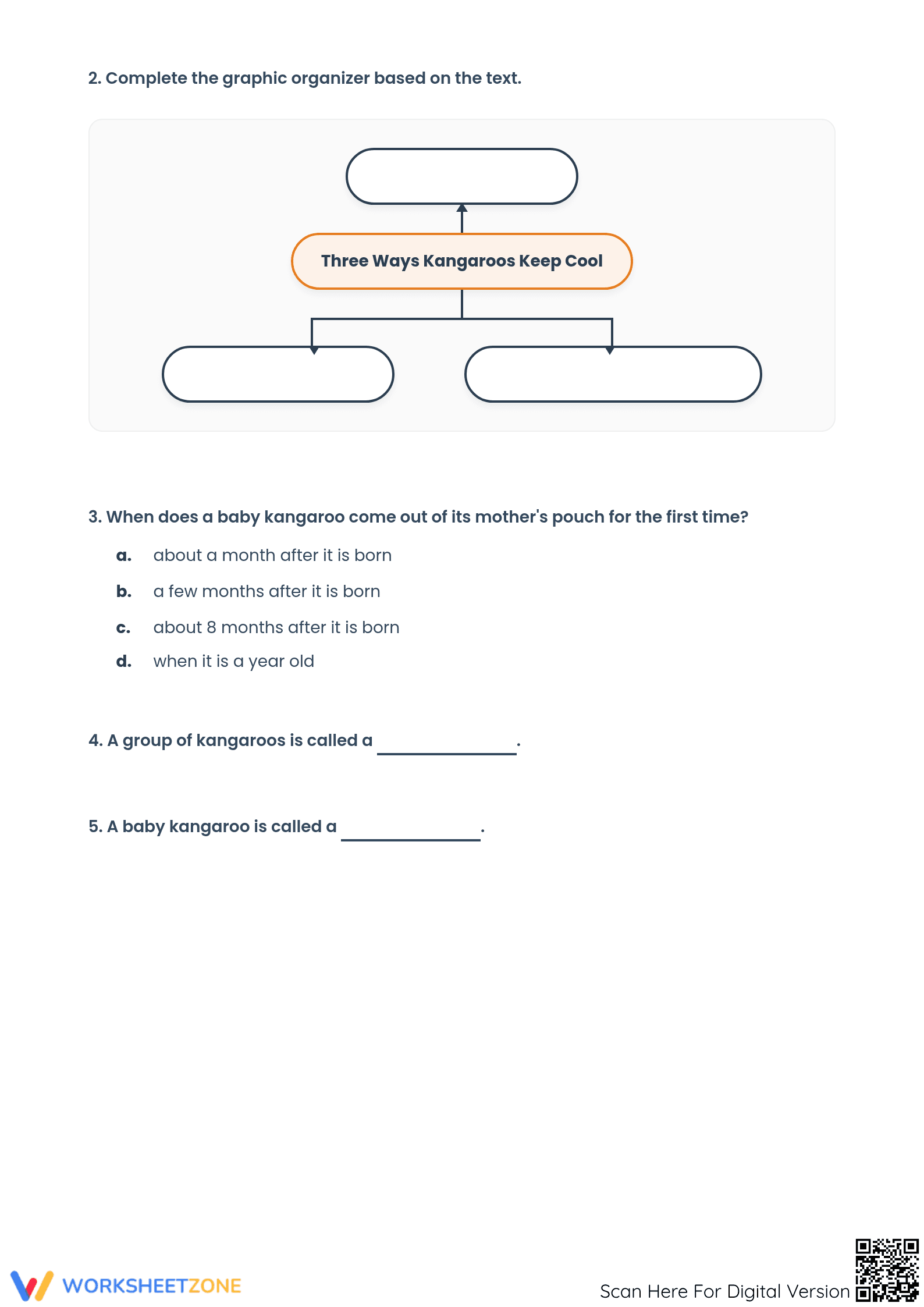
Inside this comprehensive resource, educators will find a high-interest informational passage about red kangaroos, followed by five distinct comprehension tasks. The question types include multiple-choice with written justification, a three-part graphic organizer to categorize details, and fill-in-the-blank vocabulary checks. A complete answer key is provided to ensure accurate and efficient grading.
This resource is designed for a zero-prep workflow, making it an ideal choice for busy educators:
- Print (1 minute): Simply download the PDF and print the three-page student packet. No special formatting or cutting is required.
- Distribute (1 minute): Hand out the worksheets at the start of your literacy block or leave them in a visible folder for a substitute teacher.
- Review (3 minutes): Use the included answer key to quickly check student responses or project it on the board for whole-class self-grading.
Total teacher prep time is under two minutes, providing a reliable, high-quality activity for any day of the week.
This worksheet is strictly aligned to CCSS.ELA-LITERACY.RI.6.1: Cite textual evidence to support analysis of what the text says explicitly as well as inferences drawn from the text. Students must return to the passage to justify their multiple-choice selections and accurately fill out the graphic organizer. Both standard codes can be copied directly into lesson plans, IEP goals, or district curriculum mapping tools.
Teachers can deploy this worksheet during independent reading stations to reinforce informational text strategies. It serves as an excellent follow-up activity after direct instruction on finding the main idea and supporting details. Alternatively, use it as a formative assessment tool; observe how students locate specific facts in the text to complete the graphic organizer, which provides immediate insight into their reading comprehension levels. Expected completion time is 20 to 30 minutes.
This resource is primarily designed for sixth-grade general education students, though it is highly effective for fifth-grade enrichment or seventh-grade review. The structured graphic organizer provides built-in scaffolding for visual learners and students needing extra support with text structure. It pairs perfectly with a broader science unit on animal adaptations or a direct instruction lesson on citing text evidence.
Developing strong reading comprehension skills requires consistent practice with complex, informational texts across various subjects. According to a recent RAND AIRS 2024 report, students who regularly engage with structured reading tasks that demand explicit evidence retrieval show significant improvements in overall literacy proficiency and cross-curricular academic performance. This worksheet directly supports that research by requiring students to master CCSS.ELA-LITERACY.RI.6.1, asking them to cite textual evidence to support analysis of explicit text details. By combining a high-interest passage about marsupials with targeted questions and a graphic organizer, educators can effectively measure student understanding and retention. Providing opportunities for students to justify their answers and visually map out concepts ensures deeper cognitive processing, aligning with best practices for middle school literacy instruction. Regular exposure to these formats builds the stamina needed for standardized testing.


