




























Views
Downloads
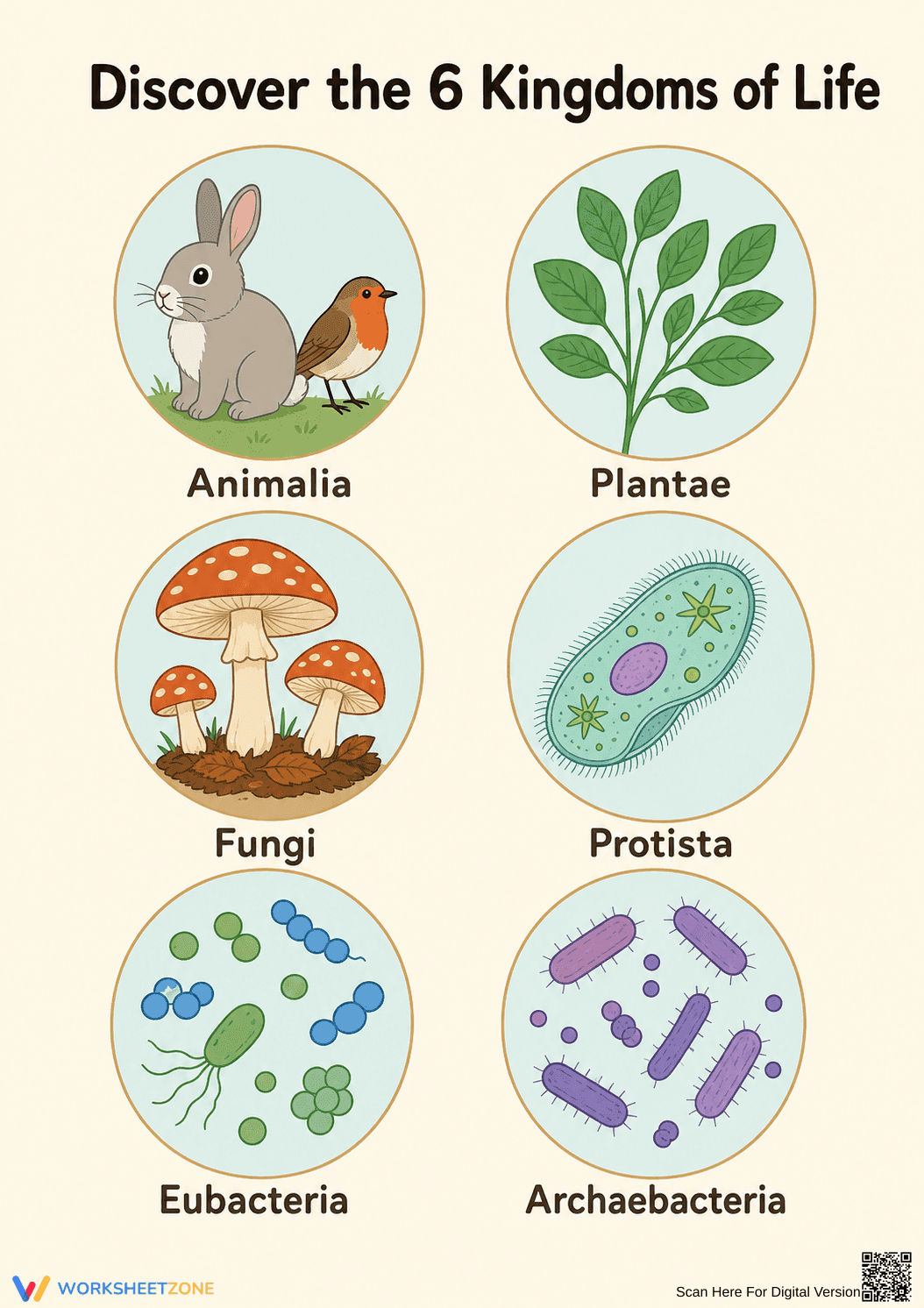

Printable 6 Kingdoms of Life Poster | Grade 10-12 Science

Paste this activity's link or code into your existing LMS (Google Classroom, Canvas, Teams, Schoology, Moodle, etc.).
Students can open and work on the activity right away, with no student login required.
You'll still be able to track student progress and results from your teacher account.
This high school biology visual aid provides a clear, engaging overview of the six kingdoms of life. Designed to help students quickly identify and differentiate between Animalia, Plantae, Fungi, Protista, Eubacteria, and Archaebacteria, this reference poster supports foundational understanding of biological classification and taxonomy.
At a Glance
- Grade: 10-12 · Subject: Biology
- Standard:
HS-LS4-1— Communicate scientific information about biological evolution and common ancestry.- Skill Focus: Identifying the 6 Kingdoms of Life
- Format: 1 page · 0 problems · No answer key · PDF
- Best For: Classroom reference poster
- Time: 5–10 minutes
This single-page resource features a beautifully illustrated, full-color chart detailing the six primary kingdoms of biological classification. Each section includes the formal scientific name of the kingdom paired with a high-quality, stylized illustration of a representative organism. The clean layout removes unnecessary clutter, allowing students to focus entirely on the core categories of life without being overwhelmed by dense text.
Integrating this visual aid into your biology curriculum requires zero teacher setup.
- Print (1 minute): Download the PDF and print in color for the best visual impact.
- Distribute (1 minute): Hand out individual copies for science binders, or project it directly onto your smartboard.
- Review (3 minutes): Walk through each kingdom, pointing out the representative organisms to anchor student understanding.
With a total prep time of under two minutes, this resource is an ideal addition to any lesson plan or emergency sub plan.
This resource aligns with HS-LS4-1, supporting students as they communicate scientific information that common ancestry and biological evolution are supported by multiple lines of empirical evidence. Understanding the broad classification of life into six distinct kingdoms is a crucial stepping stone for analyzing evolutionary relationships and phylogenetic trees. Both standard codes can be copied directly into lesson plans, IEP goals, or district curriculum mapping tools.
Use this poster as an introductory anchor chart before beginning direct instruction on taxonomy and dichotomous keys. By displaying it prominently, students have a constant visual reference to ground their learning. Alternatively, provide it as a supplemental study guide during a unit review. As a formative assessment observation tip, ask students to verbally justify why a newly introduced organism belongs to a specific kingdom based on the visual cues provided in the chart. Expected review time is 5 to 10 minutes.
This visual aid is primarily designed for high school biology students in grades 10 through 12 who are mastering taxonomy and classification. The clear, image-heavy design naturally differentiates the content for English Language Learners (ELLs) and visual learners who benefit from seeing representative examples rather than just reading definitions. It pairs perfectly with a direct instruction lesson on cellular structures, as students can begin to connect the visual examples to prokaryotic and eukaryotic traits.
Mastering biological classification requires students to synthesize complex vocabulary with observable traits. Aligning with HS-LS4-1, this resource helps students communicate scientific information about biological evolution and common ancestry by establishing a foundational understanding of the six kingdoms. According to a recent ScienceDirect TpT Analysis, visual aids and anchor charts significantly reduce cognitive load, allowing students to process and retain complex scientific taxonomies more effectively than traditional text-heavy alternatives. By providing clear, representative illustrations for Animalia, Plantae, Fungi, Protista, Eubacteria, and Archaebacteria, this poster bridges the gap between abstract scientific nomenclature and concrete biological examples. This targeted visual approach not only supports immediate recall during introductory lessons but also builds the necessary conceptual framework for advanced studies in phylogeny and evolutionary biology, ensuring students are well-prepared for rigorous high school science assessments.


