


























Views
Downloads

Printable Synonym Crossword Worksheet | Grade 5 ELA
Paste this activity's link or code into your existing LMS (Google Classroom, Canvas, Teams, Schoology, Moodle, etc.).
Students can open and work on the activity right away, with no student login required.
You'll still be able to track student progress and results from your teacher account.
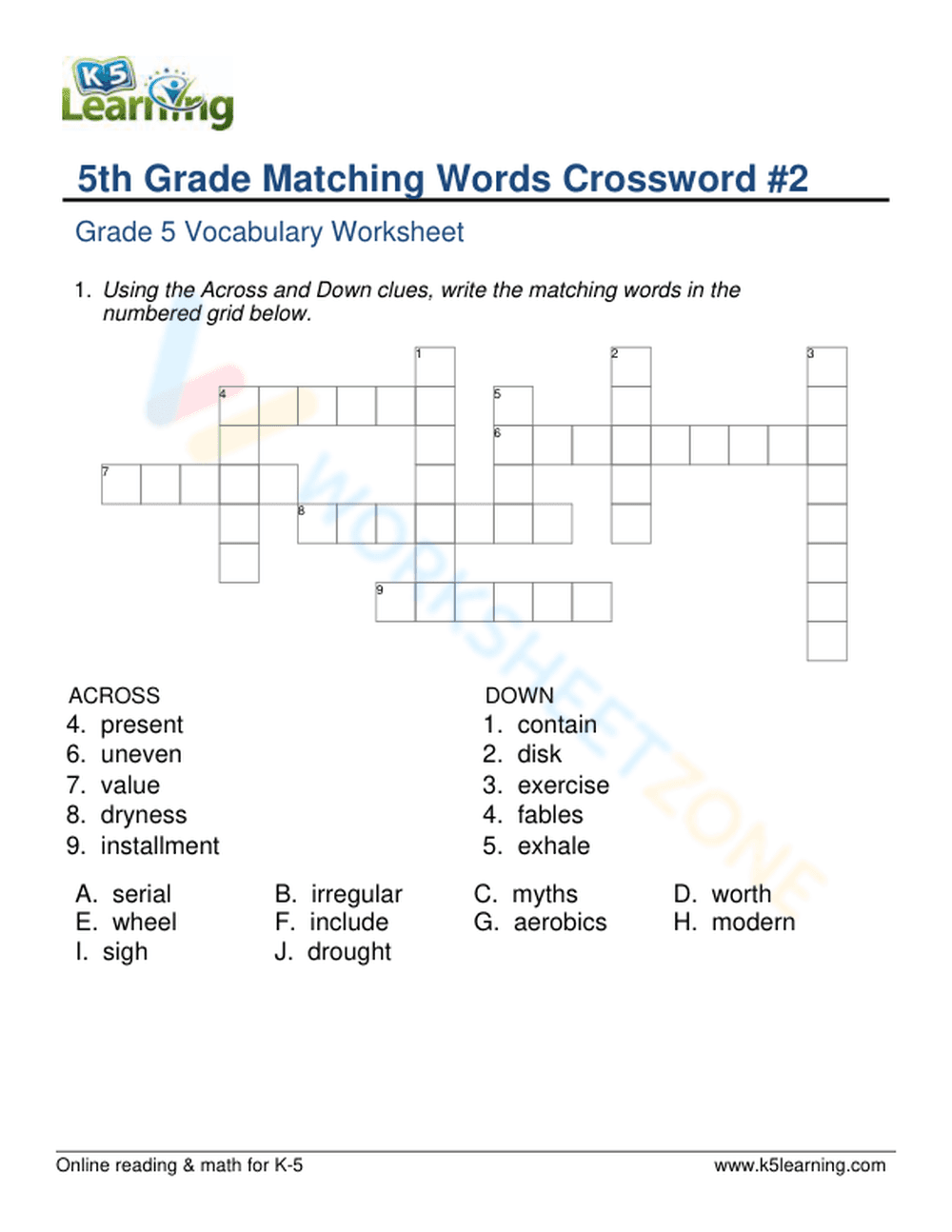
This Grade 5 vocabulary worksheet strengthens word relationships through a structured crossword format. Students identify synonyms for ten specific terms, reinforcing lexical precision and spelling accuracy. By connecting familiar words to their counterparts, learners expand their expressive language and improve reading comprehension. It provides a focused, engaging way to master fifth-grade vocabulary standards.
At a Glance
- Grade: 5 · Subject: ELA
- Standard:
CCSS.ELA-LITERACY.L.5.5.C— Use word relationships like synonyms to better understand word meanings- Skill Focus: Synonym identification and spelling
- Format: 1 page · 10 problems · Answer key included · PDF
- Best For: Independent vocabulary practice and morning work
- Time: 15–20 minutes
Inside this resource, you will find a single-page PDF featuring a 10-word crossword grid. The worksheet provides five "Across" clues and five "Down" clues, each paired with a word bank of ten potential synonyms. This layout ensures students have the necessary support to identify the correct match while still requiring them to apply critical thinking to fit the words into the grid.
Skill Progression
- Guided practice: The provided word bank offers immediate scaffolding, allowing students to recognize synonyms before attempting to recall them from memory.
- Supported practice: The crossword grid provides structural feedback; if a word does not fit the letter count or intersecting letters, students must re-evaluate their choice.
- Independent practice: Students complete the final clues without assistance, demonstrating mastery of the 10 target synonym pairs.
This gradual release model ensures students build confidence as they move from recognition to application.
Standards Alignment
This resource is specifically aligned with `CCSS.ELA-LITERACY.L.5.5.C`, which requires students to use the relationship between particular words to better understand each of the words. It also supports L.5.2.E by requiring correct spelling of grade-appropriate words. Both standard codes can be copied directly into lesson plans, IEP goals, or district curriculum mapping tools.
How to Use It
Use this worksheet as a formative assessment after a lesson on word relationships. It works exceptionally well as a "Do Now" activity or a quiet center rotation. Teachers should observe if students are using the word bank strategically or guessing based on length; this reveals their level of synonym mastery. Expect completion within 15 to 20 minutes.
Who It's For
This worksheet is designed for fifth-grade students but serves as an excellent review for sixth graders or a challenge for advanced fourth graders. It is ideal for English Language Learners (ELLs) who benefit from the visual support of a word bank. Pair this with a synonym anchor chart or a short reading passage to reinforce the vocabulary in context.
Vocabulary acquisition in the upper elementary grades relies heavily on understanding word nuances and relationships. According to Fisher & Frey (2014), intentional word play and structured practice with synonyms are vital for moving students from basic word recognition to deep lexical mastery. This worksheet addresses CCSS.ELA-LITERACY.L.5.5.C by requiring students to map ten distinct synonym pairs within a crossword puzzle, a task that demands both semantic knowledge and orthographic precision. Research from the RAND AIRS 2024 report emphasizes that high-quality, focused practice materials help bridge the gap between isolated vocabulary drills and functional literacy. By providing a word bank and a self-correcting grid, this resource supports the cognitive load required for Grade 5 learners to internalize complex word meanings. Educators can use this tool to provide evidence-based instruction that aligns with national standards for language development and reading proficiency.


