


























Views
Plays
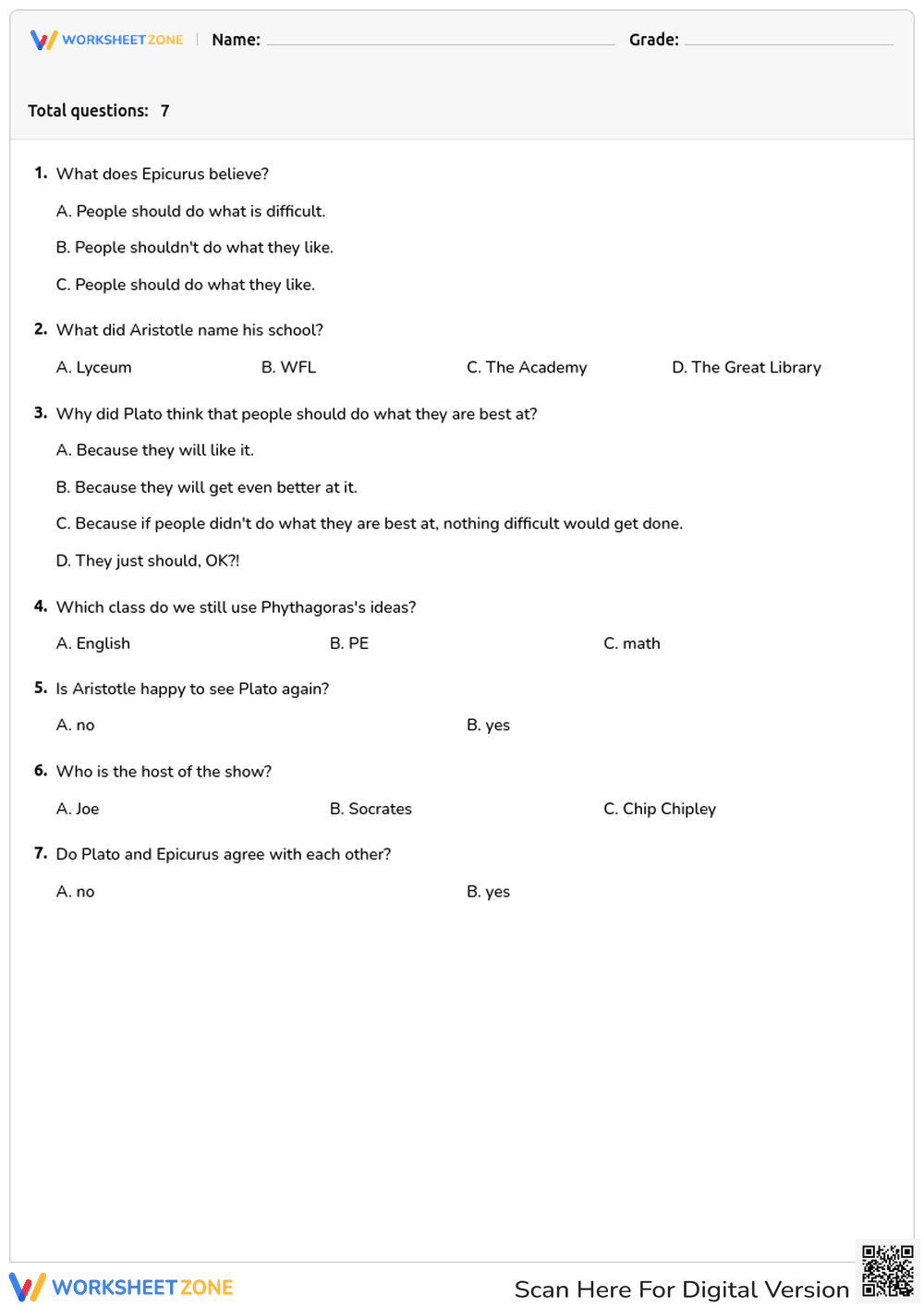

Printable Readers' Theater Quiz | Grade 4 ELA
Paste this activity's link or code into your existing LMS (Google Classroom, Canvas, Teams, Schoology, Moodle, etc.).
Students can open and work on the activity right away, with no student login required.
You'll still be able to track student progress and results from your teacher account.
This Grade 4 reading comprehension worksheet provides students with targeted practice answering text-dependent questions based on a readers' theater script. By evaluating multiple-choice options about historical figures like Plato and Aristotle, learners demonstrate their ability to recall specific details and draw basic inferences from a dramatic text.
At a Glance
- Grade: 4 · Subject: ELA
- Standard:
CCSS.ELA-LITERACY.RL.4.1— Refer to details and examples in a text.- Skill Focus: Reading Comprehension
- Format: 1 page · 7 problems · Answer key included · PDF
- Best For: Independent practice or assessment
- Time: 10–15 minutes
Inside this resource, educators will find a single-page assessment featuring seven multiple-choice questions. The questions are specifically designed to accompany a talk show style readers' theater performance featuring ancient Greek philosophers. Students must recall specific character beliefs, identify settings like Aristotle's Lyceum, and determine character interactions. A complete answer key is provided to ensure accurate and efficient grading.
This resource is designed for immediate classroom implementation with a highly efficient three-step workflow. First, print the single-page document (under one minute). Second, distribute the quiz to students immediately following the readers' theater performance (one minute). Finally, review the answers together as a class or grade them independently using the provided key (five minutes). The total teacher preparation time is under two minutes, making this an excellent option for emergency substitute plans or quick formative assessments.
This worksheet is directly aligned to CCSS.ELA-LITERACY.RL.4.1, requiring students to refer to details and examples in a text when explaining what the text says explicitly. It also supports broader comprehension goals by asking students to identify key character traits and plot points within a dramatic structure. Both standard codes can be copied directly into lesson plans, IEP goals, or district curriculum mapping tools.
Teachers can utilize this quiz immediately after students complete the corresponding readers' theater reading to gauge basic comprehension. Alternatively, it serves well as a quick morning work assignment the day after the performance to reinforce memory retention. As a formative assessment observation tip, monitor which questions students struggle with; if multiple students miss the question about Plato's beliefs, it may indicate a need to review that specific section of the script. Expect students to complete this task within 10 to 15 minutes.
This resource is primarily designed for fourth-grade students developing their reading comprehension skills, particularly with dramatic texts and scripts. The straightforward multiple-choice format provides built-in scaffolding for students who may struggle with open-ended written responses, making it accessible for diverse learners. It pairs perfectly with any introductory unit on ancient Greece or a broader exploration of readers' theater scripts.
Effective reading comprehension instruction requires students to actively engage with texts and demonstrate their understanding through targeted questioning. Aligning practice to CCSS.ELA-LITERACY.RL.4.1 ensures that learners can refer to details and examples in a text to support their answers. According to Fisher & Frey (2014), providing structured opportunities for students to respond to text-dependent questions significantly improves their ability to retain information and draw accurate inferences. This readers' theater comprehension quiz facilitates that exact process by prompting students to recall specific character details and plot points from their reading. By integrating these focused assessment tools into regular instruction, educators can accurately monitor student progress and identify areas requiring further review. Consistent practice with text-based evidence builds the foundational skills necessary for more complex literary analysis in later grades, ensuring students are adequately prepared for advanced academic challenges.


