


























Views
Downloads
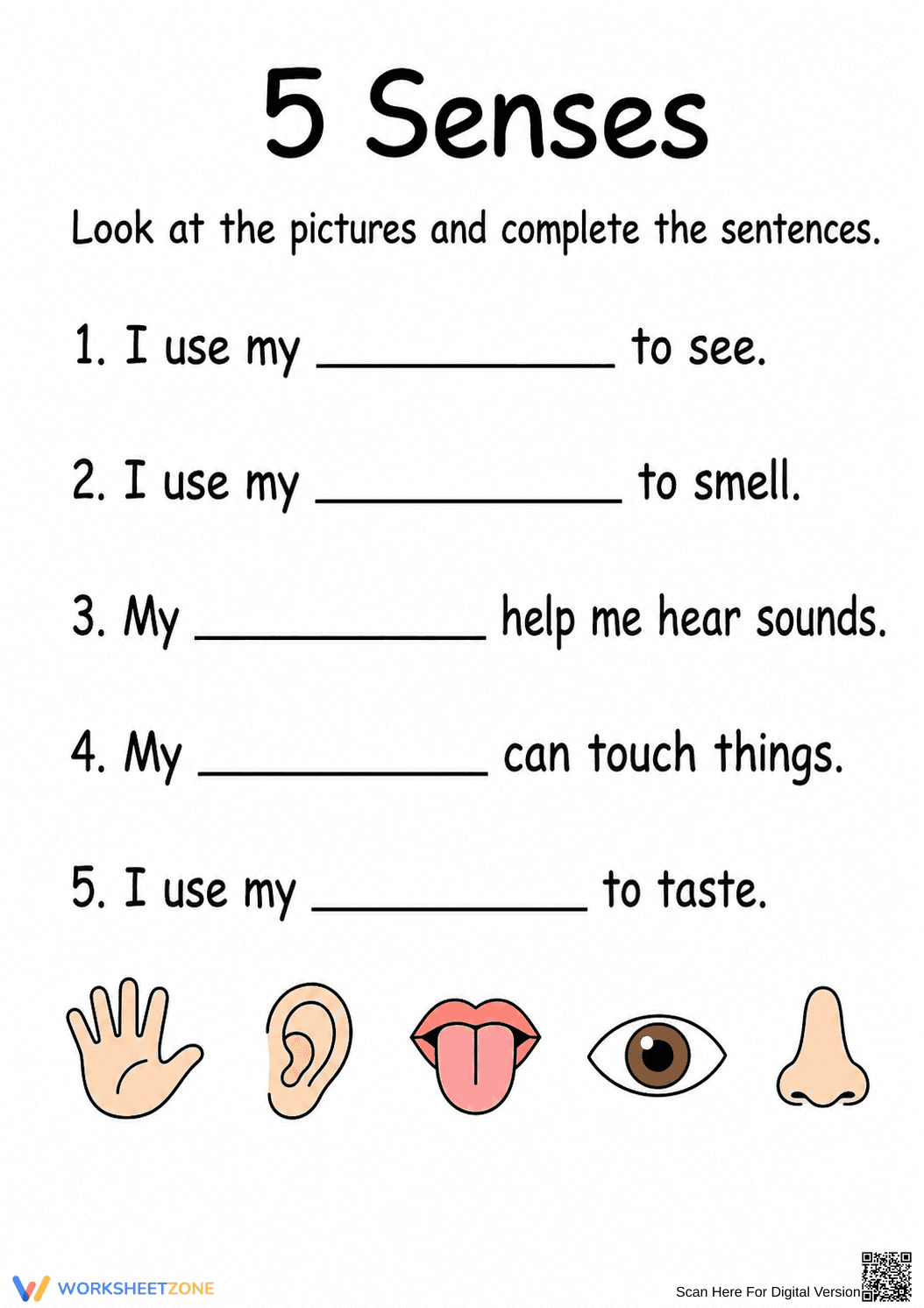

Grade 5 Five Senses — Printable No-Prep Worksheet
Paste this activity's link or code into your existing LMS (Google Classroom, Canvas, Teams, Schoology, Moodle, etc.).
Students can open and work on the activity right away, with no student login required.
You'll still be able to track student progress and results from your teacher account.
This Grade 5 five senses worksheet provides a focused approach to sensory vocabulary and biological identification. Students complete five targeted sentences by matching sensory organs to their specific functions. It serves as a foundational review for life science units or a vocabulary reinforcement tool for English language learners.
At a Glance
- Grade: 5 · Subject: Science
- Standard:
CCSS.ELA-LITERACY.L.5.6— Use domain-specific words accurately- Skill Focus: Sensory Organ Identification
- Format: 1 page · 5 problems · Answer key included · PDF
- Best For: Quick vocabulary check or bell-ringer
- Time: 5–10 minutes
What's Inside
The resource features a clean, distraction-free layout containing five fill-in-the-blank sentences. Each sentence requires the student to identify the correct body part—eyes, nose, ears, hands, or tongue—associated with seeing, smelling, hearing, touching, and tasting. Visual icons at the bottom of the single page provide a non-linguistic scaffold to support word recall and spelling accuracy, alongside a complete answer key for easy grading.
Zero-Prep Workflow
This worksheet is designed for a zero-prep workflow. Print: Teachers can print the single-page PDF in less than 30 seconds. Distribute: Handing out the assignment takes approximately one minute, and because the tasks are self-explanatory, students can begin immediately. Review: Checking the five answers as a whole-class activity takes roughly two minutes. This brings the total teacher prep and review time to under five minutes, making it an ideal candidate for emergency sub plans or transition periods.
Standards Alignment
Aligned primarily to CCSS.ELA-LITERACY.L.5.6, this worksheet ensures students can accurately use domain-specific vocabulary related to human biology. While the content is introductory, it supports the broader framework regarding how organisms process information through their senses. Both standard codes can be copied directly into lesson plans, IEP goals, or district curriculum mapping tools.
How to Use It
Use this worksheet as a formative assessment at the start of a biology unit to gauge prior knowledge before direct instruction. Alternatively, assign it as a quick exit ticket following a lesson on the nervous system. During the activity, observe if students rely heavily on the visual icons or if they can recall the terms independently. Expected completion time ranges from 5 to 10 minutes depending on the student's writing speed.
Who It's For
This resource is specifically tailored for Grade 5 students who need a refresher on basic biological terminology or for ESL/ELL students building their academic English lexicon. It pairs naturally with an anchor chart depicting the human nervous system or a short informational passage about sensory receptors to provide a comprehensive learning experience.
According to the RAND AIRS 2024 report, the integration of visual scaffolds in vocabulary acquisition tasks significantly improves retention rates for domain-specific terminology among elementary students. This worksheet utilizes that research-backed approach by pairing textual prompts with clear icons, facilitating a dual-coding effect that aids memory. By focusing on the five senses, the resource addresses the CCSS.ELA-LITERACY.L.5.6 requirement for students to use domain-specific words accurately, which is necessary for higher-level scientific inquiry. Structured practice is essential for moving students from basic recognition to functional application of technical terms. This one-page PDF provides the necessary repetition to solidify these concepts before students move on to more complex physiological systems. The inclusion of an answer key ensures that feedback can be immediate, which is a critical factor in preventing the fossilization of incorrect spelling or conceptual errors during independent practice sessions.


