




























Views
Downloads
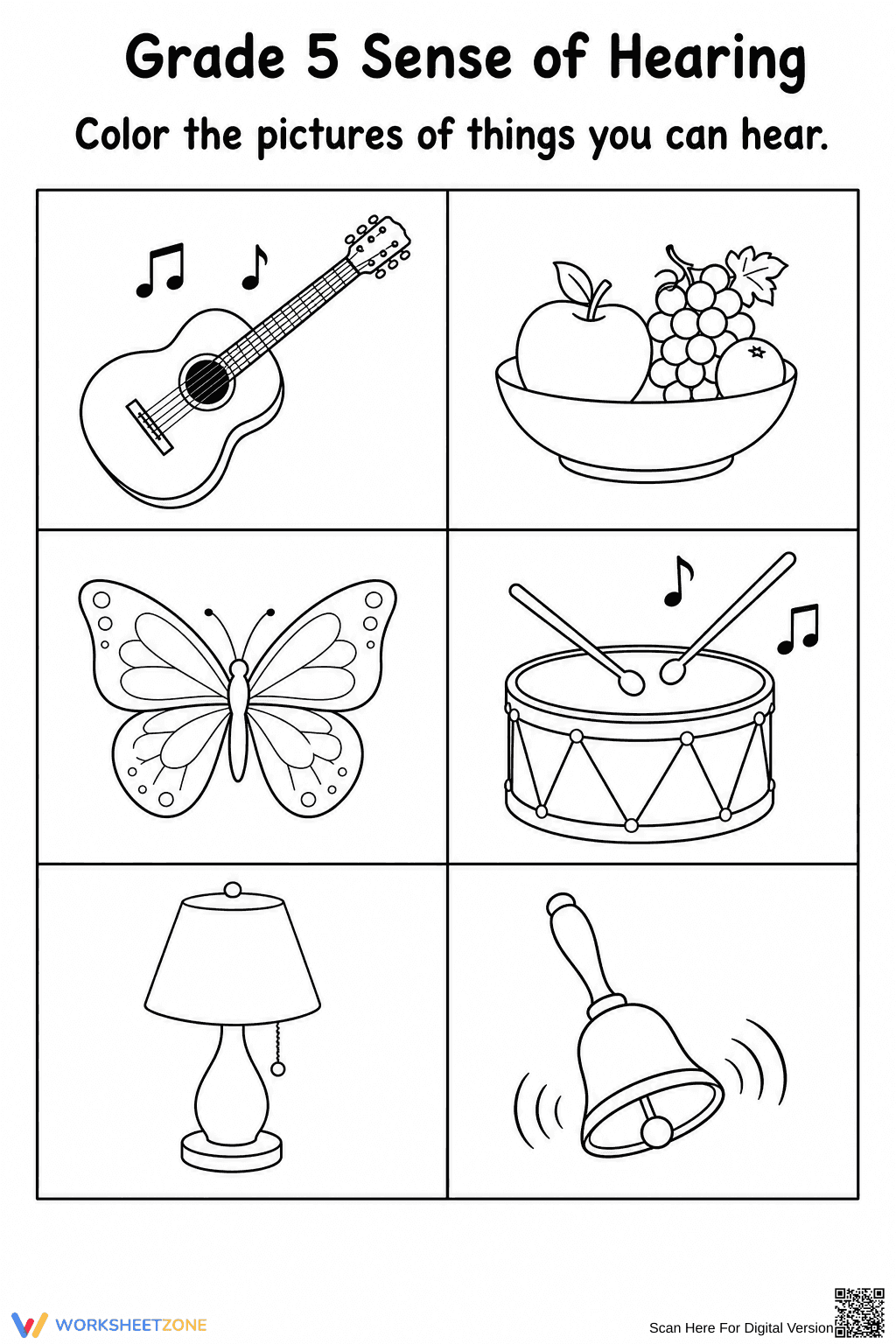

Grade 5 Sense of Hearing — Printable No-Prep Worksheet

Paste this activity's link or code into your existing LMS (Google Classroom, Canvas, Teams, Schoology, Moodle, etc.).
Students can open and work on the activity right away, with no student login required.
You'll still be able to track student progress and results from your teacher account.
This printable worksheet helps students identify objects associated with the sense of hearing. By evaluating six illustrations, learners determine which items produce sound and color them. This straightforward activity reinforces sensory observation skills and provides a quick way to review auditory concepts before moving into complex wave physics.
At a Glance
- Grade: 5 · Subject: Science
- Standard:
5-PS1-3— Make observations to identify materials based on properties- Skill Focus: Identifying sources of sound
- Format: 1 page · 6 problems · Answer key included · PDF
- Best For: Independent practice or review
- Time: 10–15 minutes
Inside this single-page resource, educators will find a clear task focused on auditory identification. The worksheet features six line-art images, including a guitar, fruit bowl, butterfly, drum, lamp, and bell. Students color only the pictures of things they can hear. The uncluttered layout minimizes distractions, making it accessible for diverse learners. An answer key ensures quick grading.
Zero-Prep Workflow
- Print (1 minute): The PDF format ensures clean copies without formatting issues across all device types.
- Distribute (1 minute): Hand out the single-page activity directly to students; no complex instructions or teacher setup are required.
- Review (2 minutes): Use the included answer key to quickly verify selections or facilitate a peer-grading session.
With a total teacher prep time of under two minutes, this worksheet is an excellent addition to any emergency sub plan or Friday review session.
Standards Alignment
This activity aligns with 5-PS1-3, requiring students to make observations and measurements to identify materials based on their properties. By distinguishing between objects that emit sound and those that do not, students practice categorizing physical phenomena based on observable traits. Both standard codes can be copied directly into lesson plans, IEP goals, or district curriculum mapping tools.
How to Use It
Teachers can utilize this worksheet as a brief warm-up before introducing a broader unit on sound waves. It serves as an effective diagnostic tool to gauge baseline understanding of auditory sources. Alternatively, it functions well as an independent wrap-up task. As a formative assessment tip, observe whether students hesitate on items like the butterfly; this indicates a need to clarify objects designed to produce sound. Expected completion time is 10 to 15 minutes.
Who It's For
This resource is primarily designed for fifth-grade students reviewing basic sensory concepts, but its highly visual nature makes it exceptionally well-suited for English Language Learners (ELLs) and students requiring modified instructional materials. The reliance on imagery rather than complex text reduces cognitive load. It pairs perfectly with an anchor chart detailing the five senses or a hands-on sound exploration lesson.
Integrating visual identification tasks into science instruction supports cognitive development and reinforces sensory categorization. According to Fisher & Frey (2014), providing students with clear, image-based tasks enhances their ability to process scientific classifications. This worksheet targets the core skill of identifying sources of sound, directly supporting 5-PS1-3 by asking students to make observations to identify materials based on their properties. When learners evaluate and select objects like a guitar or a bell over silent items, they engage in critical differentiation. This process solidifies their understanding of auditory stimuli and builds essential observation skills required for complex scientific inquiry. Utilizing targeted activities ensures that all students can successfully demonstrate their understanding of fundamental physical properties. By focusing on observable traits, educators provide a bridge between basic sensory awareness and the rigorous data collection required in higher-level science curriculum, ensuring mastery of foundational standards.


