


























Views
Downloads

Grade 5 Five Senses — Printable No-Prep Worksheet
Paste this activity's link or code into your existing LMS (Google Classroom, Canvas, Teams, Schoology, Moodle, etc.).
Students can open and work on the activity right away, with no student login required.
You'll still be able to track student progress and results from your teacher account.
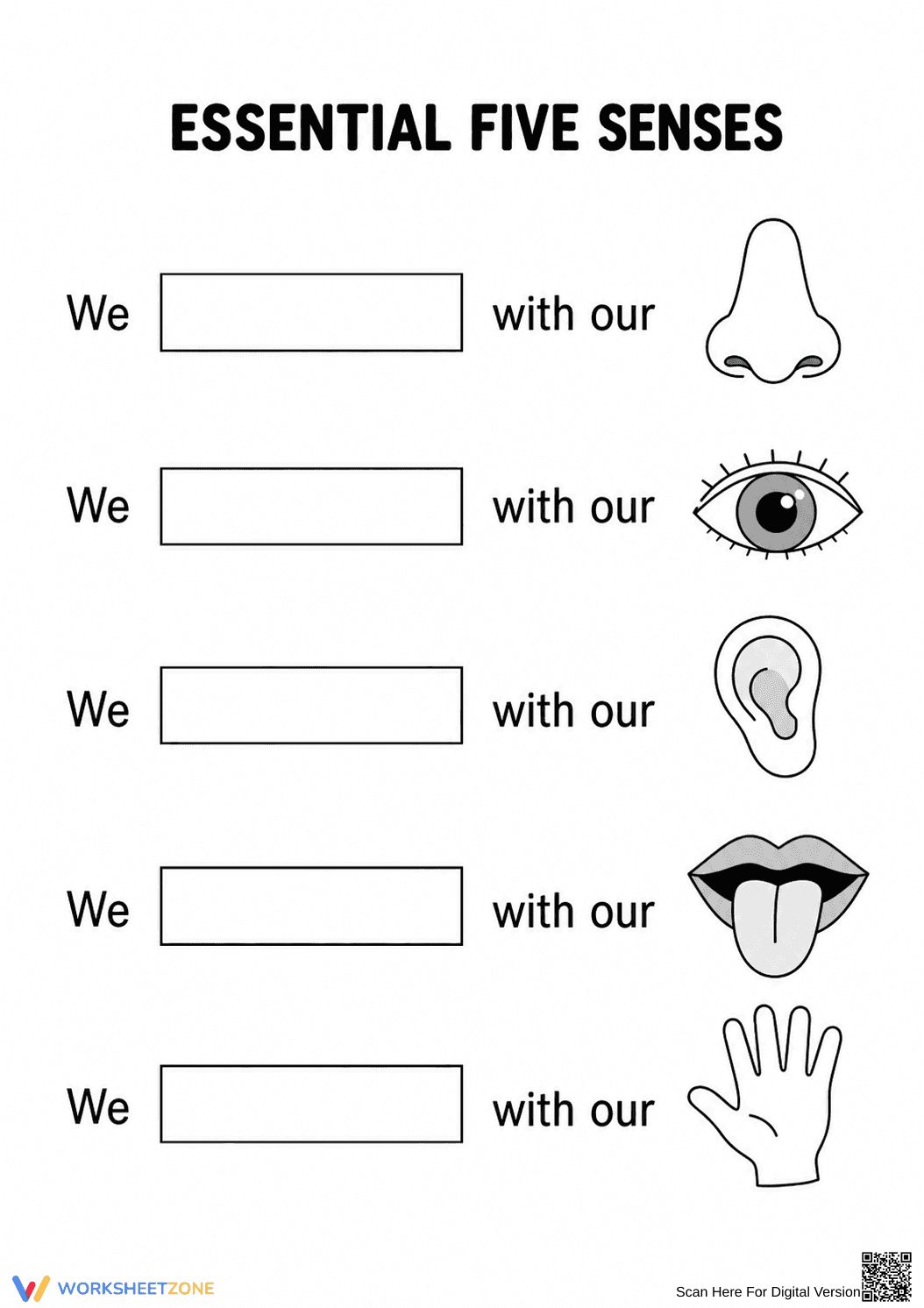
This Grade 5 science worksheet provides students with a clear, structured activity to identify and categorize sensory functions. By connecting specific action verbs to their corresponding biological organs, learners reinforce their understanding of how humans interact with the environment while building foundational scientific vocabulary.
At a Glance
- Grade: 5 · Subject: Science
- Standard:
CCSS.ELA-LITERACY.L.5.6— Acquire and use domain-specific words- Skill Focus: Sensory organ identification and function
- Format: 1 page · 5 problems · Answer key included · PDF
- Best For: Quick review or introductory science lesson
- Time: 5–10 minutes
The worksheet features five sentence-completion tasks paired with high-contrast visual icons representing the nose, eye, ear, tongue, and hand. This one-page PDF includes a clean layout that minimizes visual distraction, making it highly accessible for all learners. A comprehensive answer key is provided to facilitate rapid grading or student self-correction during independent work sessions.
This resource is designed for a highly efficient, zero-prep workflow. Teachers can print the single-page document in less than 30 seconds. Distribution takes approximately one minute during a classroom transition period. Reviewing the five answers as a whole-class activity requires only two minutes, making the total teacher engagement time under five minutes. It serves as an ideal emergency sub plan component.
This activity aligns with CCSS.ELA-LITERACY.L.5.6, focusing on the acquisition of domain-specific vocabulary related to human biology. It also supports foundational science concepts by providing the linguistic framework for how organisms receive and process information. Both standard codes can be copied directly into lesson plans, IEP goals, or district curriculum mapping tools.
Use this worksheet as a brief bell-ringer at the start of a biology unit to assess prior knowledge. Alternatively, assign it as a formative assessment after a lesson on the nervous system to ensure students can correctly link organs to sensory inputs. Observe if students can identify the specific verbs—such as smell, see, hear, taste, and touch—without prompting. Expected completion time ranges from five to ten minutes.
This resource is tailored for Grade 5 students, including English Language Learners who benefit from strong visual-to-text associations. It pairs naturally with a classroom anchor chart on the human body or a short informational passage about the nervous system. The straightforward format provides necessary support for students requiring simplified writing frames.
According to the RAND AIRS 2024 report, high-quality supplemental materials that integrate visual cues with linguistic tasks significantly improve retention in upper elementary science. This worksheet utilizes a structured fill-in-the-blank format to reinforce domain-specific vocabulary. By isolating the five primary senses, the resource ensures that students master foundational terms before moving toward complex physiological systems. Targeted practice helps bridge the gap between basic identification and higher-order analysis of biological functions. This Grade 5 resource provides the necessary repetition for students to internalize the relationship between sensory organs and environmental interaction. The inclusion of an answer key and clear icons supports independent mastery, allowing educators to focus on individualized instruction while maintaining rigorous alignment with CCSS.ELA-LITERACY.L.5.6 standards. Acquiring and using domain-specific words is essential for scientific literacy.


