


























Views
Downloads

Grade 5 5 Senses Taste Worksheet | Printable Science
Paste this activity's link or code into your existing LMS (Google Classroom, Canvas, Teams, Schoology, Moodle, etc.).
Students can open and work on the activity right away, with no student login required.
You'll still be able to track student progress and results from your teacher account.
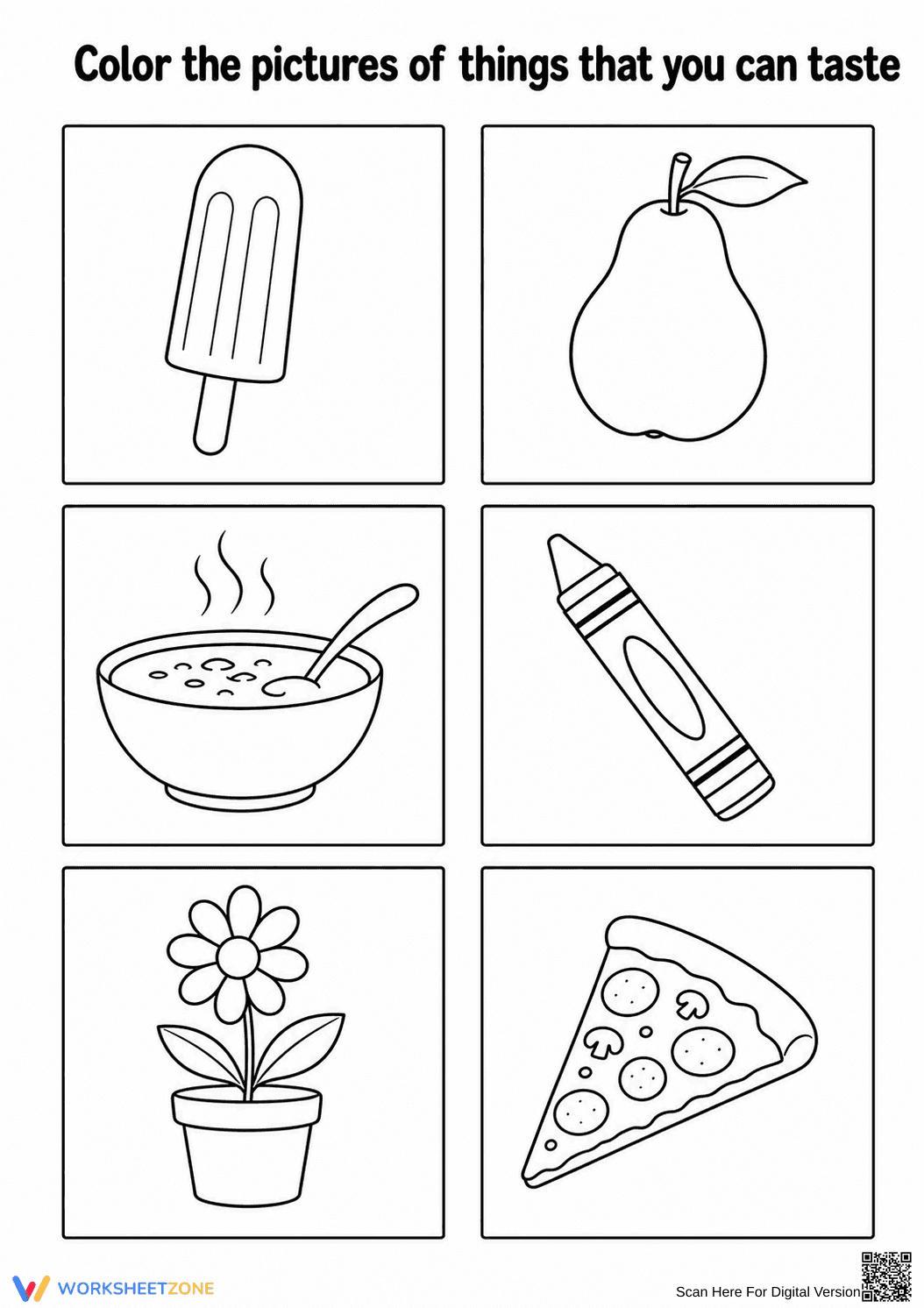
This Grade 5 sensory categorization worksheet helps students identify and classify objects based on the sense of taste. By evaluating six distinct illustrations, learners practice distinguishing edible items from non-consumable objects, reinforcing foundational biological concepts and vocabulary. This targeted activity ensures students understand how sensory inputs relate to real-world objects through a simple, engaging coloring task.
At a Glance
- Grade: 5 · Subject: Science
- Standard:
CCSS.ELA-LITERACY.L.5.5— Categorize and understand relationships between concepts and sensory attributes- Skill Focus: Identifying objects by taste
- Format: 1 page · 6 problems · Answer key included · PDF
- Best For: Independent practice or review
- Time: 5–10 minutes
Inside this single-page resource, students will find six clear, black-and-white illustrations of everyday objects, including food items like pizza and soup, alongside non-edible goods like crayons and flowers. The task requires students to evaluate each image and color only the things they can taste. A complete answer key is included to ensure quick and accurate grading for busy educators.
This resource is designed for immediate classroom use with a simple three-step workflow. First, print the copies (under 1 minute). Next, distribute to students along with coloring supplies (1 minute). Finally, review the correct answers as a class (3 minutes). Total teacher preparation time is under two minutes, making this an ideal activity for morning work, fast finishers, or an emergency sub plan.
Aligned to CCSS.ELA-LITERACY.L.5.5, this activity requires students to demonstrate understanding of word relationships and nuances in conceptual meanings by categorizing objects based on sensory attributes. It also supports general science frameworks regarding human body systems and sensory processing. Both standard codes can be copied directly into lesson plans, IEP goals, or district curriculum mapping tools.
Use this worksheet as a quick warm-up before a broader lesson on the human body or sensory organs. Alternatively, assign it as an independent center activity where students can practice categorization skills. As a formative assessment tip, observe whether students hesitate on non-food items like the crayon or flowers, which can prompt discussions about safety and sensory limitations. Expected completion time is 5 to 10 minutes.
This resource is primarily for fifth-grade students reviewing basic sensory concepts or English language learners building vocabulary around food and the five senses. The visual nature of the task provides built-in support for visual learners and students requiring modified assignments. It pairs perfectly with an anchor chart detailing the five senses or a direct instruction lesson on human biology.
Integrating sensory categorization tasks into the curriculum reinforces cognitive connections between vocabulary and biological functions. According to Fisher & Frey (2014), providing students with clear, visual categorization exercises enhances their ability to process and retain domain-specific concepts, particularly when bridging language arts and science. By aligning with CCSS.ELA-LITERACY.L.5.5, this activity ensures students practice categorizing and understanding relationships between concepts effectively. When learners actively evaluate and select items based on specific criteria, such as identifying objects by the sense of taste, they strengthen both their analytical skills and their foundational science knowledge. This brief, targeted practice supports broader comprehension of how humans interact with their environment. Teachers can utilize these visual assessments to quickly gauge student understanding of sensory inputs, ensuring that foundational gaps are addressed before moving on to more complex biological systems or advanced descriptive writing tasks.


