


























Views
Downloads

5.NR.2.2 Worksheet: Long Division — Grade 5 Aligned
Paste this activity's link or code into your existing LMS (Google Classroom, Canvas, Teams, Schoology, Moodle, etc.).
Students can open and work on the activity right away, with no student login required.
You'll still be able to track student progress and results from your teacher account.
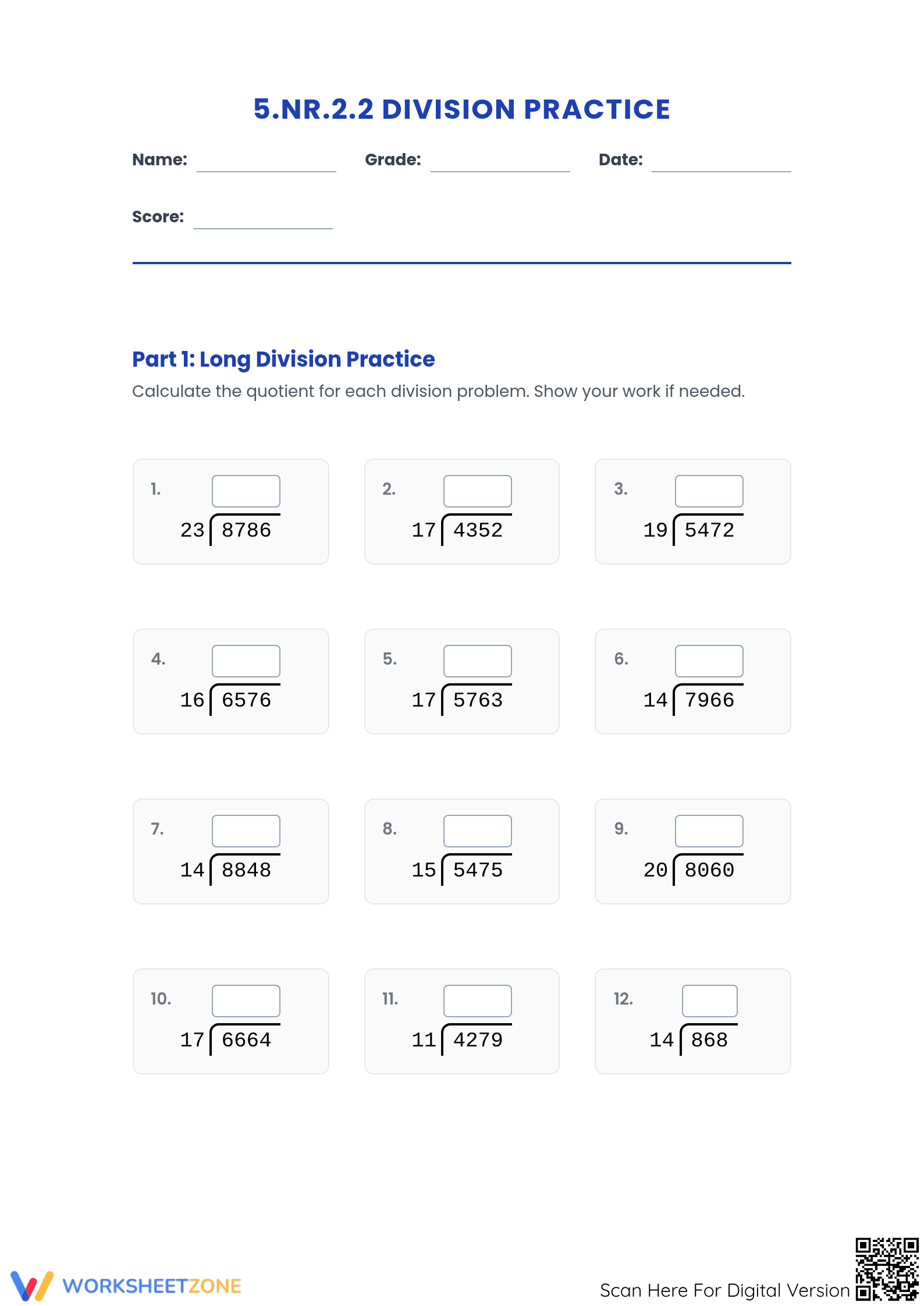
This Grade 5 math worksheet provides intensive practice for multi-digit long division, specifically focusing on dividing four-digit dividends by two-digit divisors. Students will develop procedural fluency and accuracy in calculating quotients, a critical milestone for middle school mathematics. By completing these 21 problems, learners solidify their understanding of the standard division algorithm.
At a Glance
- Grade: 5 · Subject: Math
- Standard:
5.NR.2.2— Fluently divide multi-digit numbers using the standard algorithm with two-digit divisors- Skill Focus: Multi-digit long division
- Format: 2 pages · 21 problems · Answer key included · PDF
- Best For: Independent practice and formative assessment
- Time: 30–45 minutes
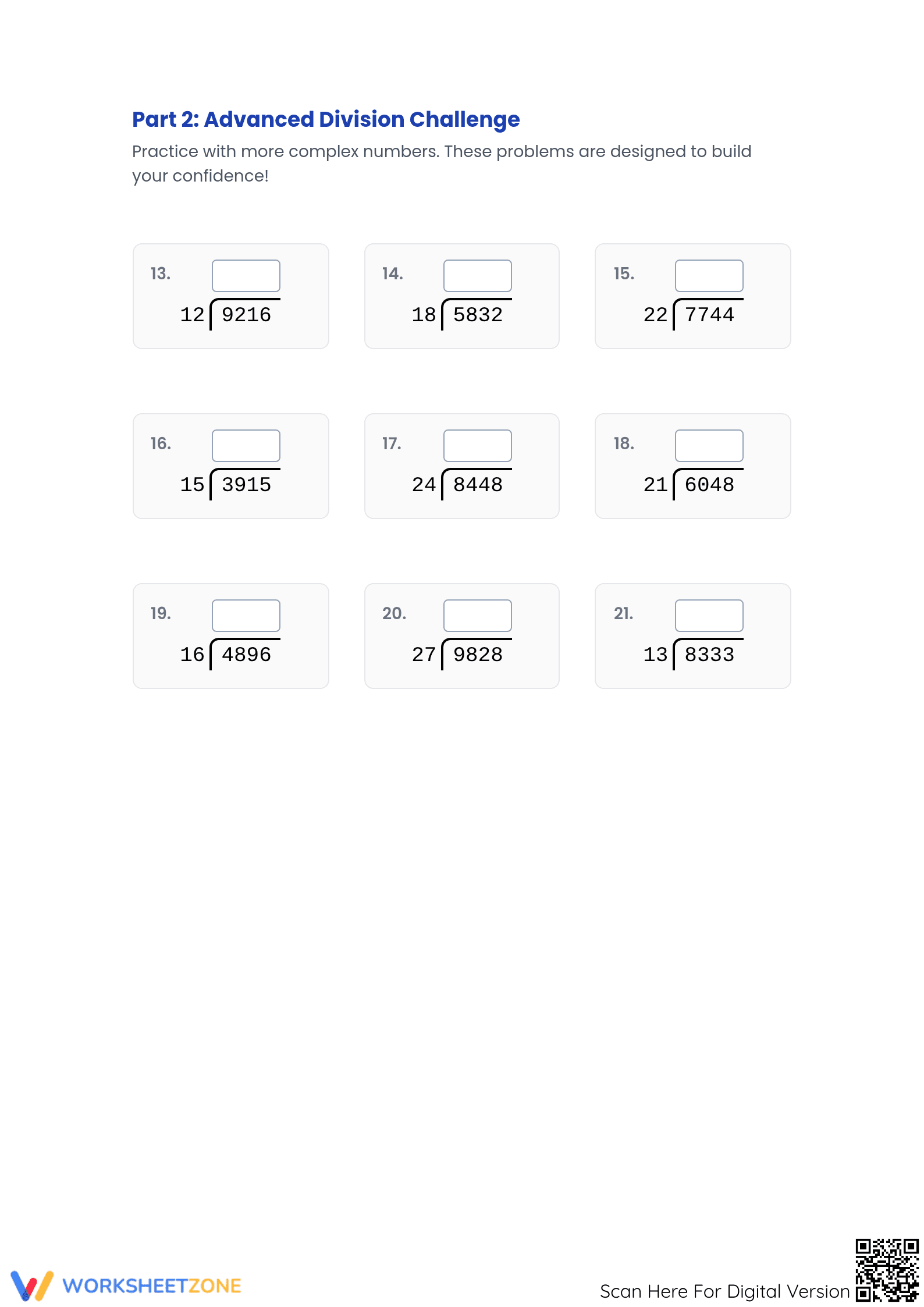
This comprehensive two-page PDF contains 21 structured long division problems. Page one features 12 foundational problems, while page two offers an "Advanced Division Challenge" with 9 additional complex calculations. Each problem is presented in a clear grid format with dedicated answer boxes and ample white space for students to show their vertical work. A complete answer key is provided for rapid grading and immediate feedback.
Mastery Evidence
The worksheet is designed to provide clear evidence of student mastery for standard 5.NR.2.2. The progression from Part 1 to Part 2 allows teachers to identify students who are approaching proficiency versus those who have reached full mastery of the standard algorithm. Results can be recorded directly into gradebooks or used to inform IEP progress monitoring for calculation goals. Each task maps directly to the sub-skill of estimating and calculating quotients with multi-digit divisors.
Standards Alignment
The primary focus is `5.NR.2.2`, which requires students to fluently divide multi-digit numbers using the standard algorithm. This resource also supports CCSS.MATH.CONTENT.5.NBT.B.6, focusing on finding whole-number quotients of whole numbers with up to four-digit dividends and two-digit divisors. Both standard codes can be copied directly into lesson plans, IEP goals, or district curriculum mapping tools to ensure instructional compliance.
How to Use It
Use this worksheet as a summative assessment after completing a unit on multi-digit division. Alternatively, assign page one as guided practice during a small-group rotation and page two as independent work for early finishers. Teachers should observe students' placement of the first digit in the quotient to identify common place-value misconceptions. Expected completion typically takes 30 to 45 minutes depending on student fluency levels.
Who It's For
This resource is ideal for fifth-grade students mastering the standard division algorithm. It serves as an excellent intervention tool for sixth graders requiring remediation or as an enrichment activity for advanced fourth graders. Pair this worksheet with a division anchor chart or a step-by-step video tutorial on the "Divide, Multiply, Subtract, Bring Down" method to support diverse learners in the classroom.
According to the RAND AIRS 2024 report, consistent procedural practice with the standard algorithm is essential for developing the computational fluency required for higher-level algebraic thinking. This worksheet targets standard 5.NR.2.2, ensuring students can accurately divide multi-digit numbers with two-digit divisors. Research by Fisher & Frey (2014) emphasizes that structured independent practice, like the 21 problems provided here, facilitates the transition from guided instruction to cognitive autonomy. By isolating the division skill without the distraction of word problems, students can focus entirely on the mechanics of the algorithm. This alignment with evidence-based instructional design ensures that the resource meets the rigorous demands of modern state frameworks. Educators can rely on this tool to provide the high-repetition practice necessary for long-term retention of mathematical procedures in the upper elementary grades.


