


























Views
Downloads

Essential 4th Step Resentment Review Worksheet
Paste this activity's link or code into your existing LMS (Google Classroom, Canvas, Teams, Schoology, Moodle, etc.).
Students can open and work on the activity right away, with no student login required.
You'll still be able to track student progress and results from your teacher account.
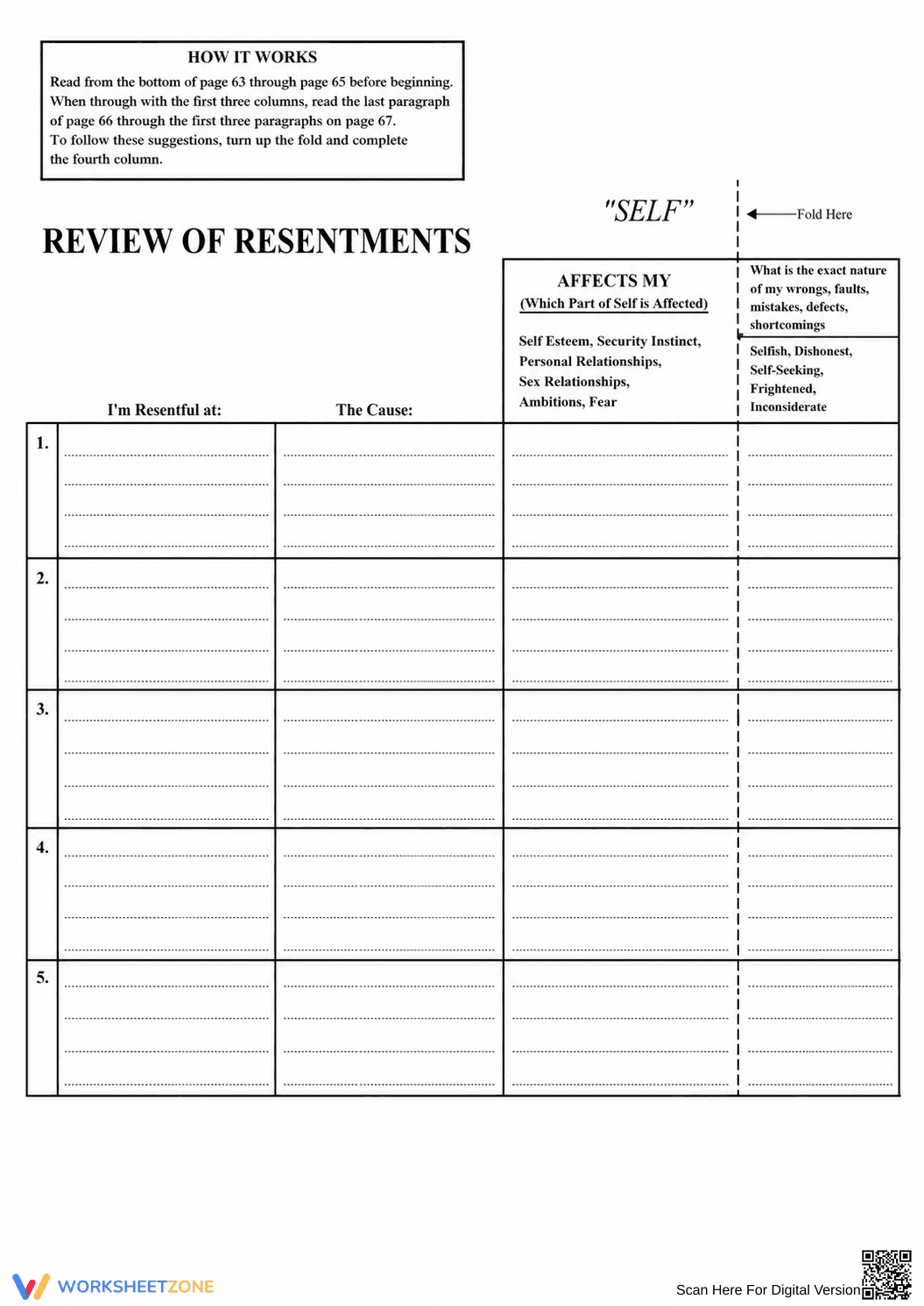
This Grade 12 behavioral worksheet facilitates deep self-reflection through a structured Review of Resentments inventory. Students identify specific triggers, analyze the underlying causes of their emotional responses, and evaluate how these feelings impact their self-esteem and relationships. It provides a clear framework for processing complex emotions and developing personal accountability before moving toward resolution.
At a Glance
- Grade: 12 · Subject: Behavior Activities
- Standard:
CCSS.ELA-LITERACY.W.11-12.10— Write routinely for reflection and self-analysis over extended time frames- Skill Focus: Emotional Inventory & Analysis
- Format: 1 page · 5 problems · Self-guided · PDF
- Best For: Individual counseling or self-help reflection
- Time: 30–45 minutes
The worksheet features a 5-row inventory table designed for high-maturity reflection. It includes four distinct columns: the target of resentment, the specific cause, the part of self affected (with a word bank including Security and Ambition), and a final column for identifying personal faults. A unique fold here feature allows for a gradual-release approach to self-discovery, ensuring students focus on one aspect of their inventory at a time.
Zero-Prep Workflow
- Print: Select the single-page PDF and print enough copies for your group or individual session. This takes less than 30 seconds of preparation.
- Distribute: Hand out the worksheet alongside the recommended reading from pages 63-67 of the source text to provide necessary context for the exercise.
- Review: Allow students to work through the columns independently, using the provided word bank to label their internal experiences and identify behavioral patterns.
The primary standard is CCSS.ELA-LITERACY.W.11-12.10, which requires students to write routinely over extended time frames for a range of tasks, purposes, and audiences. This worksheet specifically addresses the purpose of self-reflection and behavioral analysis. Both standard codes can be copied directly into lesson plans, IEP goals, or district curriculum mapping tools.
Use this resource during the independent practice phase of a social-emotional learning unit on conflict resolution or emotional regulation. It serves as an excellent formative assessment tool; teachers or counselors can observe which parts of self students identify most frequently to tailor future support. Expected completion time ranges from 30 to 45 minutes depending on the depth of reflection.
This resource is designed for Grade 12 students, adult learners, or individuals in behavioral health programs. It is particularly effective for those requiring structured prompts to navigate complex interpersonal conflicts. Pair this with an anchor chart on Healthy Coping Mechanisms or a direct instruction lesson on emotional intelligence to provide a comprehensive learning experience.
This behavioral inventory aligns with CCSS.ELA-LITERACY.W.11-12.10 by engaging students in routine reflective writing to analyze personal experiences and emotional patterns. By utilizing a structured 4-column approach, the worksheet scaffolds the complex task of identifying the exact nature of personal wrongs, a key component of behavioral self-regulation. Research by Fisher & Frey (2014) emphasizes that structured writing tasks in social-emotional contexts help students move from reactive emotional states to analytical metacognition. The inclusion of 5 specific rows ensures a comprehensive review of multiple triggers, promoting a thorough emotional inventory. This tool is essential for high school educators and counselors seeking evidence-based methods to improve student self-awareness and accountability. According to Fisher & Frey (2014), such scaffolds are vital for developing the maturity required for college and career readiness in interpersonal environments.


