


























Views
Downloads

Essential Resentment Inventory Worksheet | Grade 9
Paste this activity's link or code into your existing LMS (Google Classroom, Canvas, Teams, Schoology, Moodle, etc.).
Students can open and work on the activity right away, with no student login required.
You'll still be able to track student progress and results from your teacher account.
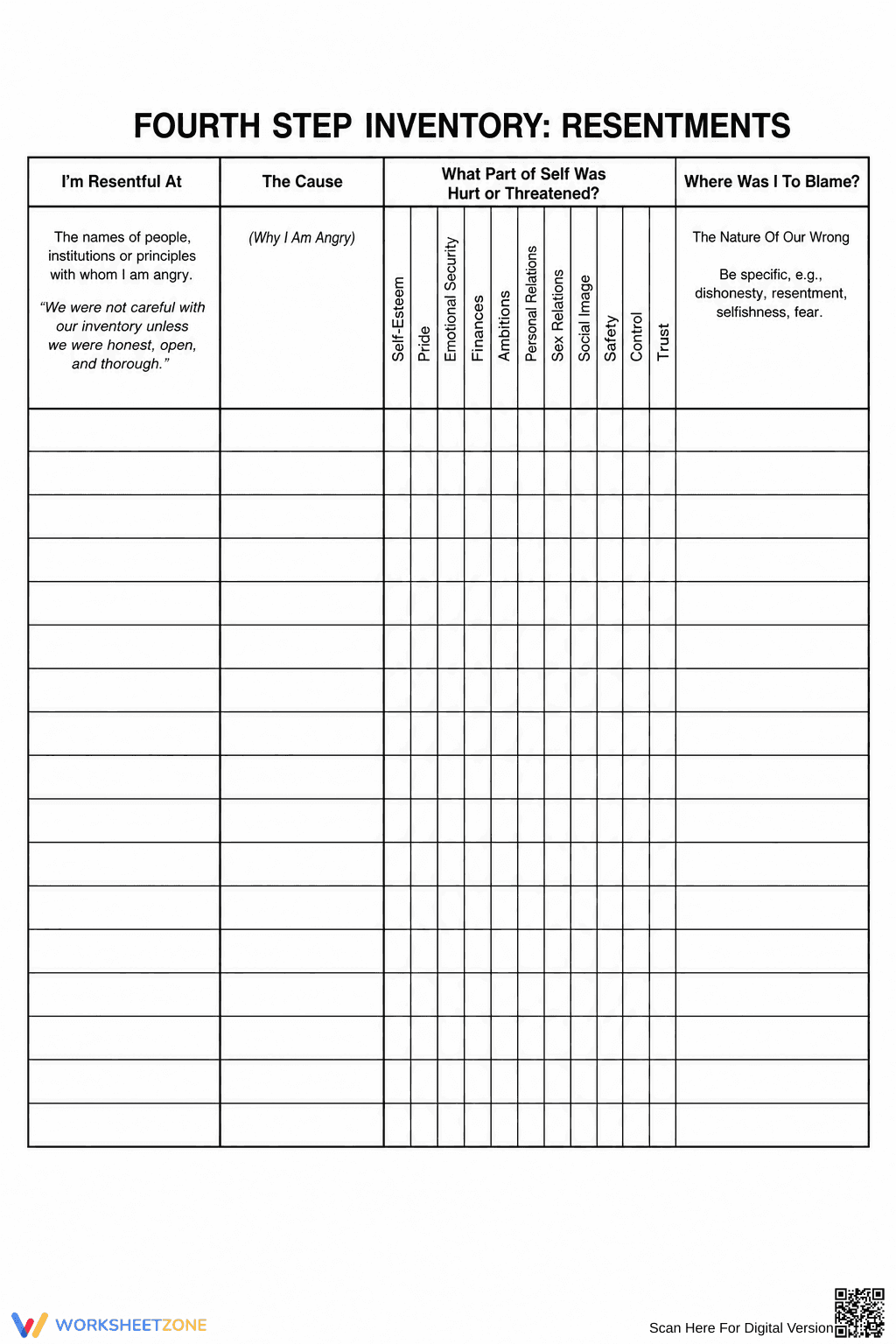
This Resentment Inventory worksheet provides a structured framework for students to process complex emotions and develop personal accountability. By identifying specific triggers and analyzing the impact on self-image, learners gain critical insights into their behavioral patterns. This tool facilitates deep self-reflection, helping students move from reactive anger to constructive emotional management and resolution.
At a Glance
- Grade: 9 · Subject: Social Skills
- Standard:
CCSS.ELA-LITERACY.W.8.10— Write routinely for a range of tasks, purposes, and audiences- Skill Focus: Emotional inventory and accountability
- Format: 1 page · 15 problems · Answer key not applicable · PDF
- Best For: Individual reflection and behavioral intervention
- Time: 20–30 minutes
The worksheet features a comprehensive four-column table designed for thorough introspection. It includes 15 entry rows, allowing for an extensive list of people, institutions, or principles. The layout includes specific checkboxes for identifying hurt areas like self-esteem, security, and ambitions, alongside a dedicated section for describing personal blame and the nature of wrongs.
This resource is designed for immediate implementation with a total teacher prep time of under 2 minutes. First, print the single-page PDF for your group or individual student. Second, distribute the inventory during a quiet reflection period, which takes seconds. Finally, review the completed entries during a one-on-one check-in or counseling session to facilitate emotional growth.
The primary standard addressed is `CCSS.ELA-LITERACY.W.8.10`, which requires students to write routinely over extended time frames for a range of discipline-specific tasks, purposes, and audiences. This inventory serves as a functional writing task that demands clarity and specificity in self-expression. Both standard codes can be copied directly into lesson plans, IEP goals, or district curriculum mapping tools.
Use this worksheet during a behavioral intervention or as part of a social-emotional learning unit on conflict resolution. It is most effective after direct instruction on identifying emotions and personal boundaries. Teachers should observe if students can move beyond surface-level anger to identify the underlying "hurt" or "threatened" part of their self-image, which serves as a vital formative assessment of emotional maturity.
This resource is ideal for high school students in grades 9-12, particularly those in alternative education settings or participating in counseling programs. It pairs naturally with an emotional vocabulary list or a direct instruction lesson on the 4th Step process. It provides necessary structure for students who struggle with abstract self-reflection.
The use of structured inventories for emotional processing is supported by research into adolescent self-regulation and behavioral health. According to Fisher & Frey (2014), providing students with scaffolds for routine writing tasks—such as this resentment inventory—enhances their ability to organize complex thoughts and take ownership of their learning and behavior. This worksheet aligns with CCSS.ELA-LITERACY.W.8.10 by requiring students to produce clear, purposeful writing that addresses specific personal prompts. By categorizing the nature of our wrong, students engage in higher-order metacognitive evaluation, a key component of the NAEP framework for writing and social-emotional development. Research from the RAND AIRS 2024 report suggests that consistent use of structured reflection tools in secondary education correlates with improved conflict resolution skills and reduced disciplinary incidents. This printable PDF offers a practical, research-backed method for fostering accountability and emotional intelligence in diverse classroom environments.


