


























Views
Downloads

4th Step Inventory Worksheet | Essential SEL Guide
Paste this activity's link or code into your existing LMS (Google Classroom, Canvas, Teams, Schoology, Moodle, etc.).
Students can open and work on the activity right away, with no student login required.
You'll still be able to track student progress and results from your teacher account.
This 4th Step Inventory worksheet provides a structured framework for students to analyze personal resentments, fears, and behaviors. By categorizing emotional responses and identifying character defects, learners develop the critical self-awareness needed for emotional regulation and interpersonal growth. It transforms abstract feelings into actionable data for personal development.
At a Glance
- Grade: 6-8 · Subject: Social Skills
- Standard:
CCSS.ELA-LITERACY.W.8.10— Write routinely over extended time frames for a range of tasks- Skill Focus: Self-reflection & Emotional Intelligence
- Format: 3 pages · 25+ prompts · No answer key · PDF
- Best For: Individual reflection and behavior intervention
- Time: 45–60 minutes
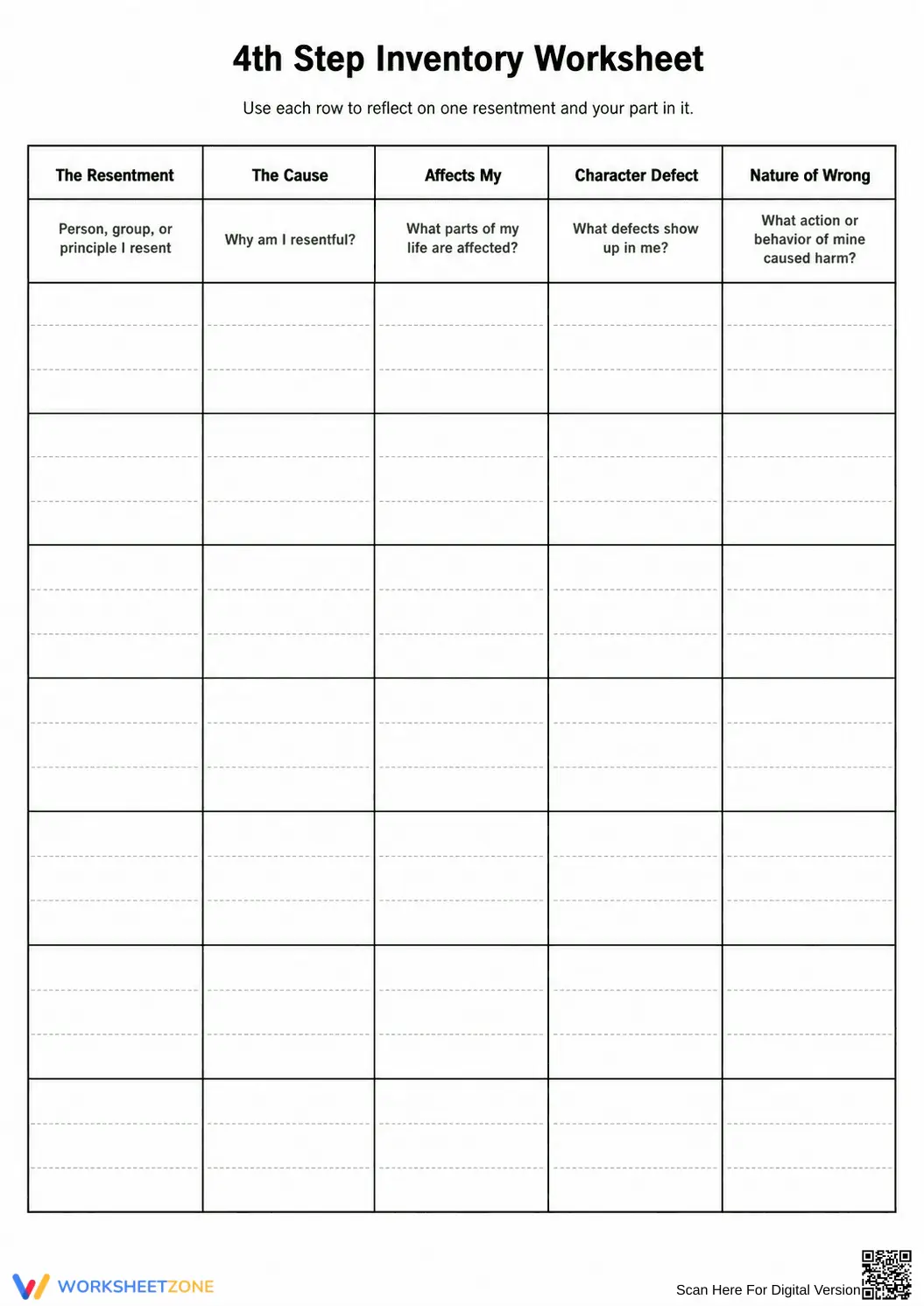
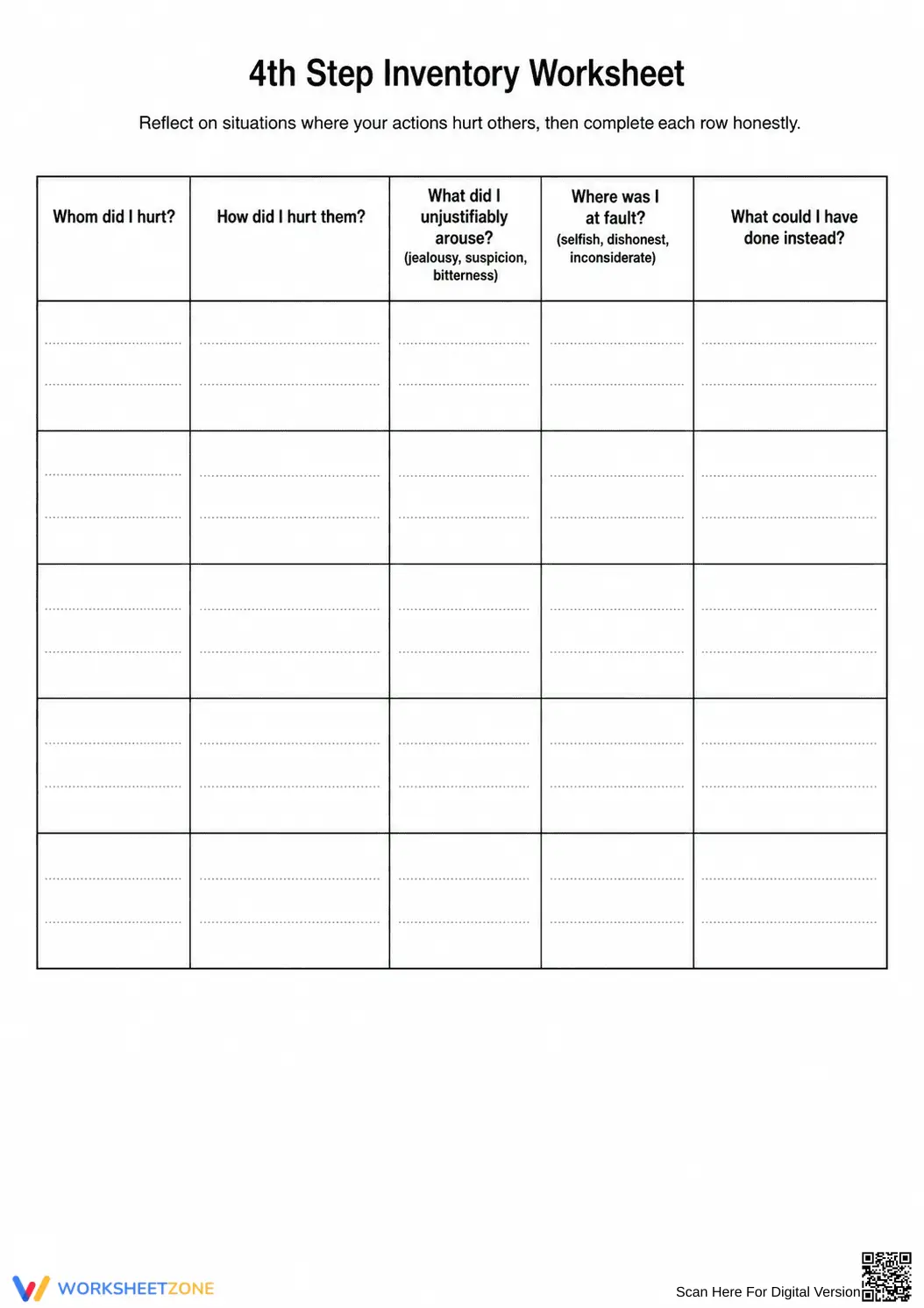
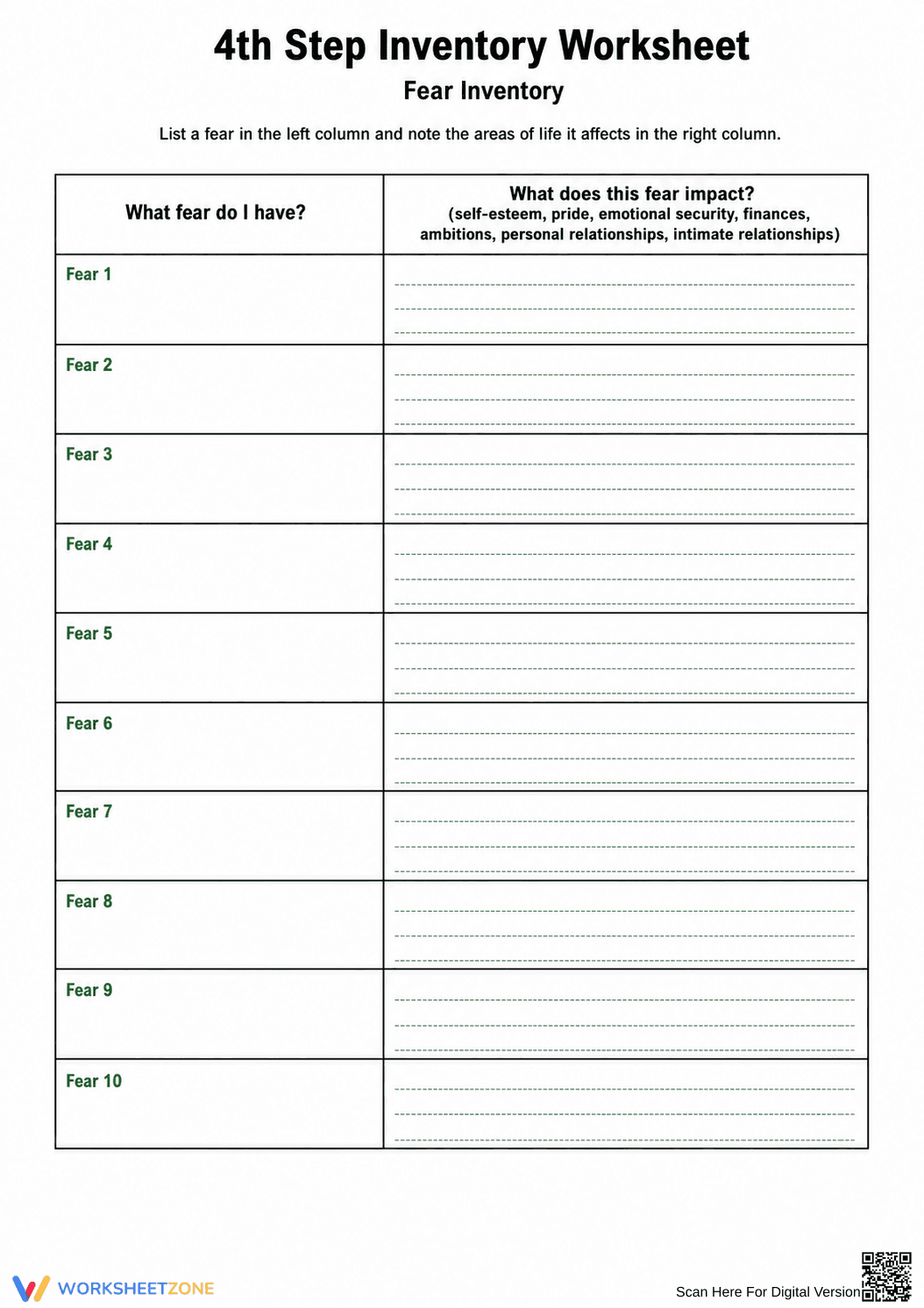
The resource contains three distinct inventory pages: a Resentment Inventory, a Harm Inventory, and a Fear Inventory. Each page utilizes a clean, tabular format with specific headers like "Nature of Wrong" and "Character Defect." The 3-page PDF includes guided prompts to help students identify the root causes of their emotional triggers without requiring teacher setup or complex instructions.
Zero-Prep Workflow
- Print: Select the specific inventory page needed for the session or print the full 3-page packet (30 seconds).
- Distribute: Hand out the worksheets during a quiet reflection period, counseling session, or as part of a behavior intervention (1 minute).
- Review: Allow students to work independently, providing guidance only when they struggle with vocabulary like "resentment" or "defect."
Total teacher prep time is under 2 minutes, making this an ideal resource for unexpected behavioral interventions, counseling office visits, or emergency sub plans.
This worksheet aligns with CCSS.ELA-LITERACY.W.8.10, which requires students to write routinely over extended time frames for a range of discipline-specific tasks, purposes, and audiences. By engaging in deep self-analysis, students practice the organizational and reflective writing skills necessary for middle school mastery. Both standard codes can be copied directly into lesson plans, IEP goals, or district curriculum mapping tools.
Use this worksheet during a dedicated Social-Emotional Learning (SEL) block or as part of a behavior intervention plan. It is most effective after a brief discussion on emotional honesty. Teachers should observe if students are able to move from blaming others to identifying their own "Nature of Wrong," which serves as a vital formative assessment of their emotional maturity. Completion typically takes 45 to 60 minutes depending on the depth of reflection.
This tool is designed for middle school students in grades 6-8, particularly those in behavioral support programs or counseling groups. It pairs naturally with an anchor chart on common character traits or a guided lesson on conflict resolution. It is also suitable for students working on specific IEP goals related to self-regulation and social responsibility.
According to the RAND AIRS 2024 report on social-emotional learning, structured reflective writing tools significantly improve a student's ability to manage interpersonal conflict and recognize personal accountability. This worksheet facilitates that process by providing a clear, logical sequence for analyzing complex emotions. By mapping specific actions to "Character Defects," students engage in the high-level metacognition required by CCSS.ELA-LITERACY.W.8.10. Research from Fisher & Frey (2014) suggests that such scaffolded reflection helps bridge the gap between reactive behavior and proactive self-regulation. This 3-page inventory serves as a practical application of these evidence-based strategies, offering a repeatable template for emotional inventorying that can be used throughout the academic year to track growth in self-awareness and social responsibility.


