


























Views
Downloads
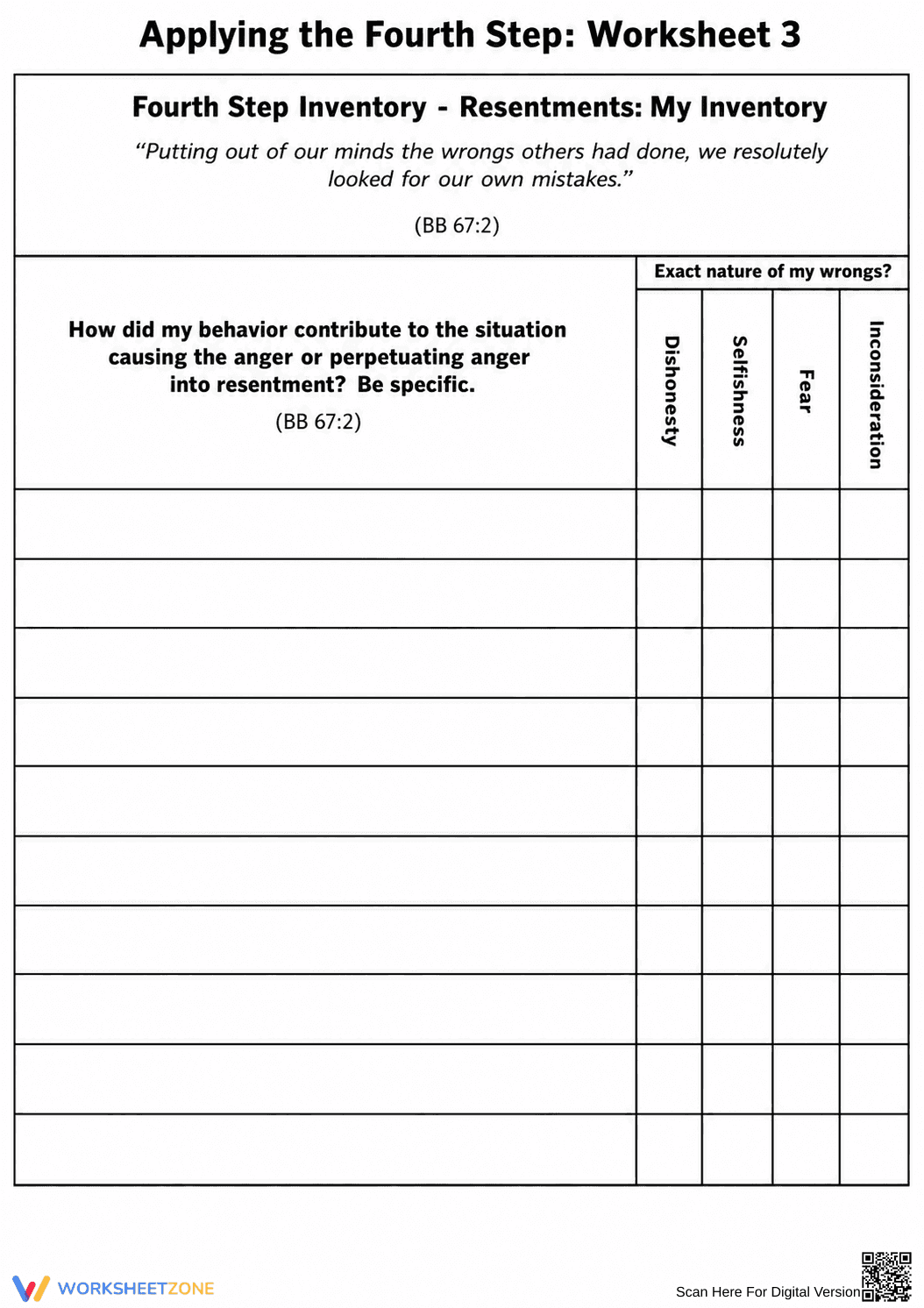

Essential Fourth Step Resentment Inventory Worksheet
Paste this activity's link or code into your existing LMS (Google Classroom, Canvas, Teams, Schoology, Moodle, etc.).
Students can open and work on the activity right away, with no student login required.
You'll still be able to track student progress and results from your teacher account.
This behavioral health worksheet facilitates deep self-reflection by helping students or individuals identify how their own actions contribute to feelings of anger and resentment. By focusing on personal accountability rather than external blame, the tool guides users to categorize their behaviors into specific character traits. This process is vital for emotional regulation and developing healthier interpersonal relationship patterns.
At a Glance
- Grade: Grade 12 · Subject: Behavior Activities
- Standard:
CCSS.ELA-LITERACY.W.11-12.10— Write routinely for a range of tasks, purposes, and audiences for self-reflection.- Skill Focus: Behavioral Self-Analysis
- Format: 1 page · 10 problems · Open-ended response · PDF
- Best For: Counseling groups and emotional regulation
- Time: 20–30 minutes
The worksheet features a structured 10-row inventory grid designed for clarity and ease of use. At the top, a grounding quote from recovery literature sets the tone for honest self-appraisal. Each row includes a large text area for describing specific behavioral contributions to a conflict, followed by a checklist to categorize the nature of the wrong. The four categories provided—Dishonesty, Selfishness, Fear, and Inconsideration—offer a simplified framework for complex emotional analysis.
Zero-Prep Workflow
- Print (30 seconds): Generate enough copies for your group or individual session; the high-contrast black and white design ensures clean copies every time.
- Distribute (30 seconds): Hand out the single-page sheet along with a pen; no additional materials or complex instructions are required for the user.
- Review (1 minute): Briefly explain the four categories of behavior to ensure the user understands the distinction between fear-based and self-seeking actions before they begin.
This resource is aligned with CCSS.ELA-LITERACY.W.11-12.10, which requires students to write routinely over extended time frames for a range of tasks and purposes. By engaging in this structured writing task, students practice the discipline of translating internal emotional states into clear, written evidence. This standard code can be copied directly into lesson plans, IEP goals, or district curriculum mapping tools.
To use this effectively, assign it during a quiet reflection period or as a follow-up to a lesson on conflict resolution. It works best after a direct instruction session on the difference between feelings and behaviors. For formative assessment, observe whether the user is able to move from general complaints about others to specific descriptions of their own actions. Completion time typically ranges from 20 to 30 minutes depending on the depth of reflection.
This worksheet is primarily designed for older teenagers in Grade 12, college students, or adults in counseling environments. It is an excellent resource for those working through issues of anger management or interpersonal conflict. It pairs naturally with an anchor chart on emotional vocabulary or a direct instruction lesson on the 12-step recovery process.
The use of structured writing for behavioral intervention is supported by Fisher & Frey (2014), who emphasize that metacognitive tasks help students bridge the gap between emotional impulse and rational analysis. This worksheet addresses the skill of behavioral self-analysis by requiring users to document 10 specific instances of resentment and categorize them under the framework of CCSS.ELA-LITERACY.W.11-12.10. Research indicates that routine writing for self-reflection significantly improves emotional regulation and reduces the frequency of interpersonal conflicts in high school and adult populations. By providing a clear, non-judgmental space for inventorying personal wrongs, this tool facilitates the development of personal responsibility. The inclusion of specific categories like fear and selfishness allows for a more nuanced understanding of one's own psychological drivers, making it a staple for social-emotional learning and behavioral health curriculum.


