


























Views
Downloads
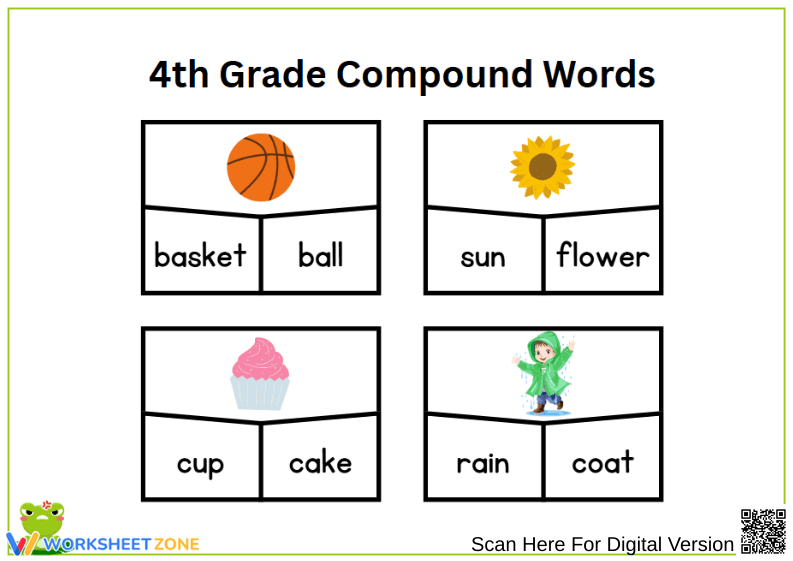

Compound Words Printable Worksheet | Grade 4 ELA
Paste this activity's link or code into your existing LMS (Google Classroom, Canvas, Teams, Schoology, Moodle, etc.).
Students can open and work on the activity right away, with no student login required.
You'll still be able to track student progress and results from your teacher account.
This Grade 4 compound words worksheet builds students' ability to identify, form, and analyze compound words through 12 structured problems, giving students direct practice with word-formation strategies tied to CCSS.ELA-LITERACY.L.4.4. Students finish with a stronger grasp of how two words combine to create new meaning.
At a Glance
- Grade: 4 · Subject: English Language Arts — Vocabulary & Language
- Standard:
CCSS.ELA-LITERACY.L.4.4— Use context clues and word parts to determine word meaning- Skill Focus: Identifying and forming compound words
- Format: 1 page · 12 problems · Answer key included · PDF
- Best For: Vocabulary centers, word-study warm-ups
- Time: 15–25 minutes
Inside, students encounter 12 problems spanning matching, combining, and identifying compound word parts. Tasks are clearly labeled, directions are student-facing, and the full answer key appears on a separate section so teachers can check work or project responses during whole-class review. No word bank is required — students draw on prior vocabulary knowledge, making this a true independent-practice tool.
Skill Progression
- Guided practice: Four problems present a completed compound word and ask students to identify both root words, with a visual split line as a scaffold.
- Supported practice: Four problems supply one root word and ask students to write a partner word that forms a valid compound, with an example provided.
- Independent practice: Four problems present two separate words and require students to combine them correctly and use the compound in a sentence, with no scaffold.
This gradual-release sequence mirrors the I Do / We Do / You Do model, allowing teachers to assign all 12 problems in one sitting or split sections across a lesson arc.
Standards Alignment
Primary standard: CCSS.ELA-LITERACY.L.4.4 — Determine or clarify the meaning of unknown and multiple-meaning words and phrases based on Grade 4 reading and content, choosing flexibly from a range of strategies including knowledge of word parts. Supporting standard CCSS.ELA-LITERACY.L.4.4.b addresses using common Greek and Latin affixes and roots as clues to meaning, reinforcing the same word-structure thinking compound-word work demands. Both standard codes can be copied directly into lesson plans, IEP goals, or district curriculum mapping tools.
How to Use It
Assign the full worksheet after direct instruction on compound words to consolidate new learning — students should complete it in 15–25 minutes independently. Alternatively, use sections 1 and 2 during instruction as guided-practice checkpoints: circulate and note which students stall on the supported-practice problems, flagging them for a small-group pull-aside. As a formative-assessment move, collect only the independent-practice section (problems 9–12) to gauge transfer without grading the full page.
Who It's For
Best suited for Grade 4 students in vocabulary or word-study rotations, including English learners who benefit from explicit morphology work. Pairs naturally with a compound-word anchor chart listing high-frequency examples (sunshine, football, raincoat) or a read-aloud that features compound-rich text. Students who finish early can be prompted to generate three original compound words not on the worksheet.
Compound-word instruction sits within the broader vocabulary-acquisition strand of CCSS.ELA-LITERACY.L.4.4, a standard that NAEP data consistently links to reading-comprehension gains in upper elementary grades. Fisher & Frey (2014) identify explicit word-part instruction — including compound analysis — as a high-leverage strategy for closing vocabulary gaps, noting that students who receive structured morphology practice outperform control peers on both decoding and meaning tasks. This one-page, 12-problem worksheet operationalizes that research: students move from recognition to production of compound words in a single session, generating evidence of skill transfer that teachers can record in lesson documentation, IEP progress notes, or vocabulary-assessment logs tied to CCSS.ELA-LITERACY.L.4.4.


