


























Views
Downloads

Printable 4th Grade Synonym Crossword Worksheet
Paste this activity's link or code into your existing LMS (Google Classroom, Canvas, Teams, Schoology, Moodle, etc.).
Students can open and work on the activity right away, with no student login required.
You'll still be able to track student progress and results from your teacher account.
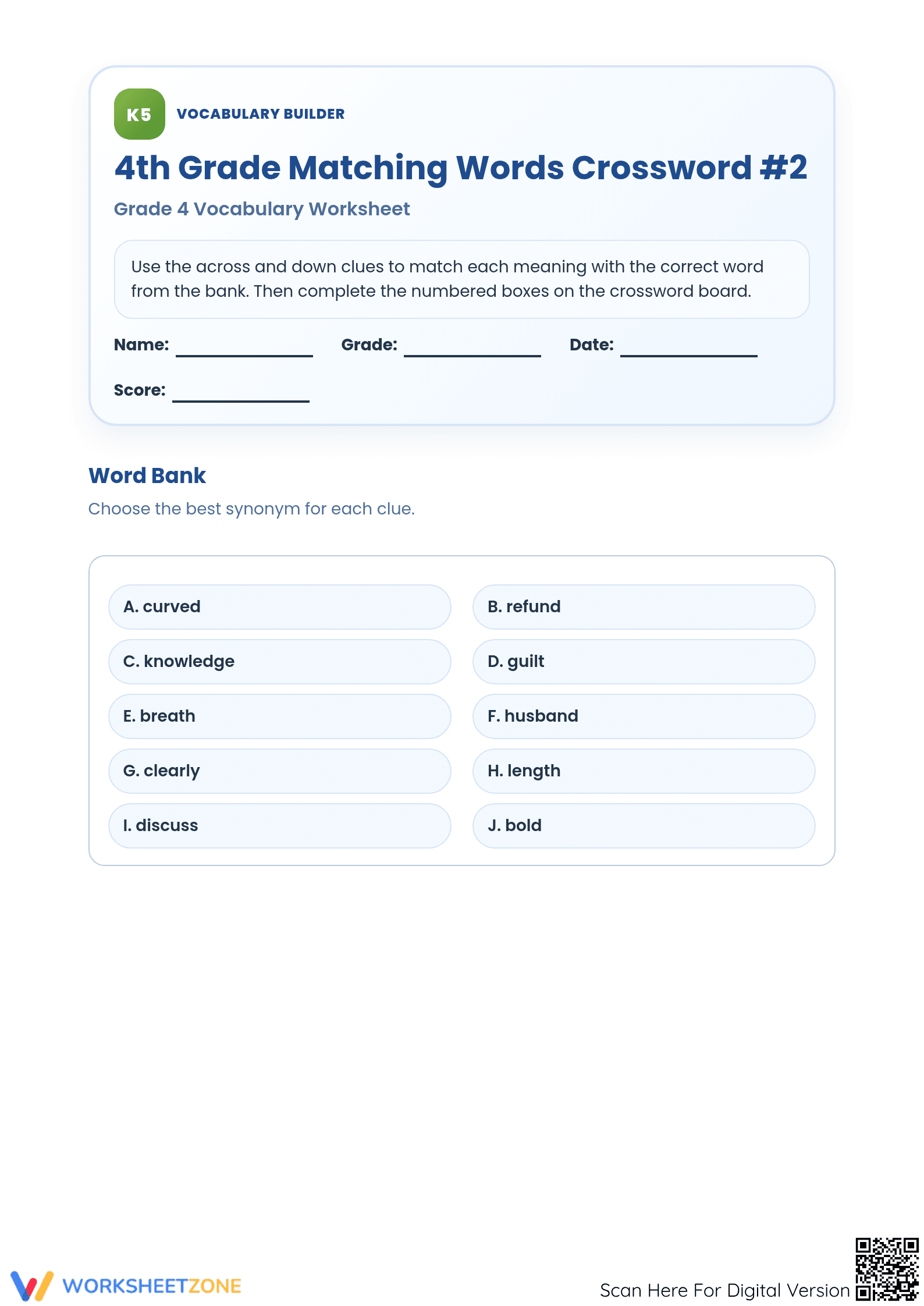
This worksheet helps fourth-grade students master lexical word classes through an engaging crossword format. By matching meanings with the correct synonyms from a provided word bank, students strengthen their verbal reasoning and expand their academic vocabulary. This resource focuses on semantic precision, ensuring learners can distinguish between similar terms effectively.
At a Glance
- Grade: 4 · Subject: ELA
- Standard:
CCSS.ELA-LITERACY.L.4.5.C— Relate words to those with similar meanings to understand synonym relationships- Skill Focus: Synonym Vocabulary Matching
- Format: 3 pages · 10 problems · Answer key included · PDF
- Best For: Vocabulary warm-up or literacy centers
- Time: 15–20 minutes
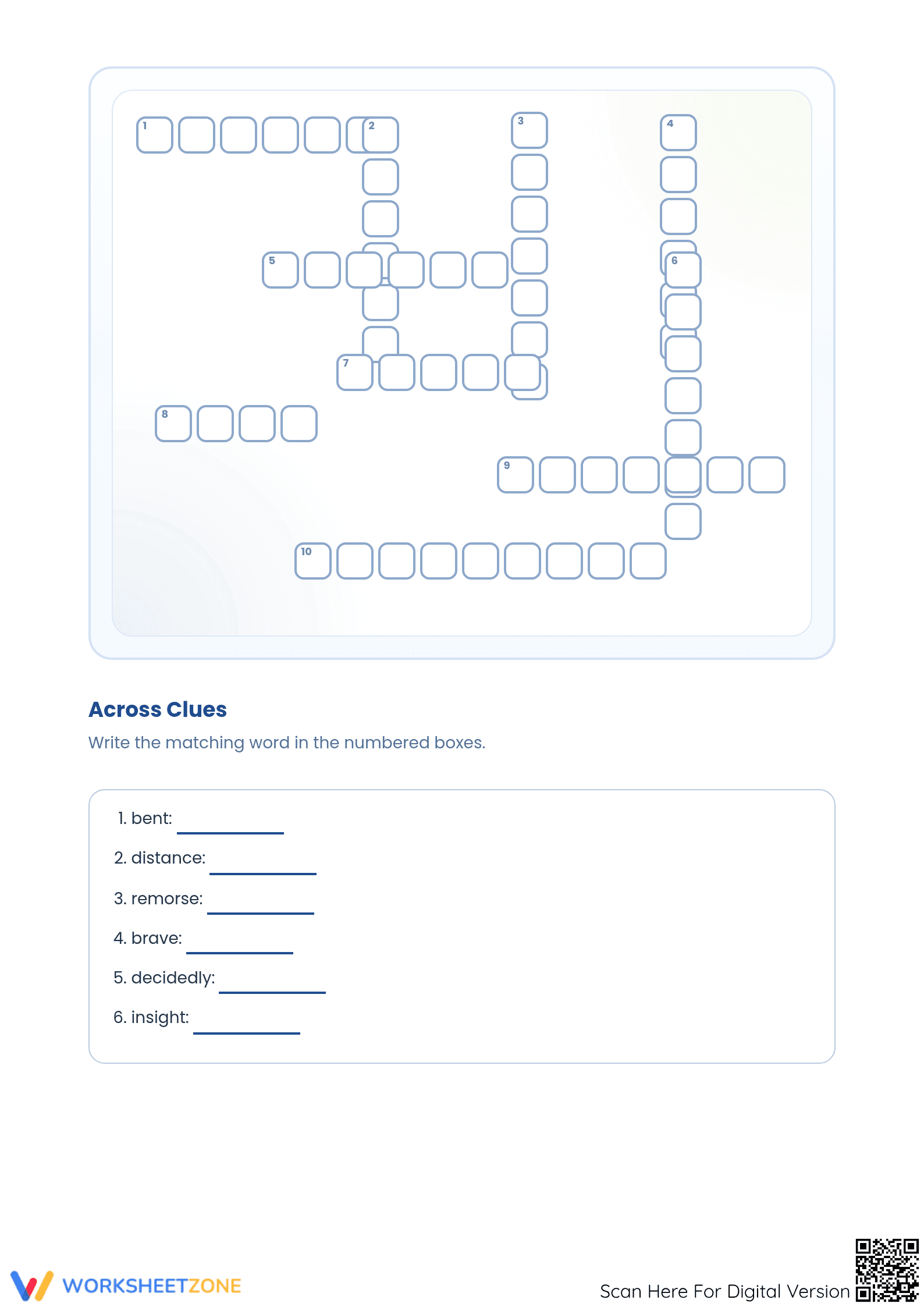
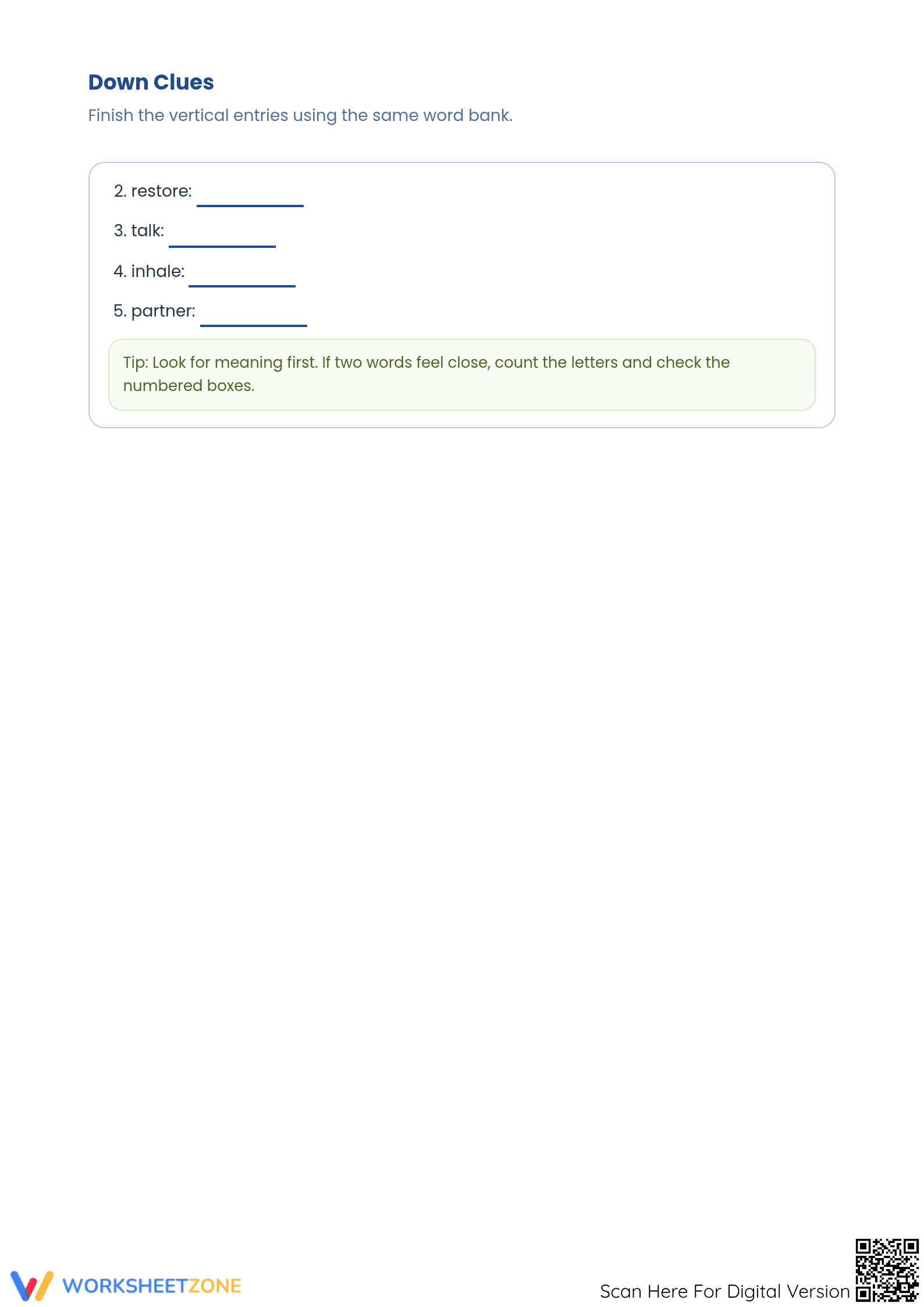
What's Inside: This three-page PDF packet features a comprehensive word bank of ten high-frequency synonyms. Students utilize a crossword grid to apply their knowledge, solving six across clues and four down clues based on concise definitions. A complete answer key is provided for immediate feedback and easy grading in any instructional setting.
Skill Progression
- Guided Practice: Students begin by reviewing the word bank, matching bold terms like "bold" or "remorse" with simple definitions to establish a baseline of understanding.
- Supported Practice: Learners use the crossword clues as scaffolds, cross-referencing letter counts and intersecting boxes to confirm their synonym choices and correct errors.
- Independent Practice: The final stage requires students to complete the entire puzzle without teacher assistance, demonstrating mastery of word relationships and lexical nuances.
This approach follows a gradual-release model, moving from identification to application.
Standards Alignment
This resource is aligned to `CCSS.ELA-LITERACY.L.4.5.C`, which requires students to demonstrate understanding of words by relating them to their opposites and to words with similar but not identical meanings. By identifying synonyms for words like "bent" and "distance," students meet core grade-level requirements for language development. Both standard codes can be copied directly into lesson plans, IEP goals, or district curriculum mapping tools.
How to Use It
Assign this crossword as a warm-up activity during your literacy block to activate prior knowledge of synonyms. During small-group instruction, use the puzzle to observe how students handle word relationships and intersecting letter clues. Expected completion time is 15 to 20 minutes for most fourth graders.
Who It's For
This resource is designed for Grade 4 general education classrooms, ESL students needing vocabulary support, and special education settings. It pairs naturally with a descriptive writing lesson where students are encouraged to replace overused words with more specific synonyms found in this crossword puzzle.
The use of crossword puzzles for synonym acquisition aligns with the research of Fisher & Frey (2014), who emphasize the importance of "word-solving" strategies in developing independent learners. By engaging with `CCSS.ELA-LITERACY.L.4.5.C`, students move beyond rote memorization to active semantic mapping. This Grade 4 worksheet leverages the power of context and intersectional cues to reinforce lexical retrieval, a critical component of reading comprehension. Recent studies in ScienceDirect TpT Analysis suggest that gamified vocabulary practice, such as matching words in a grid, significantly increases student engagement compared to traditional list-based drills. This printable resource ensures that learners encounter vocabulary in a structured yet interactive environment, fostering a deeper connection to word meanings. Teachers can rely on this aligned tool to provide high-quality practice that meets rigorous academic standards while maintaining student interest throughout the instructional cycle.


