


























Views
Downloads


4 Times Tables Worksheet | Grade 3 Printable Essential
Paste this activity's link or code into your existing LMS (Google Classroom, Canvas, Teams, Schoology, Moodle, etc.).
Students can open and work on the activity right away, with no student login required.
You'll still be able to track student progress and results from your teacher account.
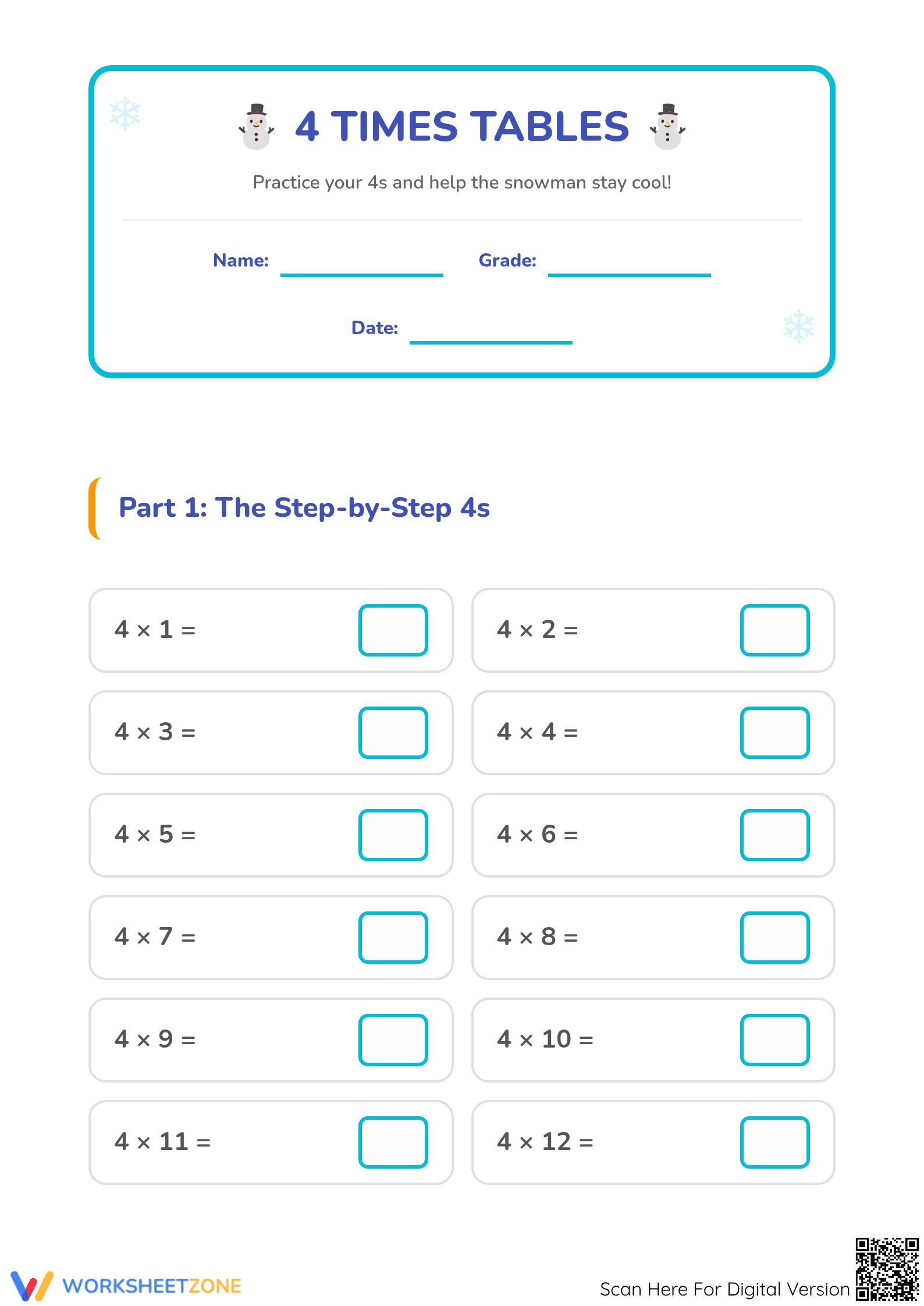
This printable 4 times tables worksheet provides Grade 3 students with a comprehensive and engaging way to master multiplication fluency. By moving from sequential practice to randomized drills and real-world word problems, learners build the cognitive pathways necessary for automaticity. It is a complete resource designed for immediate classroom integration.
At a Glance
- Grade: 3 · Subject: Math
- Standard:
CCSS.MATH.CONTENT.3.OA.C.7— Fluently multiply within 100 using strategies such as the relationship between multiplication and division- Skill Focus: 4 Times Table Fluency
- Format: 3 pages · 24 problems · Answer key included · PDF
- Best For: Winter-themed multiplication fact practice and fluency
- Time: 15–20 minutes
This resource features a logical three-part progression spread across three high-quality pages. Part one focuses on the step-by-step 4s to build initial confidence through sequential order. Part two increases the challenge with scrambled multiplication snowballs, while part three introduces winter word challenges that require students to apply their math knowledge to practical, seasonal scenarios. A full answer key is included to facilitate quick grading.
Teachers can implement this activity with less than two minutes of preparation time. Simply print the three-page PDF and distribute it to students for an immediate independent practice session. The clear instructions and snowman-themed visuals ensure students can work through the tasks without constant teacher intervention, making it an ideal choice for emergency sub plans or quiet morning work during the colder months.
The worksheet is strictly aligned to CCSS.MATH.CONTENT.3.OA.C.7, which requires students to fluently multiply and divide within 100. By the end of Grade 3, students are expected to know from memory all products of two one-digit numbers. This standard code can be copied directly into lesson plans, IEP goals, or district curriculum mapping tools to document student progress toward grade-level benchmarks.
Use this worksheet as a "Fluency Friday" challenge or as a warm-up activity during your multiplication unit. During instruction, observe how quickly students transition from the sequential page to the scrambled page; a hesitation here indicates a need for more skip counting practice. It also serves as an excellent formative assessment tool to determine which students have reached the level of automaticity required for multi-digit multiplication later in the year.
This resource is tailored for third-grade students working on multiplication mastery, though it serves as a great extension for advanced second graders. The winter theme makes it especially engaging during December and January when seasonal themes help maintain student focus. Pair it with a digital multiplication game or a physical anchor chart for a multi-modal learning experience that supports diverse learner needs.
Research from RAND AIRS 2024 emphasizes that the transition from conceptual understanding to procedural fluency is a critical juncture in elementary mathematics. For students to succeed in higher-level algebra, they must first achieve automaticity with basic multiplication facts, specifically the 4 times table, which serves as a foundation for doubling strategies and area models. This worksheet employs the scrambled practice methodology, which cognitive scientists identify as a superior way to move information from short-term to long-term memory compared to rote repetition alone. By requiring students to solve the CCSS.MATH.CONTENT.3.OA.C.7 problems in a non-linear fashion, the brain is forced to retrieve facts more deeply, reinforcing the neural pathways associated with math recall. This approach aligns with the interleaved practice effect, where mixing problem types leads to better long-term retention of multiplication facts and improved problem-solving agility in diverse mathematical contexts.


