


























Views
Downloads
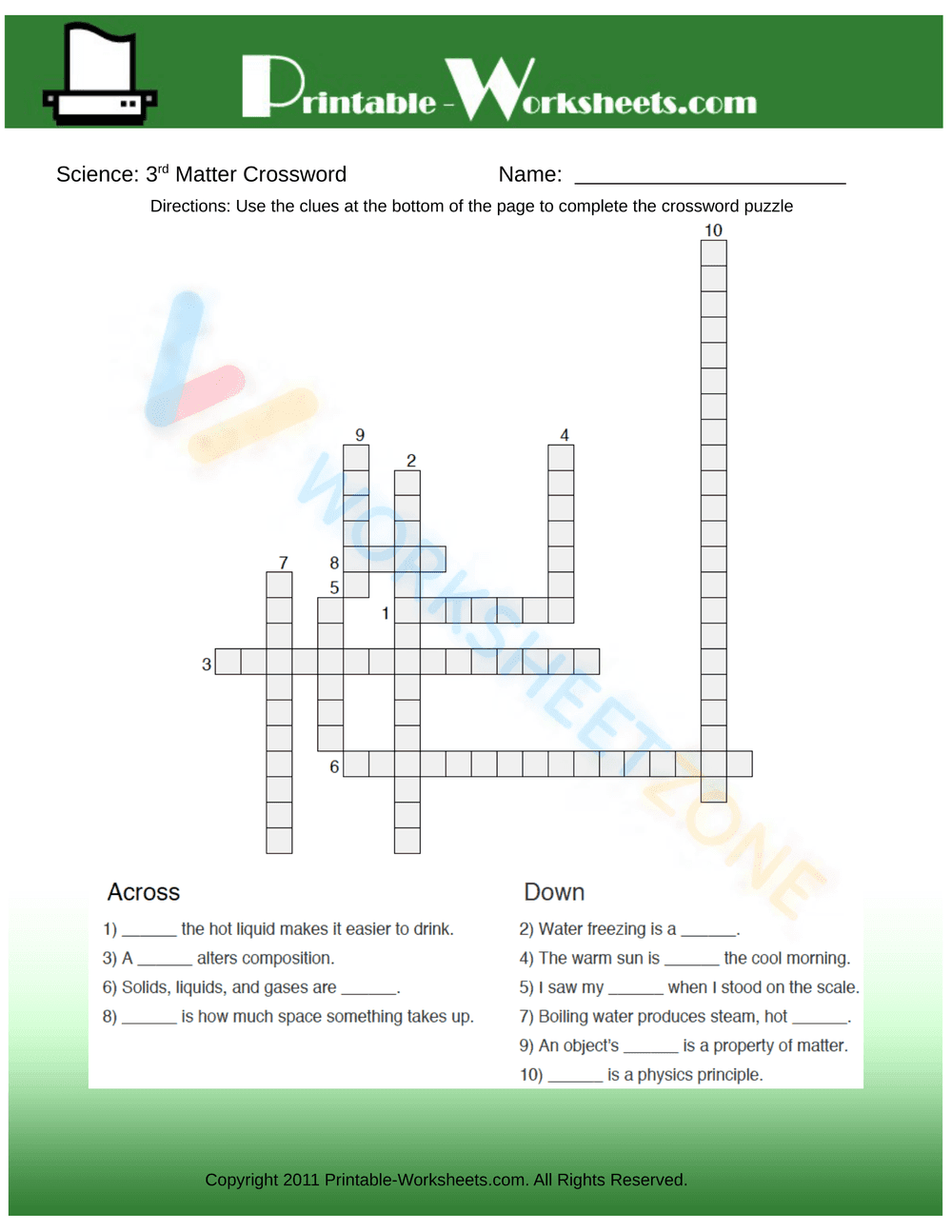

Grade 3 Matter Crossword — Printable No-Prep Worksheet
Paste this activity's link or code into your existing LMS (Google Classroom, Canvas, Teams, Schoology, Moodle, etc.).
Students can open and work on the activity right away, with no student login required.
You'll still be able to track student progress and results from your teacher account.
This Grade 3 science crossword puzzle helps students master essential vocabulary related to the properties of matter. By solving ten targeted clues about solids, liquids, gases, and physical changes, learners reinforce their understanding of foundational physical science concepts while practicing spelling and reading comprehension.
At a Glance
- Grade: 3 · Subject: Science
- Standard:
CCSS.ELA-LITERACY.L.3.6— Acquire and use domain-specific science vocabulary words- Skill Focus: Matter vocabulary and properties
- Format: 1 page · 10 problems · Answer key included · PDF
- Best For: Independent practice and review
- Time: 10–15 minutes
This single-page resource features a classic crossword puzzle layout with ten distinct clues divided into "Across" and "Down" sections. Students will read sentence-level hints that describe physical changes, states of matter, and scientific principles to determine the correct vocabulary word. The clear, distraction-free design ensures students can focus entirely on recalling and applying their science terminology. A complete answer key is provided to support quick grading or self-correction.
This worksheet is designed for immediate classroom implementation with a streamlined workflow:
- Print (1 minute): Generate copies of the single-page puzzle and the accompanying answer key.
- Distribute (1 minute): Hand out the worksheets as a warm-up, center activity, or fast-finisher task.
- Review (3 minutes): Display the answer key on the board or review the ten terms collectively to check for understanding.
With under two minutes of total teacher preparation required, this activity serves as an excellent emergency sub plan or a reliable supplement to your existing physical science unit.
This activity aligns with CCSS.ELA-LITERACY.L.3.6, requiring students to acquire and use accurately grade-appropriate conversational, general academic, and domain-specific words and phrases. By integrating science content with language arts skills, the puzzle reinforces cross-curricular literacy. Both standard codes can be copied directly into lesson plans, IEP goals, or district curriculum mapping tools.
Deploy this crossword puzzle as a formative assessment after direct instruction on the states of matter. Teachers can observe which clues students struggle to answer, indicating areas where physical science concepts may need reteaching. Alternatively, use it as an engaging morning work assignment to activate prior knowledge before a science experiment. The activity typically takes students between 10 and 15 minutes to complete, making it a highly flexible instructional tool.
This resource is ideal for third-grade students developing their academic science vocabulary. The straightforward sentence clues provide built-in context, offering natural differentiation for readers who benefit from syntactic cues. Pair this puzzle with a hands-on sorting activity or a visual anchor chart detailing solids, liquids, and gases to maximize vocabulary retention.
Mastering domain-specific terminology is a critical component of elementary science education. According to Fisher & Frey (2014), explicit vocabulary instruction combined with repeated exposure through varied formats significantly improves reading comprehension and content retention. This crossword puzzle directly supports CCSS.ELA-LITERACY.L.3.6 by requiring students to acquire and use domain-specific science vocabulary words in context. By engaging with ten targeted clues about the properties of matter, learners actively retrieve and apply academic language rather than passively memorizing definitions. This active retrieval process strengthens neural pathways associated with scientific literacy, ensuring that foundational concepts regarding solids, liquids, and gases are firmly established. Integrating structured vocabulary practice into physical science units provides students with the linguistic tools necessary to articulate their observations, formulate hypotheses, and participate meaningfully in classroom discussions.


