


























Views
Downloads

Essential Grade 3 Vocabulary Worksheet | Printable Practice
Paste this activity's link or code into your existing LMS (Google Classroom, Canvas, Teams, Schoology, Moodle, etc.).
Students can open and work on the activity right away, with no student login required.
You'll still be able to track student progress and results from your teacher account.
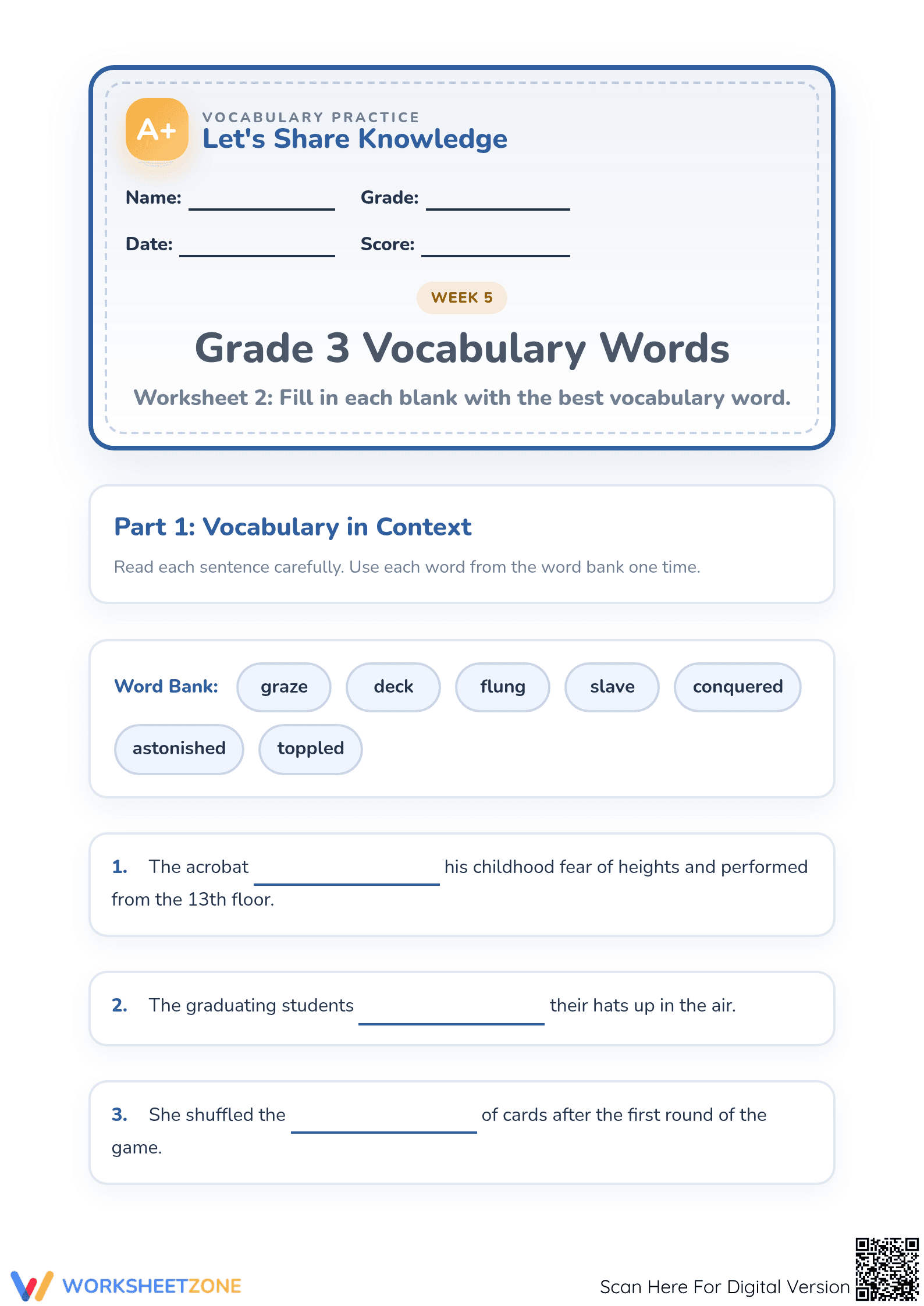
This Grade 3 vocabulary worksheet provides targeted practice for students to master academic language through context clues. By applying a word bank to specific sentence structures, learners strengthen their reading comprehension and linguistic precision. This resource ensures students can accurately select and place vocabulary words like "conquered" and "astonished" within meaningful narratives.
At a Glance
- Grade: 3 · Subject: English
- Standard:
CCSS.ELA-LITERACY.L.3.6— Acquire and use accurately grade-appropriate general academic and domain-specific words- Skill Focus: Contextual Vocabulary Usage
- Format: 3 pages · 7 problems · Answer key included · PDF
- Best For: Independent practice and morning work
- Time: 10–15 minutes
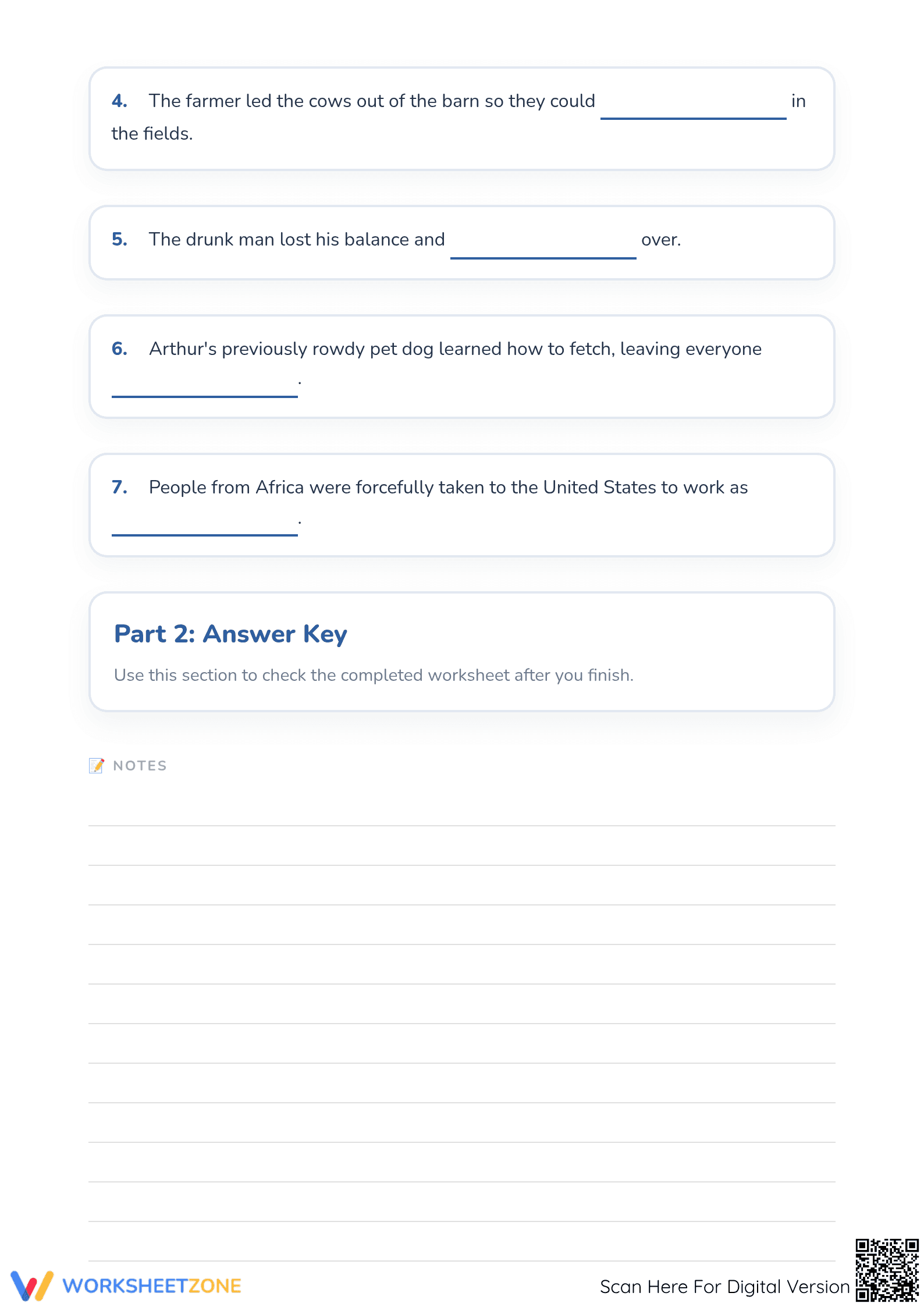
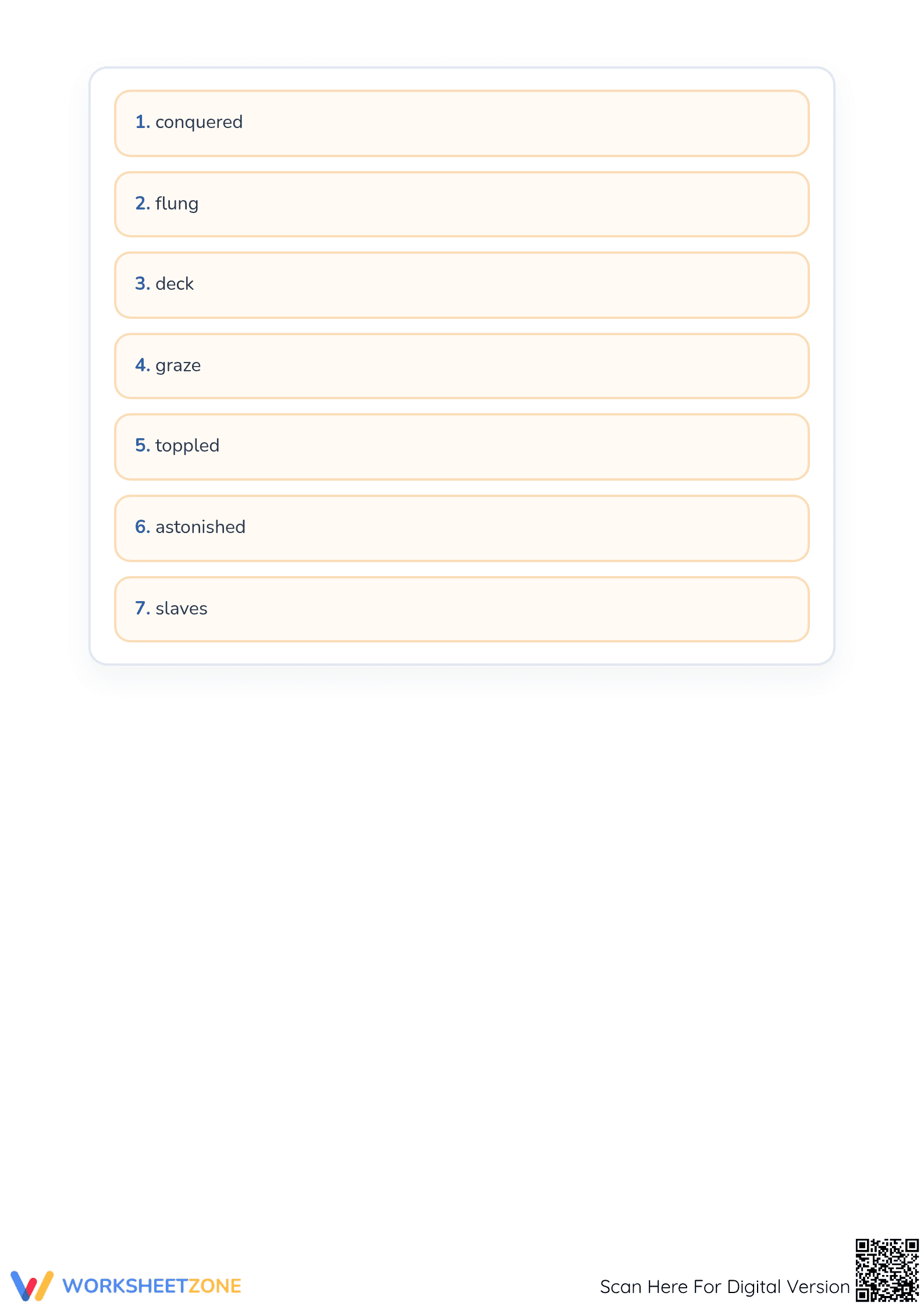
This three-page PDF includes a focused one-page student activity featuring seven fill-in-the-blank sentences. A clear word bank containing seven high-frequency academic words is provided at the top to scaffold student success. The layout includes a dedicated notes section for student reflections and a comprehensive answer key for immediate feedback or self-grading.
This resource is designed for a zero-prep classroom workflow. Step 1: Print the single-sided activity page (30 seconds). Step 2: Distribute to students as a bell-ringer or transition task (1 minute). Step 3: Review the answers using the provided key to identify common misconceptions (5 minutes). Total teacher preparation time is under two minutes, making it an ideal emergency sub plan or quick formative assessment.
The primary focus is CCSS.ELA-LITERACY.L.3.6, which requires students to "acquire and use accurately grade-appropriate conversational, general academic, and domain-specific words and phrases." By requiring students to choose the "best" word for a specific context, the worksheet also supports L.3.4.a regarding context clues. Both standard codes can be copied directly into lesson plans, IEP goals, or district curriculum mapping tools.
Use this worksheet during the independent practice phase of a lesson on context clues. It serves as an excellent formative assessment to check if students can distinguish between different parts of speech and semantic nuances. Alternatively, assign it as a homework task to reinforce weekly vocabulary lists. Completion typically takes 10 to 15 minutes depending on reading speed.
This activity is tailored for third-grade students but is also highly effective for fourth-grade students requiring Tier 2 intervention or English Language Learners (ELL) building their academic lexicon. It pairs naturally with a classroom word wall or a direct instruction lesson on synonyms and antonyms.
According to research by Fisher & Frey (2014), the gradual release of responsibility model is most effective when students are given opportunities for independent application of new vocabulary in varied contexts. This worksheet facilitates that transition by providing a structured environment where students must evaluate sentence meaning to select the correct term. The inclusion of 7 distinct tasks ensures that students encounter different syntactic structures, reinforcing the CCSS.ELA-LITERACY.L.3.6 requirement for academic word acquisition. By using a word bank, the cognitive load is managed, allowing students to focus on the semantic relationship between the word and the surrounding text. This approach aligns with evidence-based practices for literacy development, ensuring that vocabulary instruction moves beyond rote memorization into functional usage. Educators can rely on this tool to provide the necessary repetition and context-based practice required for long-term lexical retention in elementary learners.


