


























Views
Downloads


Essential Grade 3 Vocabulary Worksheet | Context & Usage
Paste this activity's link or code into your existing LMS (Google Classroom, Canvas, Teams, Schoology, Moodle, etc.).
Students can open and work on the activity right away, with no student login required.
You'll still be able to track student progress and results from your teacher account.
This Grade 3 vocabulary packet strengthens word acquisition through multi-modal practice. Students move beyond simple definitions to apply high-frequency academic terms in context, identifying synonyms and completing narrative passages. By the end of these five pages, learners demonstrate a functional grasp of descriptive adjectives and verbs essential for third-grade reading comprehension.
At a Glance
- Grade: 3 · Subject: English Language Arts
- Standard:
CCSS.ELA-LITERACY.L.3.6— Acquire and use grade-appropriate conversational, general academic, and domain-specific words- Skill Focus: Context Clues & Synonyms
- Format: 5 pages · 28 problems · Answer key included · PDF
- Best For: Independent practice or weekly vocabulary assessment
- Time: 30–45 minutes
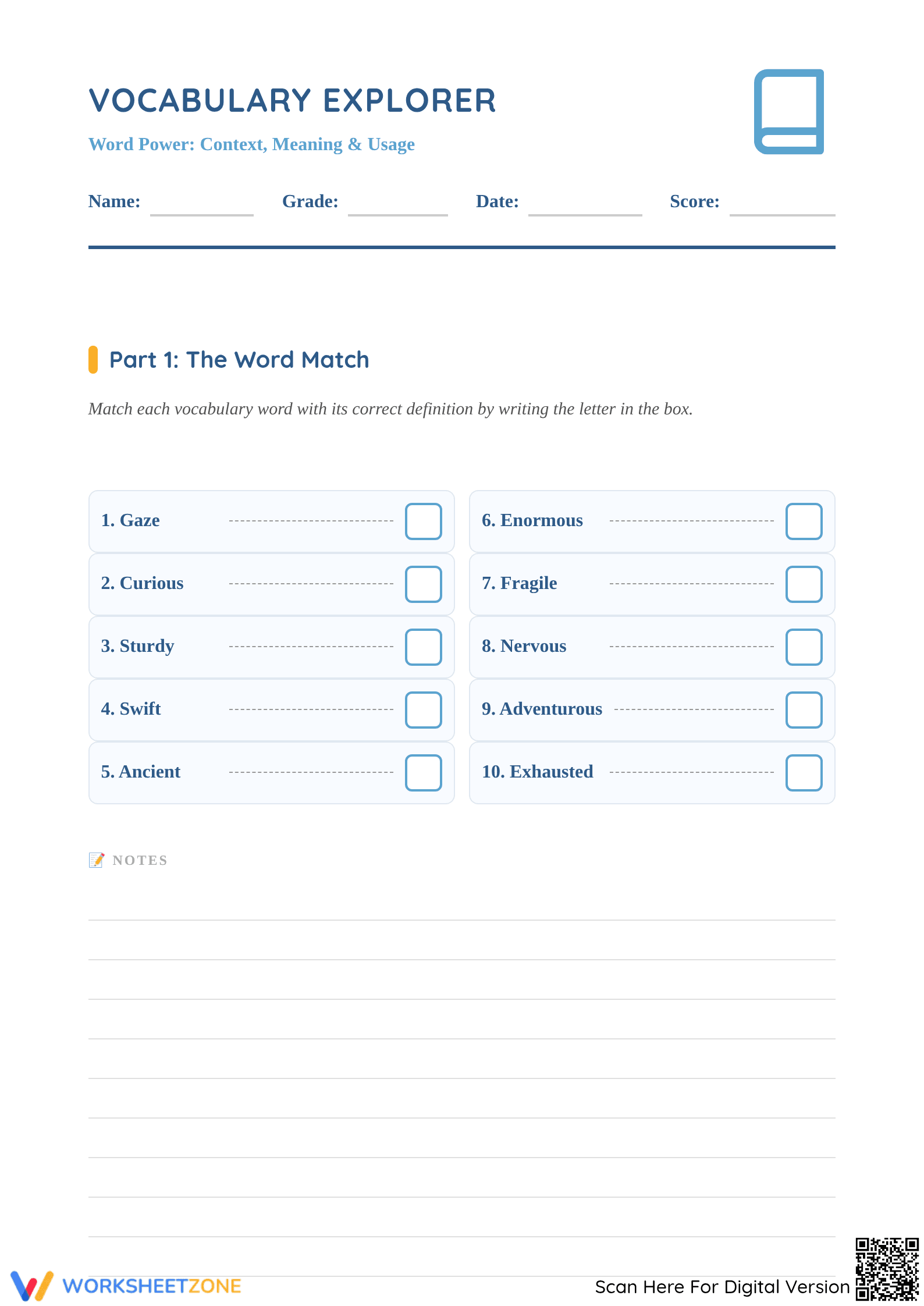
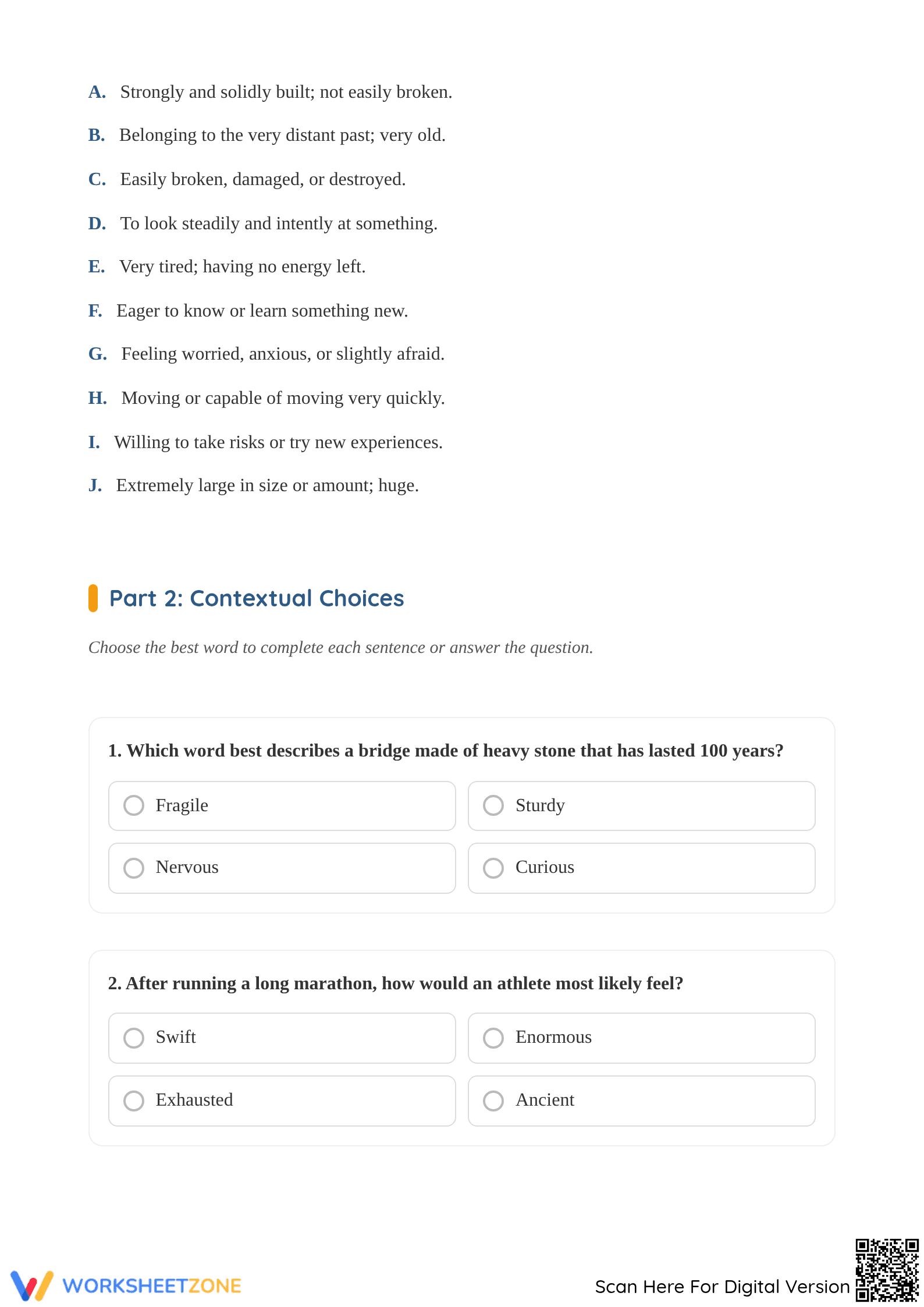
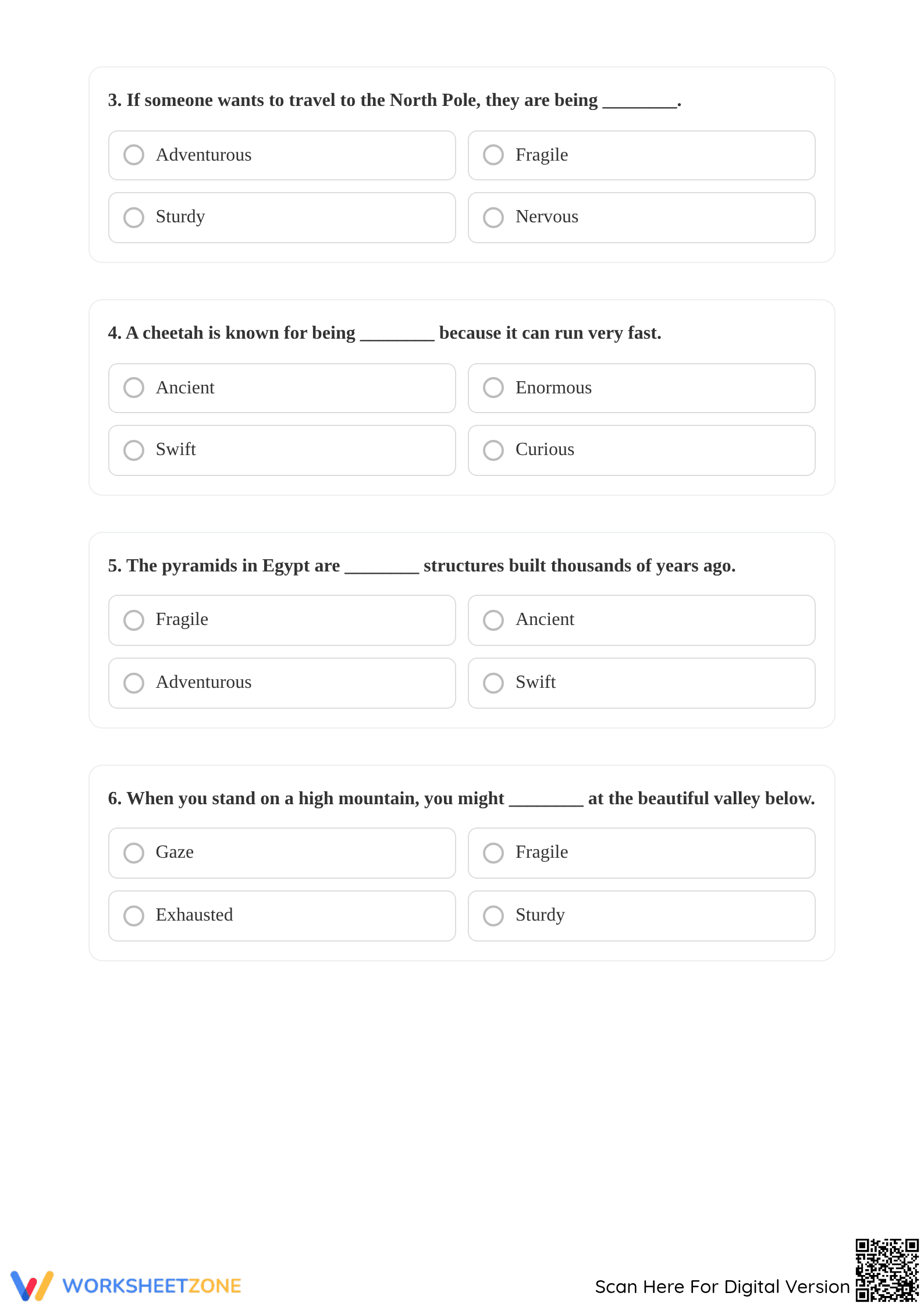
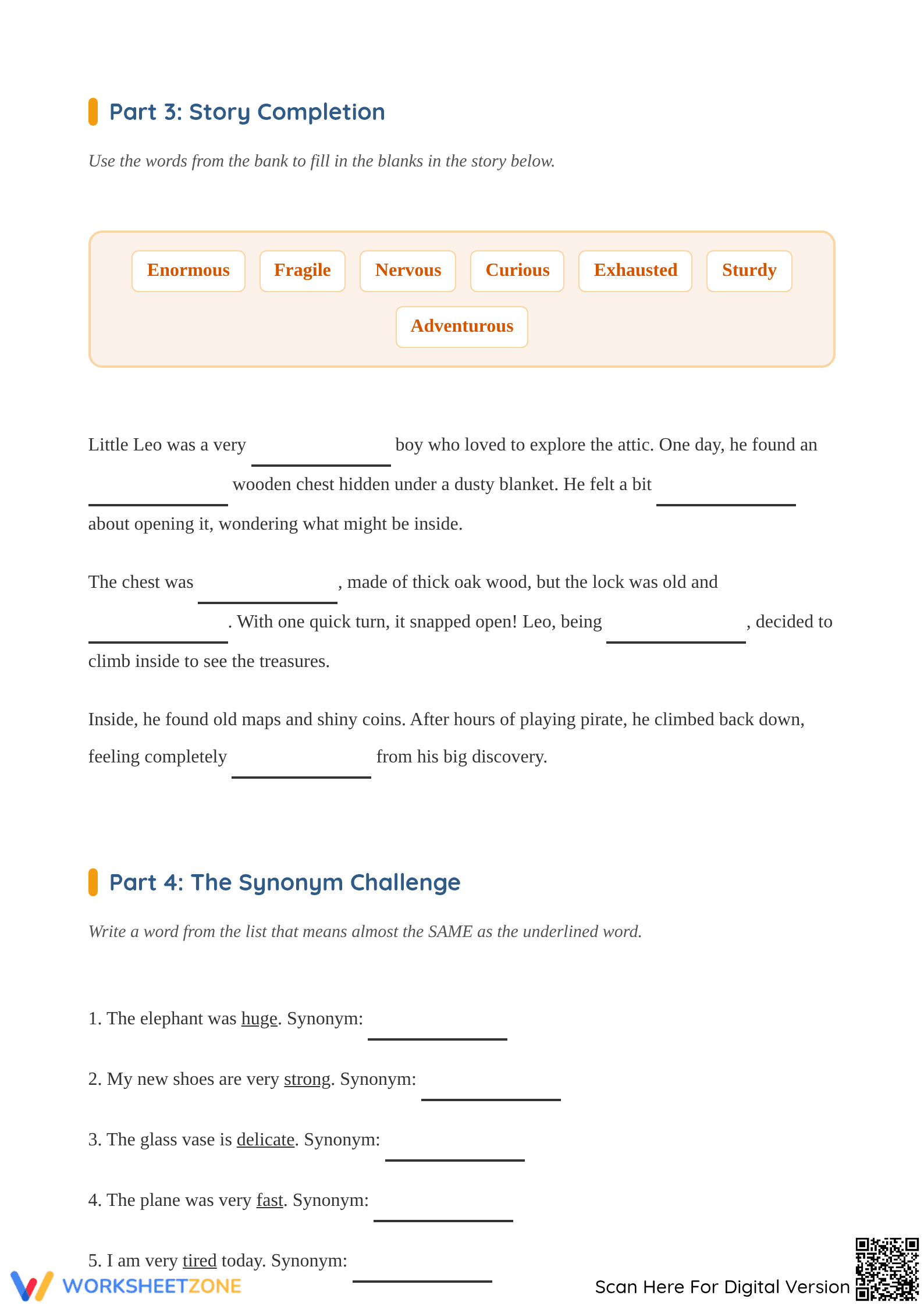
The "Vocabulary Explorer" includes four distinct sections across five printable pages. It begins with a 10-word matching exercise to establish baseline definitions. Following this, students tackle six contextual multiple-choice questions and a narrative "Story Completion" task using a word bank. The final page features a "Synonym Challenge" to reinforce word relationships. A full answer key is provided for every section.
This resource follows a zero-prep workflow designed for busy educators. First, print the five-page PDF in less than a minute. Second, distribute the packets to students for independent or small-group work. Third, use the included answer keys for rapid grading or student self-correction. This streamlined structure makes it an ideal choice for emergency sub plans or morning work when teacher prep time is limited.
This worksheet is primarily aligned with CCSS.ELA-LITERACY.L.3.6, focusing on the acquisition of academic vocabulary. It also supports CCSS.ELA-LITERACY.L.3.5.C by having students distinguish shades of meaning among related words. Both standard codes can be copied directly into lesson plans, IEP goals, or district curriculum mapping tools to ensure compliance with state frameworks.
Use this packet as a summative assessment after a unit on descriptive language. Alternatively, assign one part per day as a warm-up during your ELA block. Teachers should observe students during the "Story Completion" phase to identify if they can transfer word knowledge to narrative structures. Expected completion typically takes 35 minutes for on-grade learners working at a steady pace.
This resource is designed for third-grade students but serves as an excellent intervention tool for fourth graders needing vocabulary reinforcement. It pairs naturally with descriptive reading passages or anchor charts focused on vivid verbs. The clear layout supports English Language Learners (ELLs) by providing consistent formatting and word banks to reduce cognitive load during the acquisition process.
According to the RAND AIRS 2024 report on literacy instruction, vocabulary acquisition is most effective when students encounter new words across multiple formats, including matching, contextual application, and synonym identification. This Grade 3 worksheet implements this research-backed strategy by providing 28 distinct tasks that move from rote recognition to higher-order application. By requiring students to use words like "sturdy," "ancient," and "exhausted" within a narrative story, the resource ensures that the vocabulary becomes part of the student's active lexicon rather than just a memorized list. This approach aligns with the Fisher & Frey (2014) framework for gradual release of responsibility, where the word bank and matching tasks provide initial scaffolding before students must generate synonyms independently. Educators can use this CCSS.ELA-LITERACY.L.3.6 aligned tool to provide the high-dosage practice necessary for closing achievement gaps in reading comprehension and expressive language.


