


























Views
Downloads

Grade 3 Vocabulary Context Clues | Essential Practice
Paste this activity's link or code into your existing LMS (Google Classroom, Canvas, Teams, Schoology, Moodle, etc.).
Students can open and work on the activity right away, with no student login required.
You'll still be able to track student progress and results from your teacher account.
This Grade 3 vocabulary worksheet provides targeted practice in using context clues to determine the correct word for a given sentence. By analyzing surrounding text, students develop the critical thinking skills necessary to expand their lexicon and improve reading fluency. This resource ensures students can apply new terminology in meaningful ways.
At a Glance
- Grade: 3 · Subject: English
- Standard:
CCSS.ELA-LITERACY.L.3.4.A— Use sentence-level context as a clue to the meaning of a word- Skill Focus: Context Clues & Vocabulary
- Format: 3 pages · 7 problems · Answer key included · PDF
- Best For: Independent practice or morning work
- Time: 10–15 minutes
What's Inside
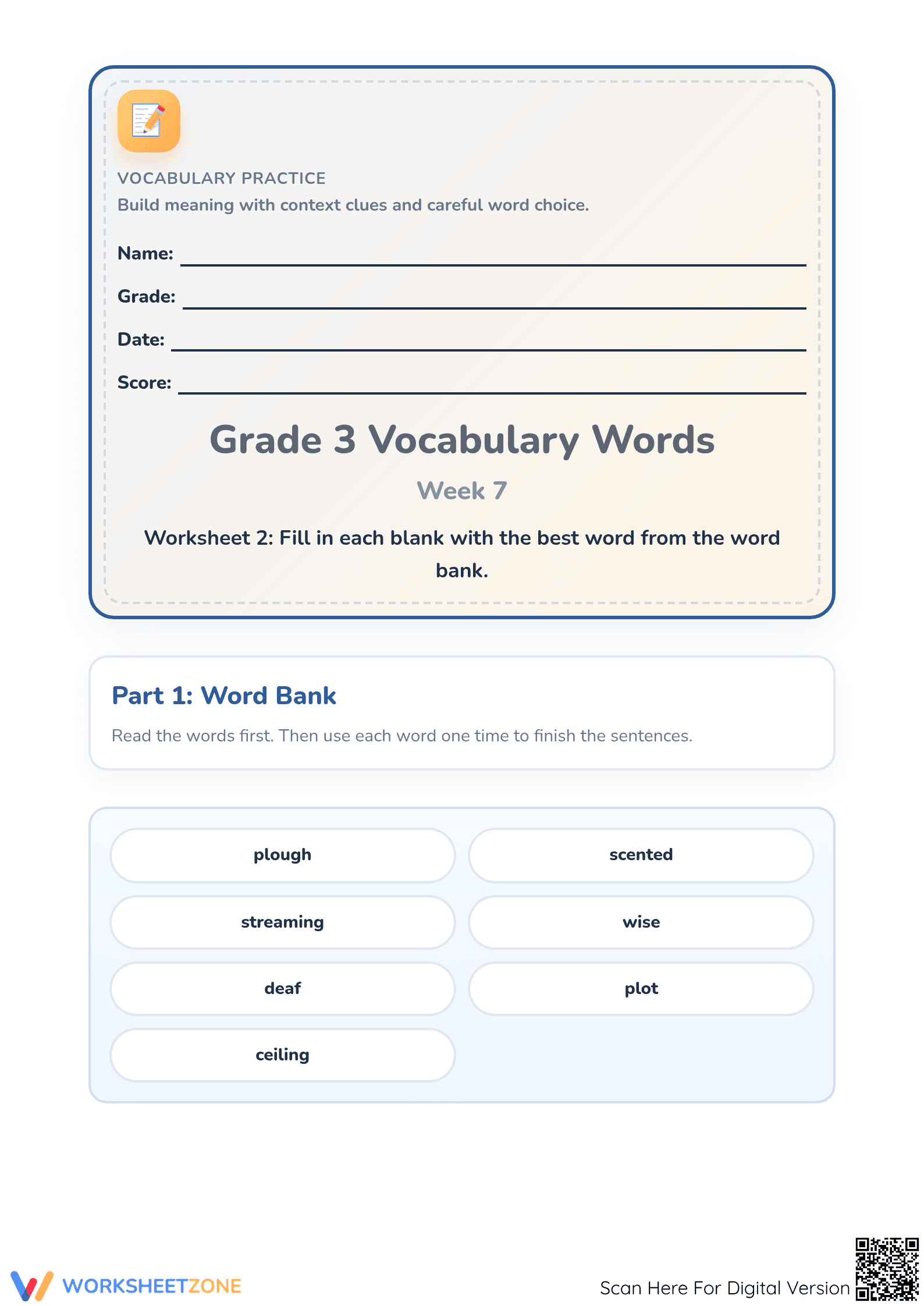
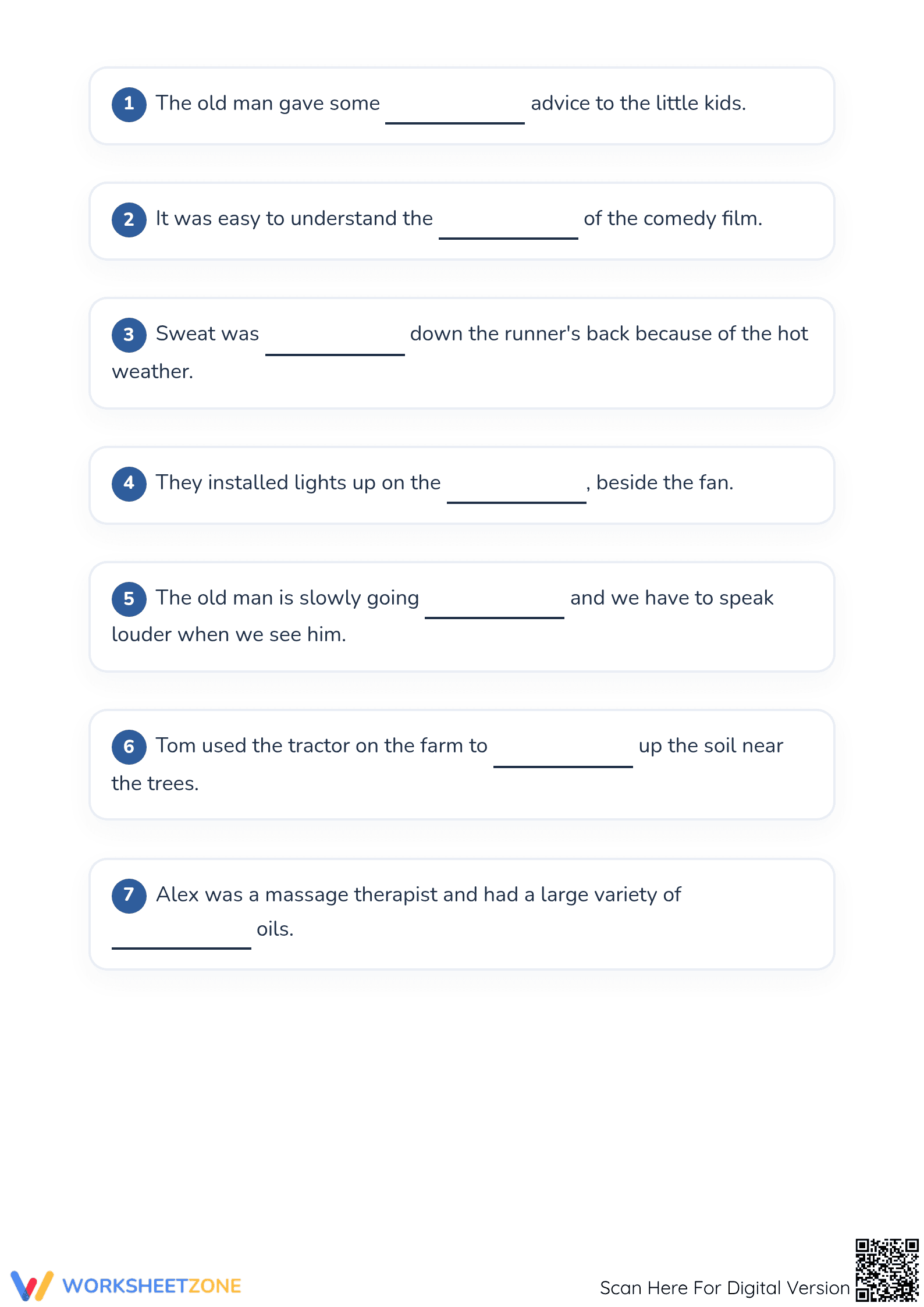
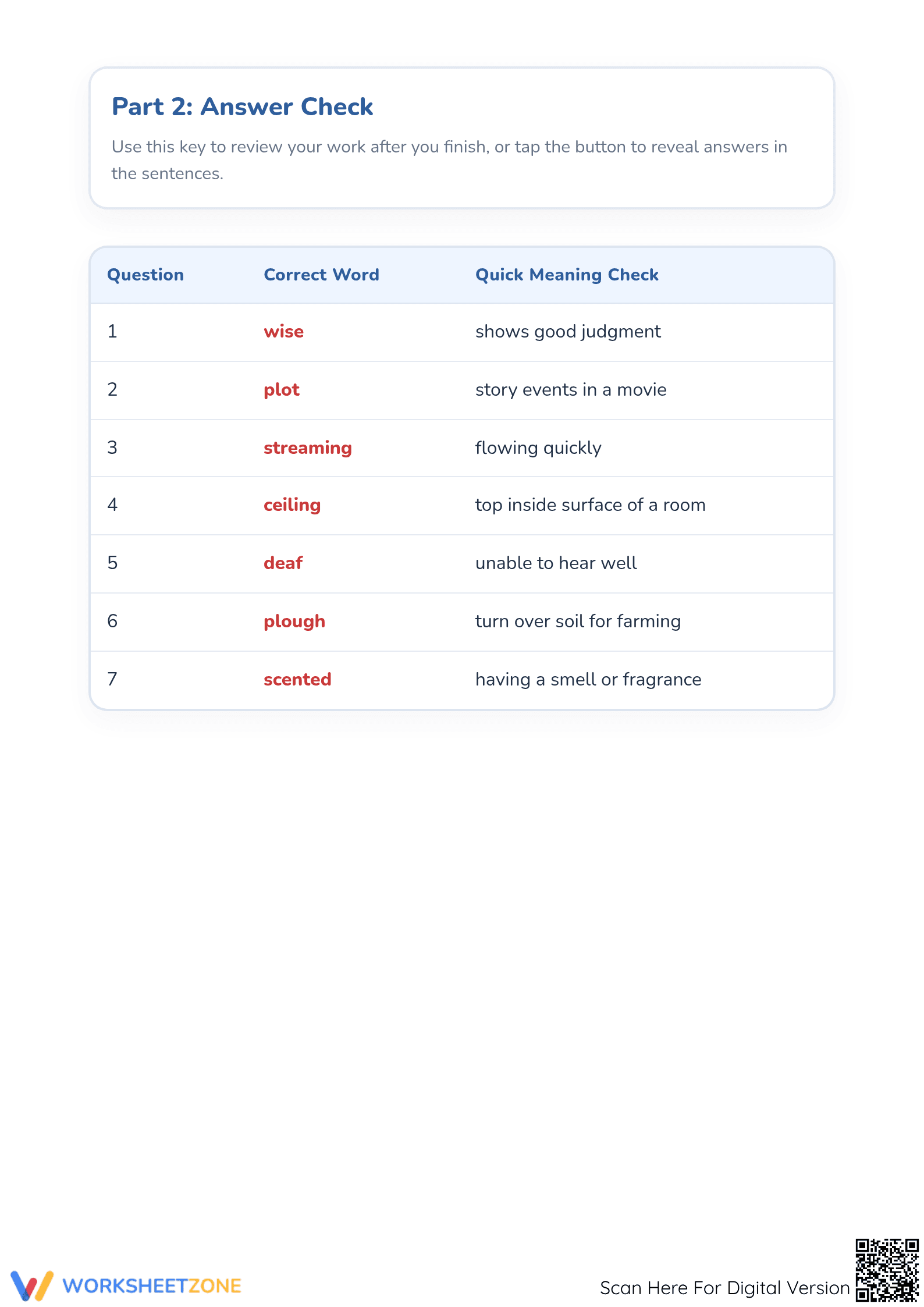
The packet contains a structured three-page layout designed for clarity. Page one introduces a word bank featuring seven tier-two vocabulary words such as "plough," "scented," and "streaming." Page two presents seven unique sentences with blanks, requiring students to evaluate the context to select the appropriate word. The final page is a comprehensive answer key that includes a "Quick Meaning Check" for every term.
Zero-Prep Workflow
This resource is designed for immediate implementation with three simple steps. First, print the PDF pages (less than 1 minute). Second, distribute the worksheet to students for independent or paired completion (approximately 12 minutes). Third, use the provided answer key to review responses as a class or for rapid individual grading (under 2 minutes). It is an ideal solution for substitute teacher folders or daily warm-up routines.
Standards Alignment
This worksheet aligns directly with `CCSS.ELA-LITERACY.L.3.4.A`, which requires students to use sentence-level context as a clue to the meaning of a word or phrase. It also supports general language acquisition goals by introducing varied parts of speech in functional settings. Both standard codes can be copied directly into lesson plans, IEP goals, or district curriculum mapping tools.
How to Use It
Assign this worksheet during the "independent practice" phase of a lesson on context clues. It works exceptionally well as a formative assessment to check if students can distinguish between similar-sounding words or apply definitions to real-world scenarios. Teachers should observe if students are looking for specific keywords in the sentences, such as "tractor" or "massage therapist," to inform their word choices. Completion typically takes 10 to 15 minutes.
Who It's For
This resource is tailored for third-grade students but serves as an excellent review for fourth graders or a challenge for advanced second graders. It is particularly beneficial for English Language Learners (ELL) who need scaffolded practice with sentence structures. Pair this worksheet with a vocabulary anchor chart or a short reading passage to reinforce the week's word list.
Research from the RAND AIRS 2024 report indicates that explicit vocabulary instruction combined with context-clue practice significantly improves reading comprehension in elementary learners. This worksheet targets CCSS.ELA-LITERACY.L.3.4.A by requiring students to synthesize sentence-level information to select the correct tier-two word. By engaging with words like "plough" and "scented" in varied contexts, students move beyond rote memorization toward functional literacy. The inclusion of a "Quick Meaning Check" in the answer key provides immediate feedback, a critical component of the gradual release of responsibility model. Such structured practice is essential for closing the achievement gap in early literacy, as noted in recent NAEP data regarding vocabulary acquisition. This resource serves as a high-utility tool for teachers seeking to integrate rigorous language standards into daily routines without increasing administrative burden.


