




























Views
Downloads

Grade 2 3D Shapes Properties — Printable No-Prep Worksheet

Paste this activity's link or code into your existing LMS (Google Classroom, Canvas, Teams, Schoology, Moodle, etc.).
Students can open and work on the activity right away, with no student login required.
You'll still be able to track student progress and results from your teacher account.
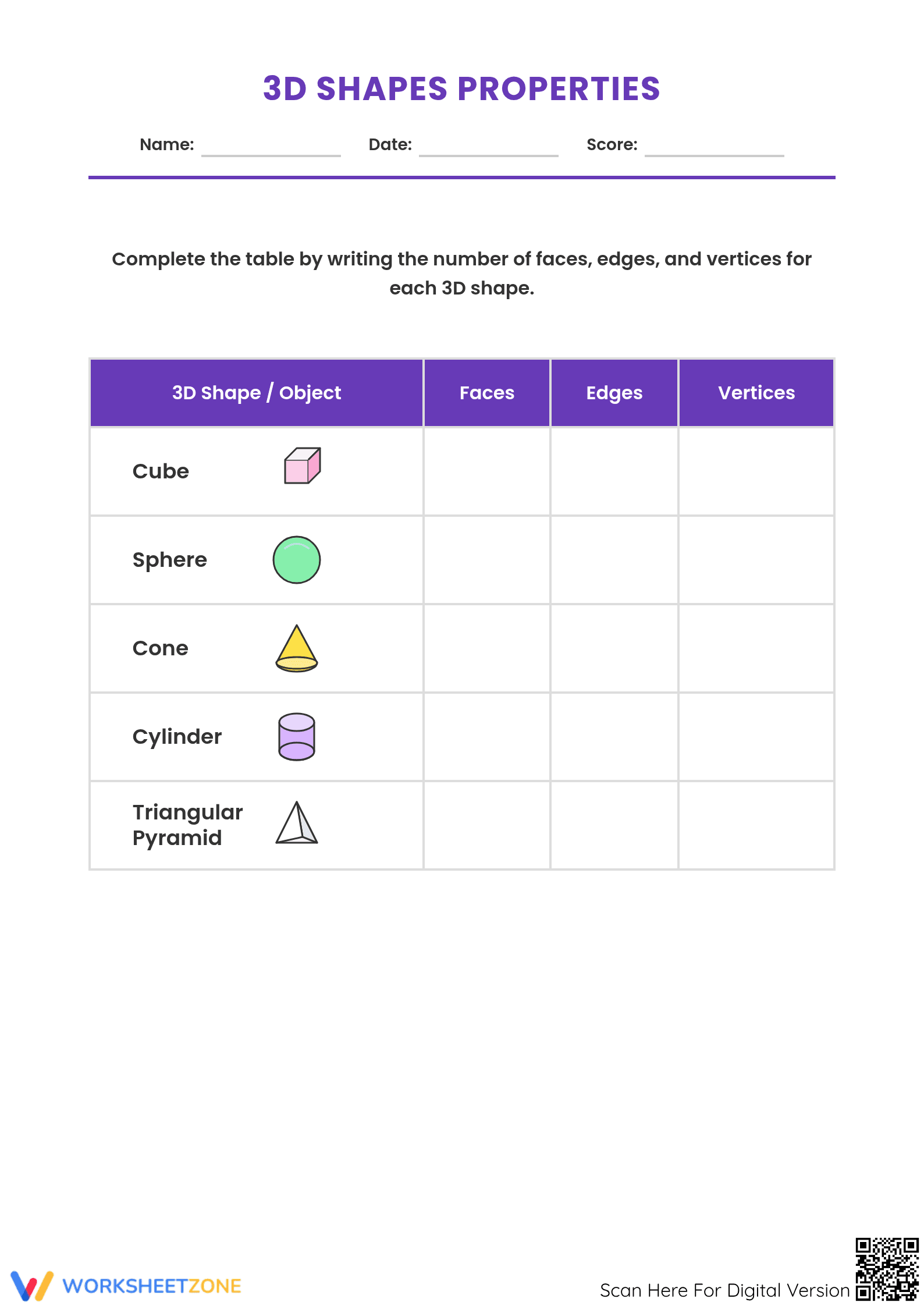
This Grade 2 Math worksheet provides focused practice on identifying the properties of 3D shapes. Students will reinforce their understanding of faces, edges, and vertices for common geometric solids, building essential foundational geometry skills through a straightforward, engaging activity.
At a Glance
- Grade: 2 · Subject: Math
- Standard:
CCSS.MATH.CONTENT.2.G.A.1— Identify the number of faces, edges, and vertices on 3D shapes.- Skill Focus: 3D shapes properties
- Format: 1 page · 15 problems · Answer key included · PDF
- Best For: Quick practice, homework, sub plans, exit tickets
- Time: 10–15 minutes
Inside this one-page worksheet, students find a clear table featuring five distinct 3D shapes: cube, sphere, cone, cylinder, and triangular pyramid. For each, students record the number of faces, edges, and vertices. An answer key is provided on a separate page for quick, easy grading.
A Zero-Prep Workflow
This worksheet is designed for ultimate classroom efficiency with a simple, three-step workflow:
- Print: Easily print class copies in under 30 seconds.
- Distribute: Hand out to students for immediate use.
- Review: Use the included answer key for fast and simple checking.
The total teacher preparation time is under two minutes, making this an ideal resource for busy educators, substitute teachers, or any time a reliable, self-contained activity is needed.
Standards Alignment
This worksheet directly aligns with CCSS.MATH.CONTENT.2.G.A.1, which states that students will “Recognize and draw shapes having specified attributes, such as a given number of angles or a given number of faces. Identify triangles, quadrilaterals, pentagons, hexagons, and cubes.” This activity specifically targets the identification of 3D shape properties (faces, edges, vertices), a key component of foundational geometric reasoning. The standard code can be copied directly into lesson plans, IEP goals, or district curriculum mapping tools.
How to Use It
Utilize this worksheet as a quick warm-up to activate prior knowledge before a geometry lesson, or use it as an effective exit ticket to gauge comprehension after direct instruction. During the activity, observe students for common misconceptions, such as confusing edges with faces or miscounting vertices on more complex shapes. The typical completion time is 10–15 minutes, allowing for immediate feedback and classroom discussion.
Who It's For
This resource is perfectly suited for Grade 2 students developing their understanding of basic geometric solids. It also serves as an excellent review for Grade 3 and Grade 4 learners who may need to revisit these fundamental concepts. The clear visuals support diverse learners, including English Language Learners. For a more hands-on approach, pair this activity with physical 3D shape manipulatives, allowing students to physically touch and count each property.
Understanding the distinct properties of 3D shapes—such as faces, edges, and vertices—is a fundamental building block in elementary geometry. This foundational knowledge, aligned with CCSS.MATH.CONTENT.2.G.A.1, is critical for developing spatial reasoning and more complex mathematical concepts, as highlighted by educational research. According to Fisher & Frey (2014), explicit instruction and structured practice in identifying object attributes are essential for deepening comprehension and supporting long-term retention of mathematical vocabulary. Worksheets providing targeted practice like this one help bridge abstract geometric concepts with concrete examples, ensuring students can recognize and accurately articulate the components of 3D figures and reinforcing crucial early geometry benchmarks.


