


























Views
Downloads

Essential 3D Shapes Revision Worksheet | Grade 2-3
Paste this activity's link or code into your existing LMS (Google Classroom, Canvas, Teams, Schoology, Moodle, etc.).
Students can open and work on the activity right away, with no student login required.
You'll still be able to track student progress and results from your teacher account.
This comprehensive 3D shapes revision worksheet helps elementary students master the identification and properties of three-dimensional figures. By connecting geometric concepts to real-world objects, learners build a solid foundation in spatial reasoning. Students will identify shapes, calculate attributes like vertices and edges, and apply their knowledge to everyday items.
At a Glance
- Grade: 2-3 · Subject: Math / Geometry
- Standard:
CCSS.MATH.CONTENT.2.G.A.1— Recognize and describe shapes by their specific attributes like faces and vertices- Skill Focus: 3D Shape Identification & Properties
- Format: 2 pages · 20 problems · Answer key included · PDF
- Best For: End-of-unit review or quick assessment
- Time: 15–25 minutes
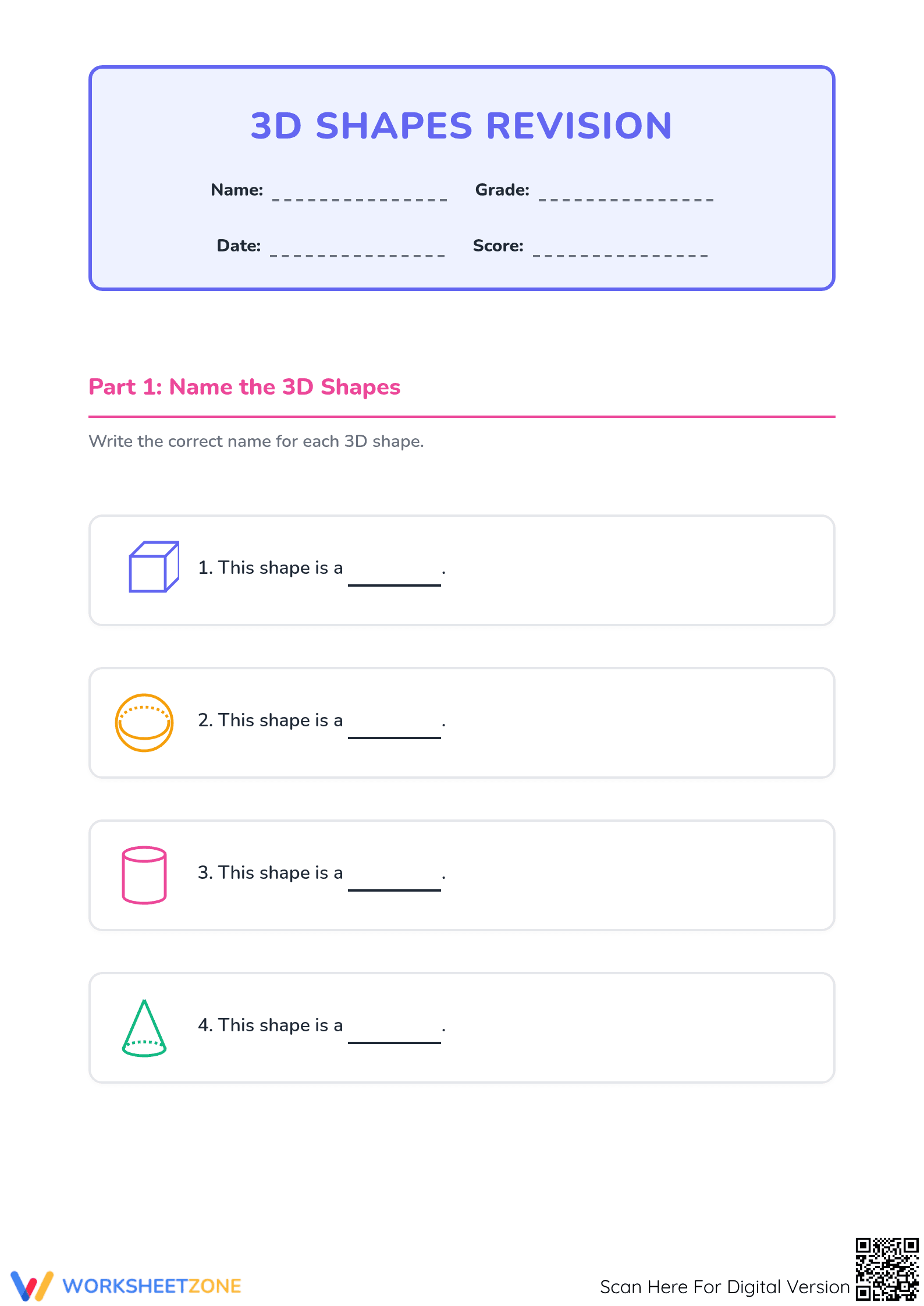
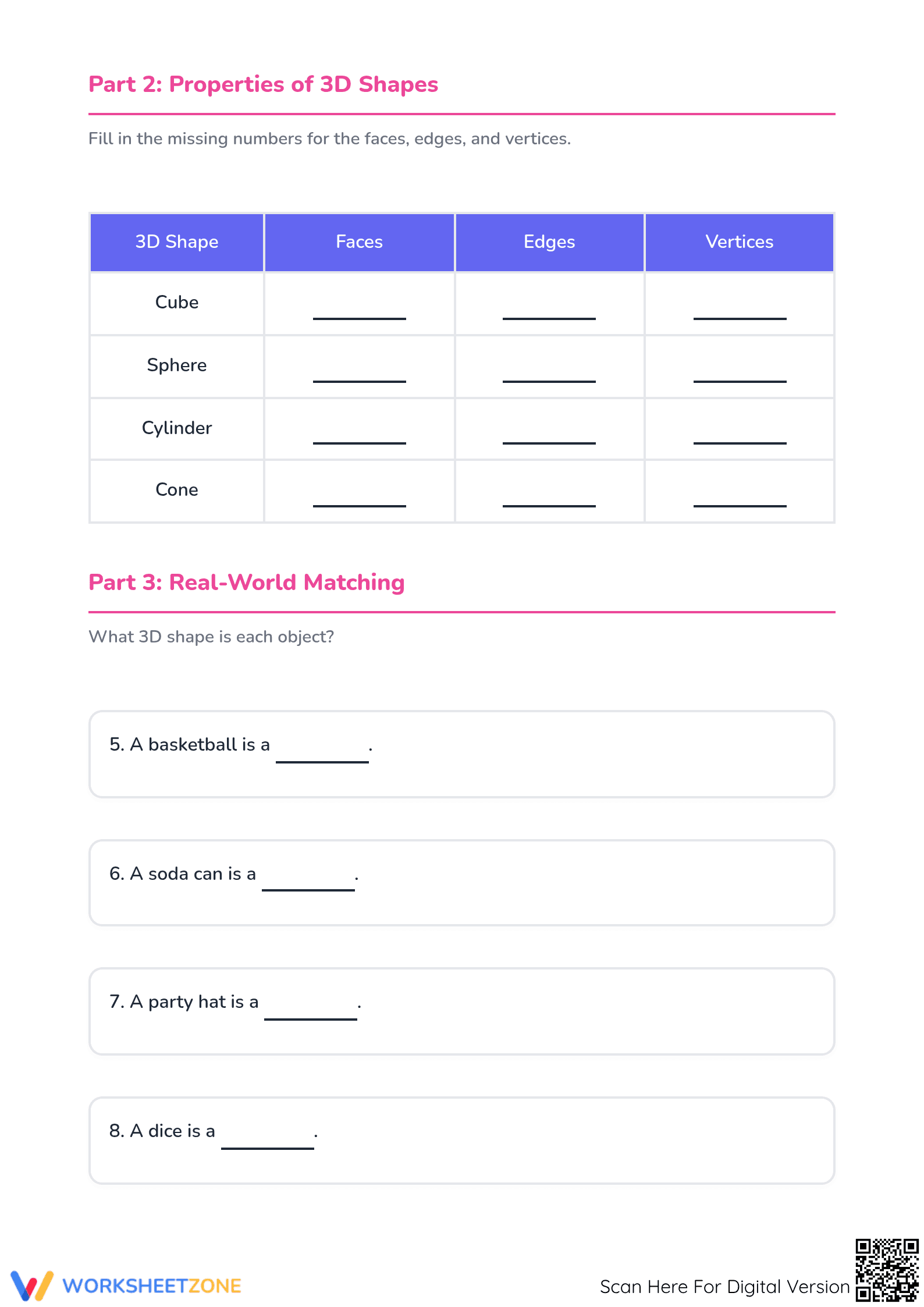
This two-page PDF resource features three distinct sections designed for a thorough review. Page one focuses on visual identification with four naming tasks. Page two includes a detailed property table for recording faces, edges, and vertices, followed by a real-world matching section. The layout is clean and includes a full answer key for rapid grading.
The zero-prep workflow for this resource is designed for maximum efficiency. First, print the two-page document (30 seconds). Next, distribute the sheets to your students for independent or partner work (1 minute). Finally, use the provided answer key to review responses as a whole class or for individual grading (under 1 minute). Total teacher preparation time is less than two minutes.
This worksheet is primarily aligned with CCSS.MATH.CONTENT.2.G.A.1, which requires students to recognize and draw shapes having specified attributes, such as a given number of faces. It also supports third-grade geometry standards by reinforcing the classification of shapes based on their properties. Both standard codes can be copied directly into lesson plans, IEP goals, or district curriculum mapping tools.
Use this worksheet as a summative assessment after completing a unit on solid geometry. It is also an excellent tool for a "Do Now" activity to gauge prior knowledge before starting more complex volume or surface area concepts. During the activity, observe if students can distinguish between edges and vertices, which serves as a vital formative assessment data point.
This resource is ideal for general education students in grades 2 through 4, as well as English Language Learners who benefit from the visual cues and real-world connections. It pairs naturally with physical manipulatives like wooden geometric solids or an anchor chart displaying shape names and their corresponding attributes.
Research from EdReports 2024 emphasizes that high-quality geometry instruction must bridge the gap between abstract mathematical definitions and concrete physical representations. This worksheet addresses that need by requiring students to map the properties of a cylinder or sphere to common household items like soda cans and basketballs. By focusing on CCSS.MATH.CONTENT.2.G.A.1, the material ensures that students develop the precise vocabulary—specifically faces, edges, and vertices—necessary for later success in higher-level spatial reasoning and measurement. Studies in the NAEP framework suggest that early mastery of 3D attributes is a significant predictor of future achievement in STEM fields. This resource provides the structured practice required to move students from basic recognition to attribute-based classification. The inclusion of 20 distinct tasks ensures sufficient repetition for retention without overwhelming the learner, making it a reliable tool for classroom teachers seeking evidence-based practice materials.


