




























Views
Downloads

Higher Order Thinking Guide | Essential Grade 9-12 ELA

Paste this activity's link or code into your existing LMS (Google Classroom, Canvas, Teams, Schoology, Moodle, etc.).
Students can open and work on the activity right away, with no student login required.
You'll still be able to track student progress and results from your teacher account.
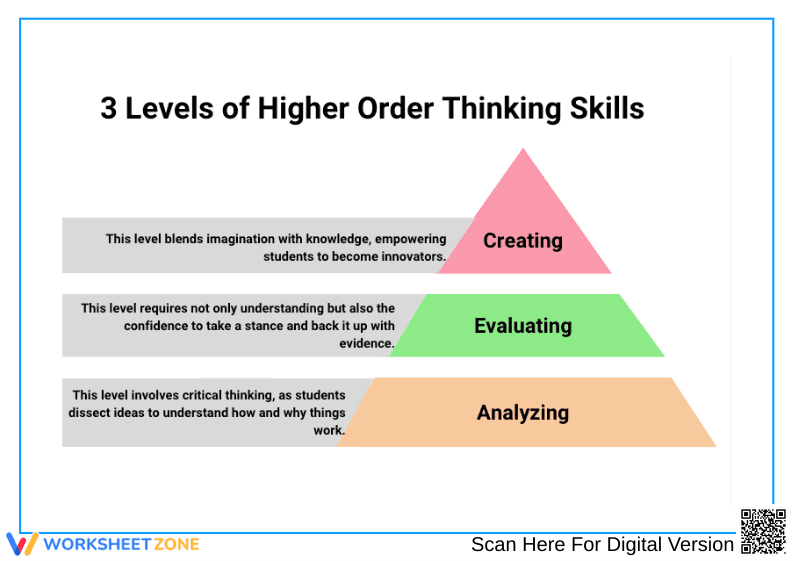
This Grade 9-12 higher order thinking skills guide provides students with a clear visual framework for mastering complex cognitive tasks. By defining the top three tiers of Bloom's Taxonomy—analyzing, evaluating, and creating—this resource empowers learners to move beyond basic recall toward sophisticated evidence-based argumentation and innovative problem-solving in their academic writing.
At a Glance
- Grade: 9-12 · Subject: ELA / Critical Thinking
- Standard:
CCSS.ELA-LITERACY.W.11-12.1— Write arguments to support claims in an analysis of substantive topics or texts- Skill Focus: Higher Order Thinking (HOTS)
- Format: 1 page · Reference Guide · No answer key needed · PDF
- Best For: Anchor charts and essay planning
- Time: 5–10 minutes
This single-page reference sheet features a high-contrast pyramid graphic that breaks down the three most advanced cognitive domains. Each level includes a concise definition that links specific mental actions to student outcomes. The layout uses color-coded tiers to distinguish between dissecting ideas, defending stances with evidence, and synthesizing new concepts into original work.
Zero-Prep Workflow
Teachers can integrate this resource into their daily routine in under two minutes. First, print the PDF for individual student folders or display it on a digital whiteboard. Second, distribute the guide during the brainstorming phase of a writing assignment to prompt deeper inquiry. Finally, refer to the specific pyramid tiers during peer review sessions to ensure students are operating at the appropriate cognitive depth.
Standards Alignment
This resource aligns with `CCSS.ELA-LITERACY.W.11-12.1`, which requires students to write arguments to support claims in an analysis of substantive topics or texts, using valid reasoning and relevant evidence. By explicitly defining the "Evaluating" and "Analyzing" stages, the guide helps students meet the rigorous demands of high school composition. Both standard codes can be copied directly into lesson plans, IEP goals, or district curriculum mapping tools.
How to Use It
Use this guide during the pre-writing phase of a literary analysis essay to help students move from summary to evaluation. Teachers can facilitate a formative assessment by asking students to point to the pyramid level their current thesis statement occupies. This visual aid ensures students remain focused on higher-level synthesis rather than simple plot summary during independent work time.
Who It's For
This guide is designed for high school students in Grades 9-12, particularly those in AP English or college-preparatory tracks. It provides essential support for English Language Learners by providing clear representations of abstract academic concepts. Pair this resource with a graphic organizer for argumentative writing to maximize its instructional impact during direct instruction or small group workshops.
The integration of higher order thinking skills (HOTS) is a cornerstone of modern secondary education, as evidenced by the Fisher & Frey (2014) framework for intentional interest and cognitive rigor. Research indicates that when students explicitly understand the hierarchy of cognitive tasks—moving from the dissection of information to the creation of original work—they demonstrate significantly higher levels of metacognitive awareness and academic persistence. This Grade 9-12 guide operationalizes CCSS.ELA-LITERACY.W.11-12.1 by providing a visual roadmap for these complex processes. By standardizing the language of "Analyzing, Evaluating, and Creating," educators can provide consistent feedback that targets specific cognitive gaps. Standalone use of such anchor charts has been shown to improve student self-regulation during independent writing tasks, ensuring that learners remain focused on the rigorous demands of high-school level inquiry and evidence-based argumentation across all core subject areas.


