


























Views
Downloads

Multiple Meanings Homograph Worksheet | Grade 2 Essential
Paste this activity's link or code into your existing LMS (Google Classroom, Canvas, Teams, Schoology, Moodle, etc.).
Students can open and work on the activity right away, with no student login required.
You'll still be able to track student progress and results from your teacher account.
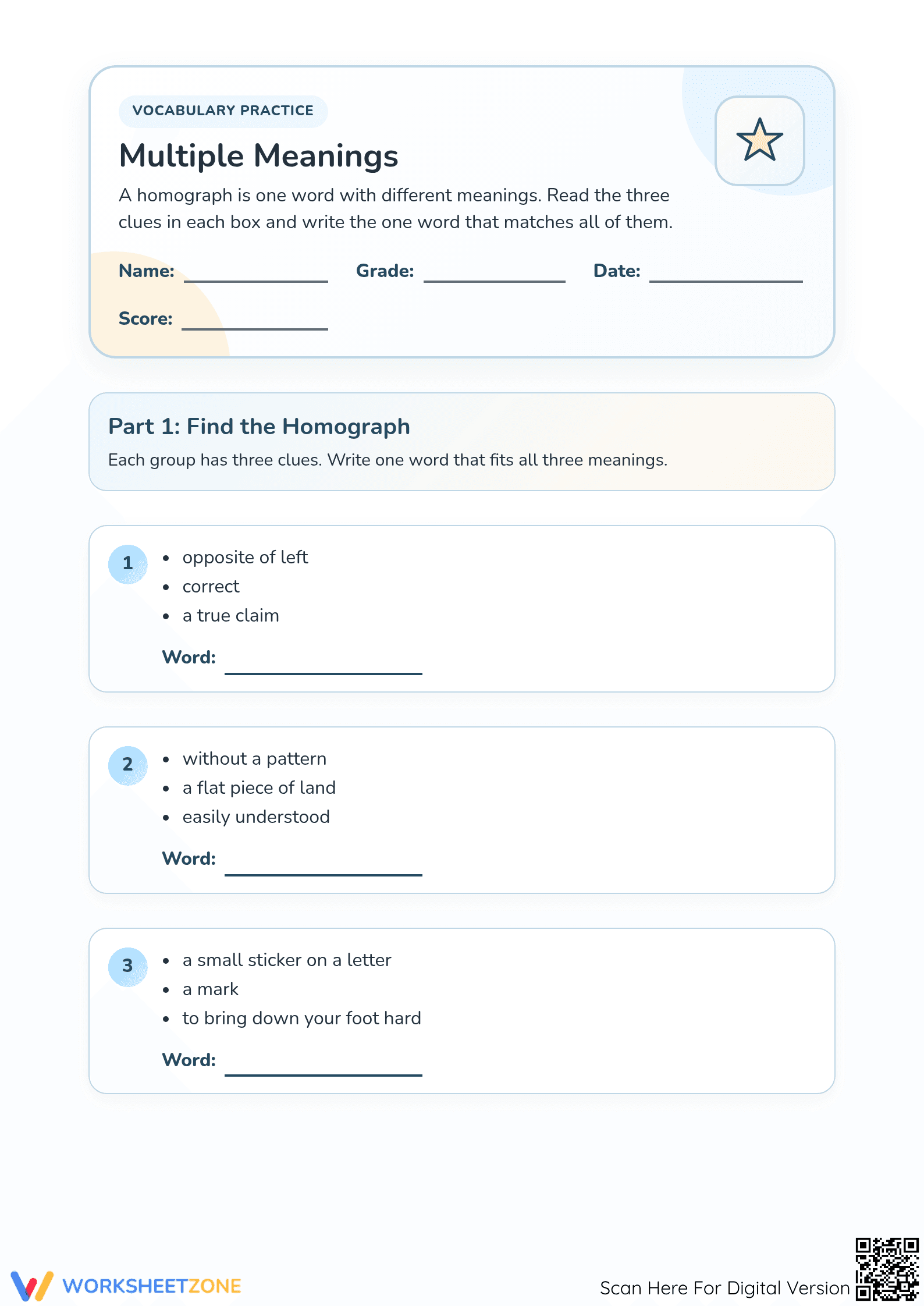
This Grade 2 vocabulary worksheet helps students master homographs by identifying words with multiple meanings through context clues. Students analyze three distinct definitions to find the single matching word, strengthening their linguistic flexibility and reading comprehension. It provides a clear, structured approach to expanding second-grade vocabulary through engaging word riddles and sentence application.
At a Glance
- Grade: 2 · Subject: ELA
- Standard:
CCSS.ELA-LITERACY.L.2.4— Determine or clarify the meaning of unknown and multiple-meaning words- Skill Focus: Homographs and Multiple Meanings
- Format: 3 pages · 11 problems · Answer key included · PDF
- Best For: Independent practice or vocabulary centers
- Time: 15–20 minutes
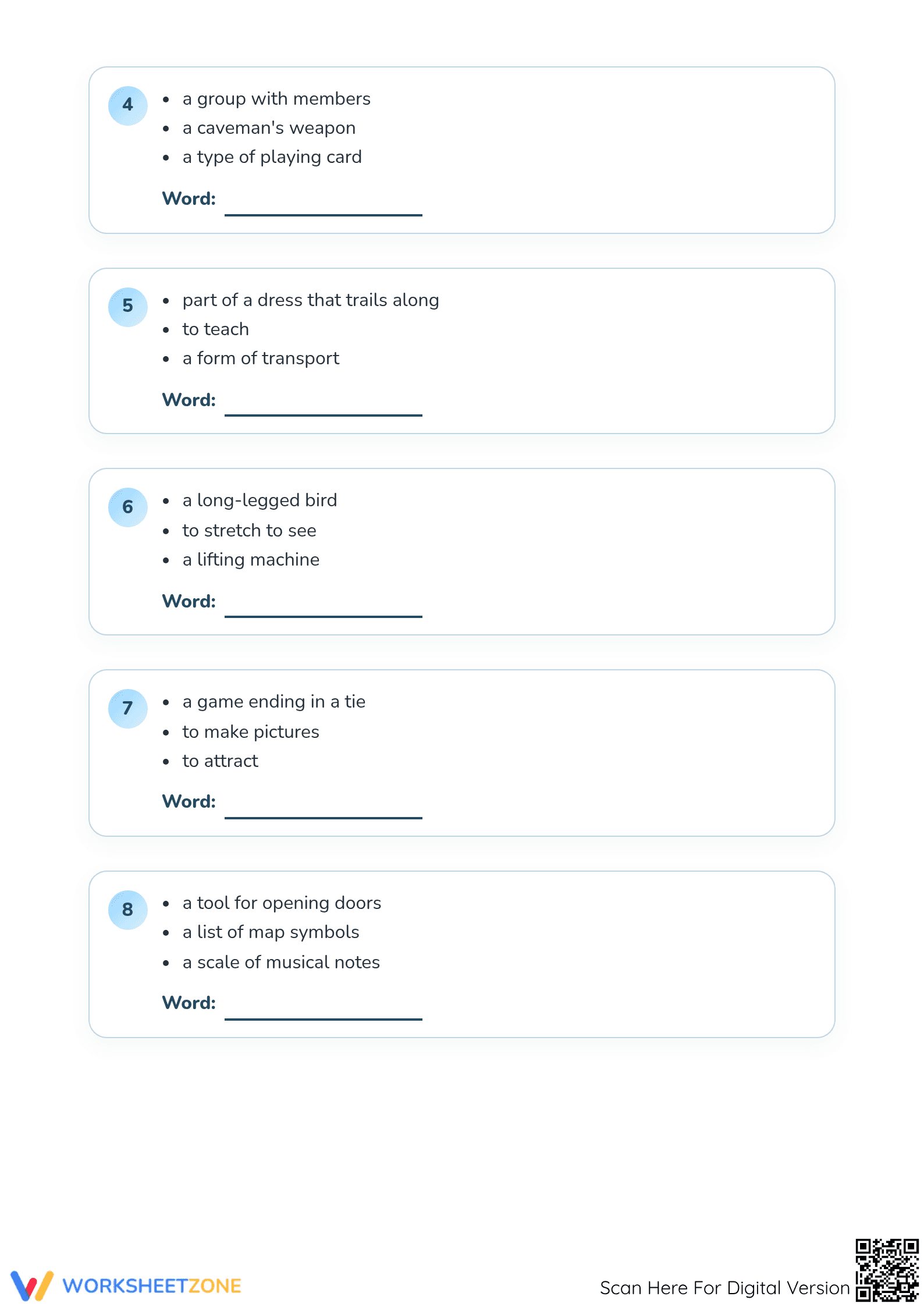
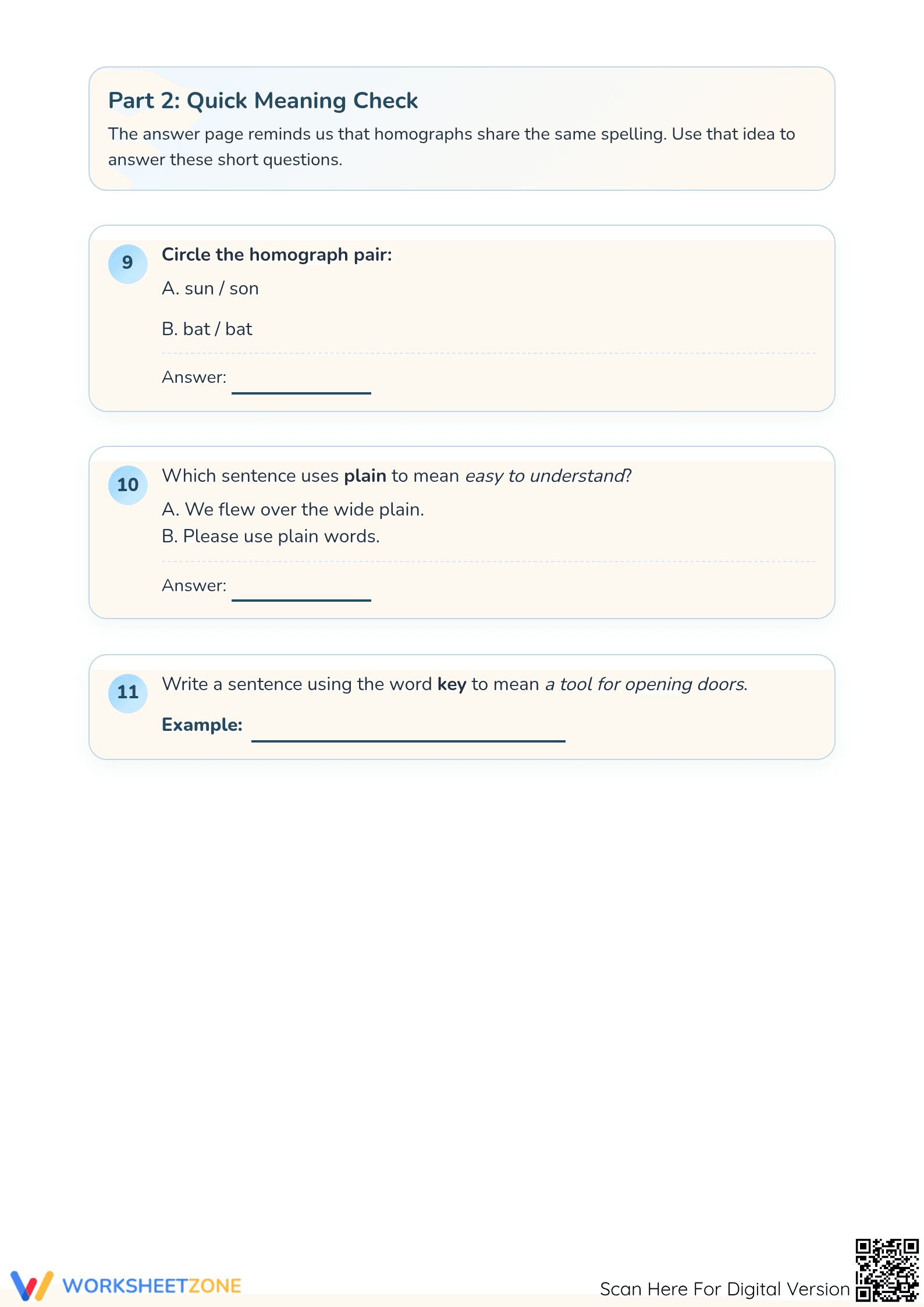
This comprehensive 3-page PDF includes 11 targeted vocabulary tasks. The first two pages feature eight "Find the Homograph" boxes where students read three clues to identify a shared word. The final page offers a "Quick Meaning Check" with multiple-choice identification and a sentence-writing prompt. A complete answer key is provided for immediate feedback and easy grading.
Zero-Prep Workflow
- Print: Select the 3-page PDF and print enough copies for your class (30 seconds).
- Distribute: Hand out the worksheets as a warm-up or during your literacy block (30 seconds).
- Review: Use the included answer key to check student work or project it for a whole-class review (1 minute).
Total teacher preparation time is under two minutes, making this an ideal resource for busy mornings or unexpected substitute teacher plans.
Standards Alignment
This resource is aligned with CCSS.ELA-LITERACY.L.2.4, which requires students to determine or clarify the meaning of unknown and multiple-meaning words and phrases. It specifically targets the ability to use context to identify how one word can function in different ways. Both standard codes can be copied directly into lesson plans, IEP goals, or district curriculum mapping tools.
How to Use It
Use this worksheet during the independent practice phase of a lesson on homographs. After introducing the concept with an anchor chart, assign the first 8 problems to see if students can synthesize multiple clues. For a formative assessment, observe students during the sentence-writing task on page 3 to ensure they can apply the word "key" in a specific context. Completion typically takes 15 to 20 minutes.
Who It's For
This resource is designed for Grade 2 students but works well for Grade 3 review or English Language Learners (ELL) who need explicit practice with English homographs. It pairs naturally with a classroom word wall or a direct instruction lesson on common multiple-meaning words like "bat," "plain," and "right."
According to the RAND AIRS 2024 report, explicit instruction in multiple-meaning words is a critical component of early literacy development, directly impacting a student's ability to decode complex texts. This worksheet addresses CCSS.ELA-LITERACY.L.2.4 by providing 11 structured opportunities for students to practice homograph identification. Research from Fisher & Frey (2014) emphasizes that vocabulary acquisition is most effective when students are asked to reconcile different meanings of the same word within varied contexts. By requiring students to match one word to three distinct clues, this resource promotes the cognitive flexibility needed for reading fluency. The inclusion of a sentence-writing task ensures that students move beyond recognition to active application. This evidence-based approach supports long-term retention of core vocabulary skills necessary for meeting national standards in English Language Arts.


