


























Views
Downloads
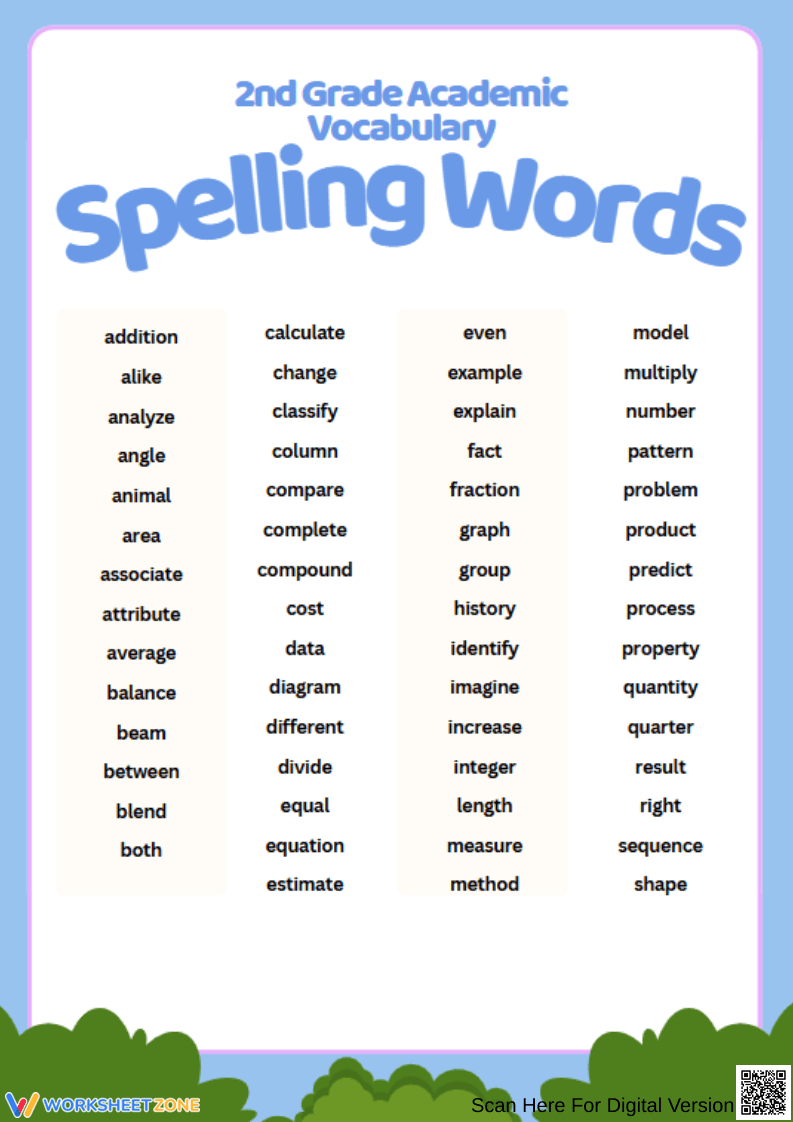

Printable Academic Vocabulary List | Grade 2 ELA
Paste this activity's link or code into your existing LMS (Google Classroom, Canvas, Teams, Schoology, Moodle, etc.).
Students can open and work on the activity right away, with no student login required.
You'll still be able to track student progress and results from your teacher account.
This Grade 2 academic vocabulary reference sheet provides students with essential cross-curricular terms to strengthen their reading comprehension and writing skills. By mastering these foundational spelling words, young learners build the academic language necessary to succeed across all core subjects, from math to science and literacy.
At a Glance
- Grade: 2 · Subject: ELA
- Standard:
CCSS.ELA-LITERACY.L.2.6— Acquire and use grade-appropriate academic vocabulary.- Skill Focus: Academic Vocabulary & Spelling
- Format: 1 page · 60 words · No answer key needed · PDF
- Best For: Spelling lists and reference folders
- Time: 5–10 minutes
This single-page printable features a comprehensive list of 60 high-frequency academic vocabulary words tailored for second-grade learners. The terms are neatly organized into four easy-to-read columns, making it an ideal reference tool for students. Words span multiple disciplines, including math-specific terms like "fraction," "equation," and "diagram," alongside general academic verbs such as "analyze," "compare," and "identify." The clean, distraction-free layout ensures students can quickly locate and review their spelling words without feeling overwhelmed.
- Guided practice: Introduce a few words daily, discussing their meanings and modeling how to use them in context during whole-group instruction.
- Supported practice: Have students keep this list in their writing folders to reference spelling and incorporate new vocabulary into their daily journal entries.
- Independent practice: Assign specific columns for weekly spelling tests or vocabulary quizzes to ensure long-term retention of these 60 critical terms.
This gradual-release approach ensures students confidently transition from recognizing words to actively using them.
Aligned to CCSS.ELA-LITERACY.L.2.6: Use words and phrases acquired through conversations, reading and being read to, and responding to texts, including using adjectives and adverbs to describe. This resource also supports foundational spelling skills by exposing students to complex spelling patterns. Both standard codes can be copied directly into lesson plans, IEP goals, or district curriculum mapping tools.
Distribute this list at the beginning of the quarter or semester for students to keep in their homework binders or writing centers. During independent writing time, encourage students to select at least two words from the list to improve their sentence structures. As a formative assessment, observe whether students can correctly spell and apply these terms during cross-curricular activities, such as writing a brief explanation in math or science. Reviewing a handful of words takes just 5 to 10 minutes of daily instructional time.
This resource is designed for second-grade students developing their academic language and spelling proficiency. It serves as an excellent scaffold for English Language Learners (ELLs) who benefit from explicit vocabulary instruction and a handy visual reference. Pair this word list with a graphic organizer or a direct instruction lesson on using context clues to maximize student understanding and retention.
Mastering academic language is a critical component of early elementary education, directly impacting a student's ability to access complex texts and express ideas clearly. Aligned with CCSS.ELA-LITERACY.L.2.6, this resource helps students acquire and use grade-appropriate academic vocabulary across multiple disciplines. According to Fisher & Frey (2014), explicit vocabulary instruction combined with multiple exposures to words in varied contexts significantly improves reading comprehension and writing quality. By providing a structured list of 60 high-leverage terms, educators can systematically build students' linguistic toolkits. This foundational knowledge not only supports immediate spelling and vocabulary goals but also prepares learners for the increasing linguistic demands of upper elementary grades. Integrating these words into daily routines ensures that students move beyond rote memorization to achieve true conceptual understanding and practical application in their academic work.


