


























0
Views
0
Downloads

0.0
0
Save
0 Likes
Understanding 2D Shapes
0 Views
0 Downloads
Paste this activity's link or code into your existing LMS (Google Classroom, Canvas, Teams, Schoology, Moodle, etc.).
Students can open and work on the activity right away, with no student login required.
You'll still be able to track student progress and results from your teacher account.
Information
Description
What It Is:
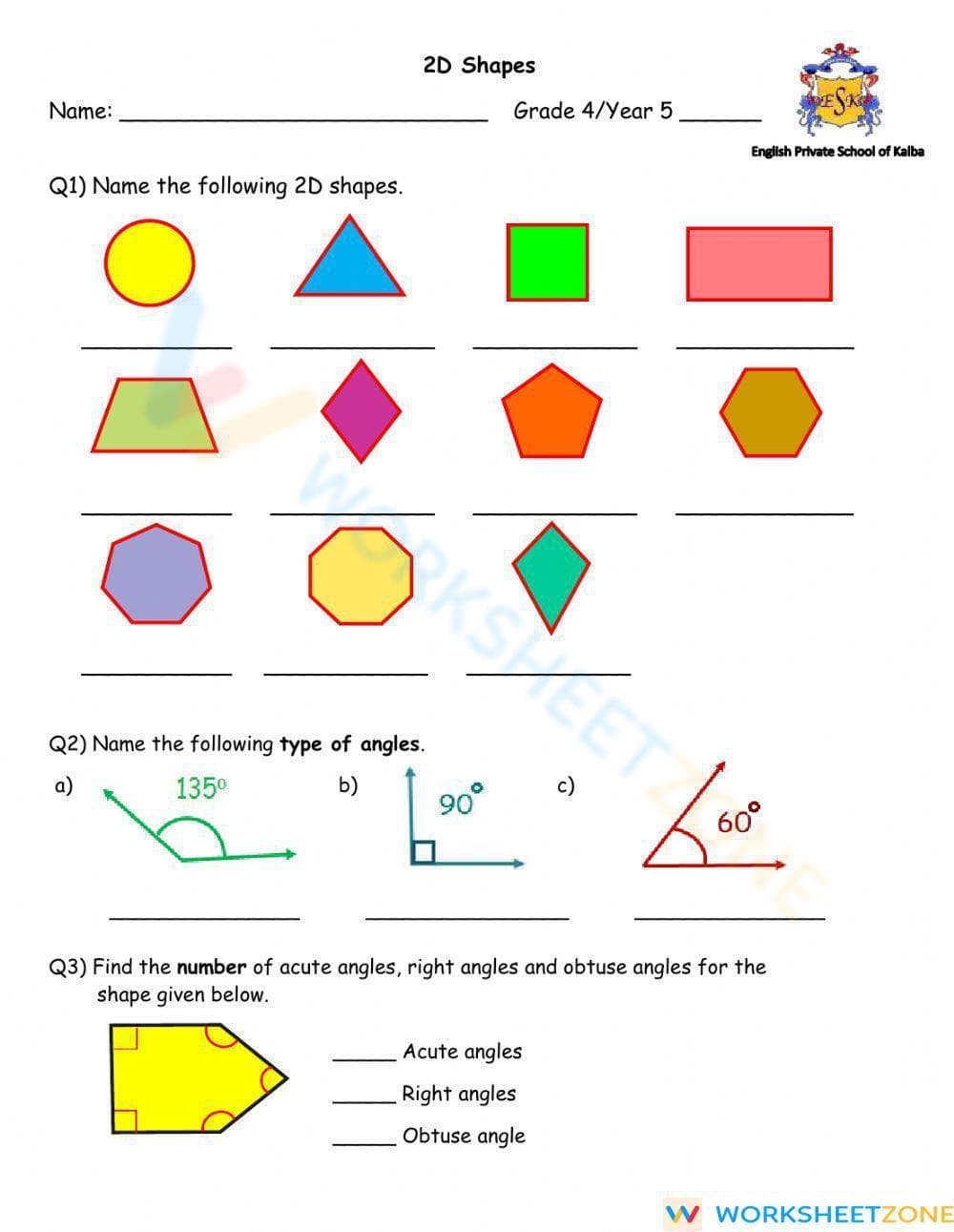
This is a math worksheet focusing on 2D shapes and angles. It includes three exercises: naming various 2D shapes like circles, triangles, squares, rectangles, trapezoids, diamonds, pentagons, hexagons, heptagons, octagons, and kites; identifying types of angles (135°, 90°, and 60°); and counting acute, right, and obtuse angles within a given shape.
Grade Level Suitability:
This worksheet is suitable for Grade 4 or Year 5. The content involves recognizing common 2D shapes and basic angle types, which are typically covered in these grade levels. The angle identification and counting exercises add a slightly more challenging element.
Why Use It:
This worksheet helps students reinforce their understanding of 2D shapes and angle types. It improves shape recognition skills, develops angle identification abilities, and enhances analytical thinking by requiring students to count angles within a composite shape.
How to Use It:
The worksheet can be used as a classroom activity, homework assignment, or review exercise. Students should first name the 2D shapes provided in the first section. Next, they should identify the type of angle presented in the second section. Finally, they should count and record the number of acute, right, and obtuse angles within the given shape in the third section.
Target Users:
This worksheet is designed for elementary school students, particularly those in Grade 4 or Year 5. It is also beneficial for students who need extra practice in recognizing 2D shapes and understanding different types of angles.
This is a math worksheet focusing on 2D shapes and angles. It includes three exercises: naming various 2D shapes like circles, triangles, squares, rectangles, trapezoids, diamonds, pentagons, hexagons, heptagons, octagons, and kites; identifying types of angles (135°, 90°, and 60°); and counting acute, right, and obtuse angles within a given shape.
Grade Level Suitability:
This worksheet is suitable for Grade 4 or Year 5. The content involves recognizing common 2D shapes and basic angle types, which are typically covered in these grade levels. The angle identification and counting exercises add a slightly more challenging element.
Why Use It:
This worksheet helps students reinforce their understanding of 2D shapes and angle types. It improves shape recognition skills, develops angle identification abilities, and enhances analytical thinking by requiring students to count angles within a composite shape.
How to Use It:
The worksheet can be used as a classroom activity, homework assignment, or review exercise. Students should first name the 2D shapes provided in the first section. Next, they should identify the type of angle presented in the second section. Finally, they should count and record the number of acute, right, and obtuse angles within the given shape in the third section.
Target Users:
This worksheet is designed for elementary school students, particularly those in Grade 4 or Year 5. It is also beneficial for students who need extra practice in recognizing 2D shapes and understanding different types of angles.


