


























Views
Downloads
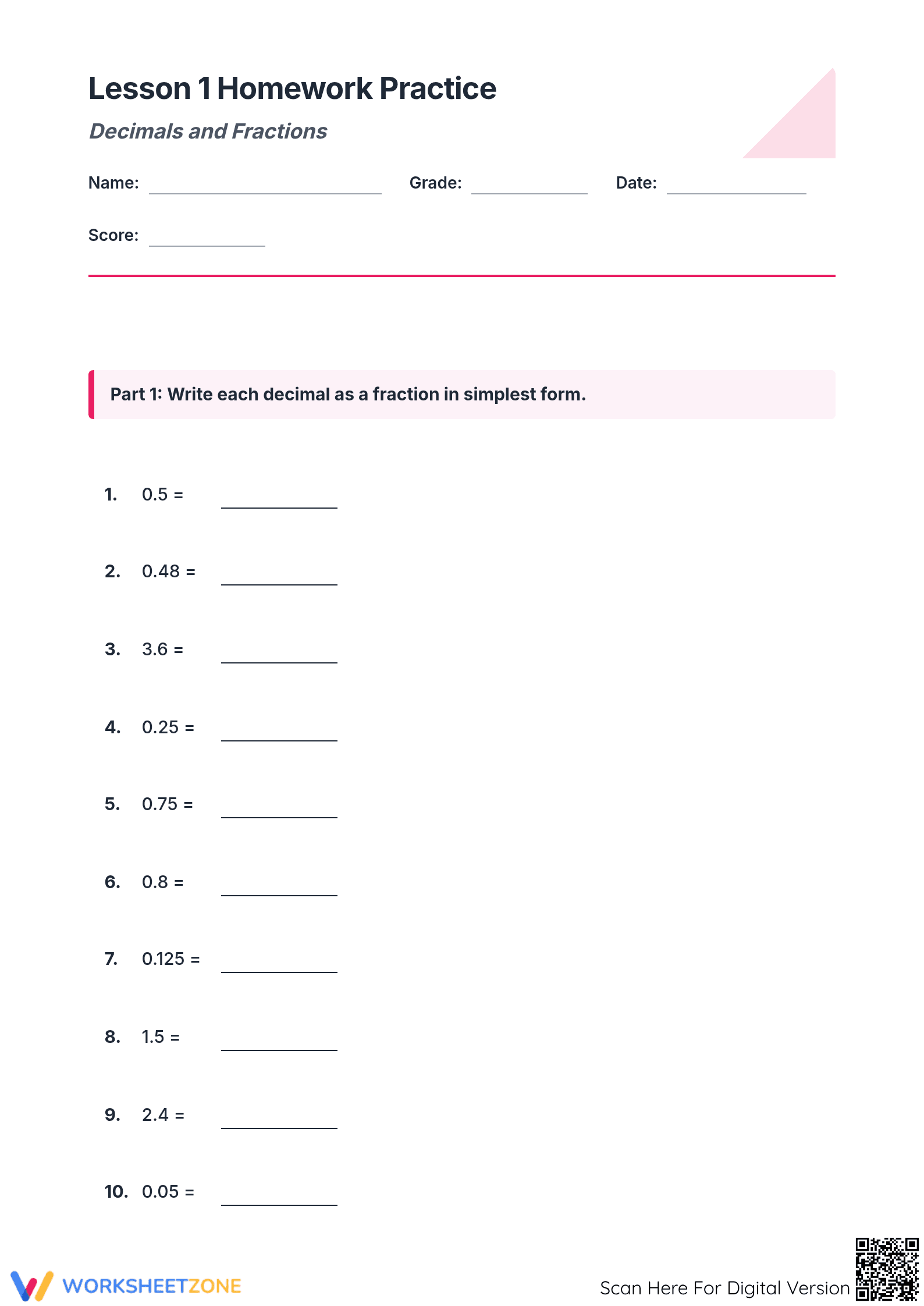



Decimals to Fractions Worksheet (3 Levels) | Grade 7 Ready
Paste this activity's link or code into your existing LMS (Google Classroom, Canvas, Teams, Schoology, Moodle, etc.).
Students can open and work on the activity right away, with no student login required.
You'll still be able to track student progress and results from your teacher account.
This worksheet provides targeted practice for Grade 7 students on converting decimals to fractions. Through a series of structured problems across three distinct difficulty levels, students will strengthen their understanding of rational numbers and build procedural fluency, preparing them for more complex algebraic concepts.
At a Glance
- Grade: 7 · Subject: Math
- Standard:
CCSS.MATH.CONTENT.7.NS.A.2— Convert between decimal and fraction representations of rational numbers.- Skill Focus: Converting Decimals to Fractions
- Format: 2 pages · 26 problems · Answer key included · PDF
- Best For: Differentiated practice, self-assessment, station work
- Time: 25–40 minutes
What's Inside
This resource includes a two-page worksheet with 26 problems and a complete, one-page answer key for easy grading. The problems are organized into three sections—"Practice," "Challenge," and "Super Challenge"—to provide a clear path for students to build their skills from foundational to advanced.
Three Levels for Differentiation
This worksheet uses a three-tiered structure to meet diverse learner needs.
- Below Grade (Practice): Foundational problems with terminating decimals offer a structured entry point to build confidence.
- On Grade (Challenge): Problems increase in complexity, including repeating decimals that require a more rigorous application of place value.
- Above Grade (Super Challenge): This section pushes students with complex repeating decimals and multi-step problems, encouraging higher-order thinking.
Standards Alignment
This worksheet is directly aligned with CCSS.MATH.CONTENT.7.NS.A.2, which focuses on the application of operations with rational numbers. It targets the key sub-skill of converting between decimal and fraction forms. The standard code can be copied directly into lesson plans, IEP goals, or curriculum maps.
How to Use It
Use this worksheet for independent practice after a lesson to solidify the skill. Its three levels make it ideal for math centers, allowing students to work at their own pace. As a formative assessment tool, observe which section a student chooses to quickly gauge their mastery and identify needs for reteaching. Most students will complete their chosen section in 25-40 minutes.
Who It's For
Designed for Grade 7 and Grade 8 math classes, this resource supports classrooms with diverse abilities. The built-in differentiation provides accessible starting points while challenging advanced learners. It pairs well with a classroom anchor chart on place value and converting repeating decimals.
Foundational fluency with rational numbers is a critical predictor of success in algebra and higher-level mathematics. This worksheet supports that goal by providing structured practice aligned with CCSS.MATH.CONTENT.7.NS.A.2. It allows students to move from simple conversions to more complex applications, a scaffolded approach supported by educational research. According to Fisher & Frey (2014), a gradual release of responsibility model, where students move from guided to independent work, is highly effective for skill acquisition in mathematics. This resource embodies that principle through its three-tiered design ("Practice," "Challenge," "Super Challenge"), ensuring all students can access the material and progress toward mastery. This targeted practice on converting between decimals and fractions helps solidify number sense, a key component of mathematical proficiency.


