


























Views
Downloads
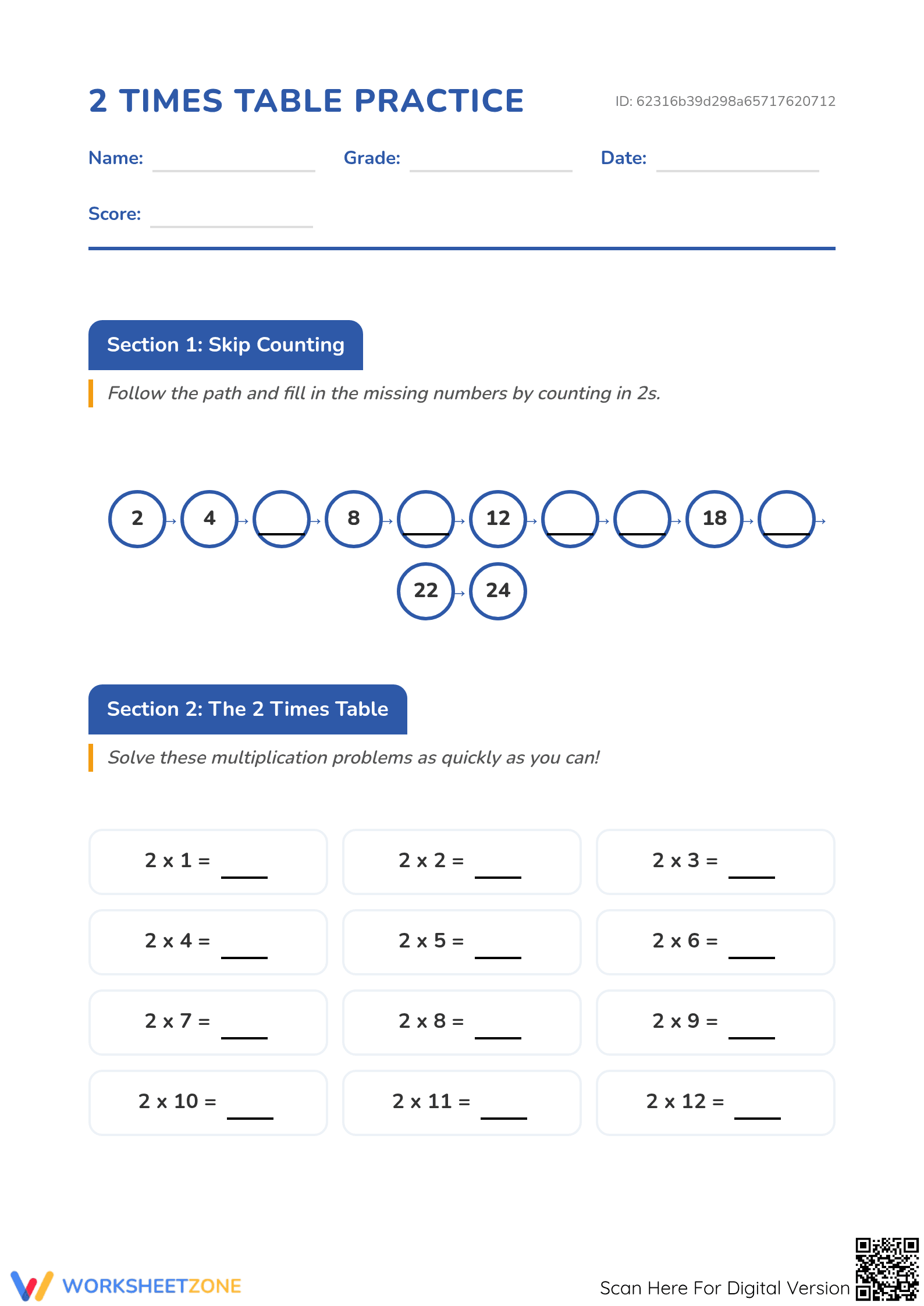



Printable 2 Times Table Worksheet | Grade 3 Math
Paste this activity's link or code into your existing LMS (Google Classroom, Canvas, Teams, Schoology, Moodle, etc.).
Students can open and work on the activity right away, with no student login required.
You'll still be able to track student progress and results from your teacher account.
Build fluency with the 2 times table using this comprehensive Grade 3 math worksheet. This four-page packet provides students with varied practice, from coloring multiples to solving word problems, ensuring they develop a solid foundation in early multiplication facts and move toward automaticity with this essential skill.
At a Glance
- Grade: 3 · Subject: Math
- Standard:
CCSS.MATH.CONTENT.3.OA.C.7— Fluently multiply within 100 and know all products of two one-digit numbers.- Skill Focus: Multiplication Facts (2 Times Table)
- Format: 4 pages · 70 problems · Answer key included · PDF
- Best For: Foundational multiplication practice, fact fluency drills, homework.
- Time: 20–30 minutes
What's Inside
This resource contains a four-page worksheet with 70 problems dedicated to the 2 times table. Activities include coloring multiples, completing multiplication wheels, matching equations, and solving word problems. A complete four-page answer key is also provided for quick grading.
A Progression to Mastery
This packet uses a gradual-release model to build confidence.
- Guided Practice: The first page starts with a visual coloring activity and a structured table for students to complete, providing strong support.
- Supported Practice: Subsequent pages move to matching and fill-in-the-blank equations, where students apply knowledge with clear prompts.
- Independent Practice: The packet culminates in standard multiplication problems and word problems, requiring students to recall facts independently.
This progression follows the effective 'I Do, We Do, You Do' structure, moving learners from guided examples to independent mastery.
Standards Alignment
This worksheet is aligned with Common Core standard CCSS.MATH.CONTENT.3.OA.C.7, which requires students to 'Fluently multiply... By the end of Grade 3, know from memory all products of two one-digit numbers.' This resource targets the foundational fact fluency needed for this standard. The code can be copied directly into lesson plans or curriculum maps.
How to Use It
Use this packet after an initial lesson on the 2 times table for robust independent practice or homework. It's excellent for a math center rotation. For formative assessment, observe which students complete the fluency sections quickly. The full worksheet should take students approximately 20-30 minutes.
Who It's For
This resource is designed for Grade 3 students learning multiplication facts. It is also ideal for Grade 4 students requiring review to build fact fluency. The clear layout is accessible for most learners. Pair this worksheet with a multiplication chart for extra visual support.
Developing automaticity with basic multiplication facts is critical for future success in mathematics, as it frees up working memory for more complex problem-solving. This worksheet for standard CCSS.MATH.CONTENT.3.OA.C.7 provides the focused repetition necessary for students to 'know from memory all products of two one-digit numbers.' Research consistently shows that a lack of fluency in basic math facts is a significant barrier to learning higher-level mathematics, including fractions and algebra. As noted in the NAEP framework, procedural fluency is a key component of mathematical proficiency. By offering over 70 structured problems on the 2 times table, this resource directly supports the development of this essential skill, aligning with findings that emphasize the importance of systematic practice for building long-term retention and confidence in young learners.


