




























Views
Downloads



Grade 2 Counting & Place Value — Printable Math Worksheet

Paste this activity's link or code into your existing LMS (Google Classroom, Canvas, Teams, Schoology, Moodle, etc.).
Students can open and work on the activity right away, with no student login required.
You'll still be able to track student progress and results from your teacher account.
Mastery of place value is the cornerstone of early elementary mathematics. This comprehensive three-page worksheet provides Grade 2 and Grade 3 students with structured practice in counting base-ten blocks, identifying digits in place value boxes, and mastering skip counting patterns. Students will transition from visual models to abstract numeric sequences with confidence.
At a Glance
- Grade: Grade 2 · Subject: Math
- Standard:
CCSS.MATH.CONTENT.2.NBT.A.1— Understand that the three digits of a three-digit number represent amounts of hundreds, tens, and ones- Skill Focus: Place Value & Skip Counting
- Format: 3 pages · 10 tasks · Answer key included · PDF
- Best For: Independent practice or formative assessment
- Time: 20–30 minutes
What's Inside
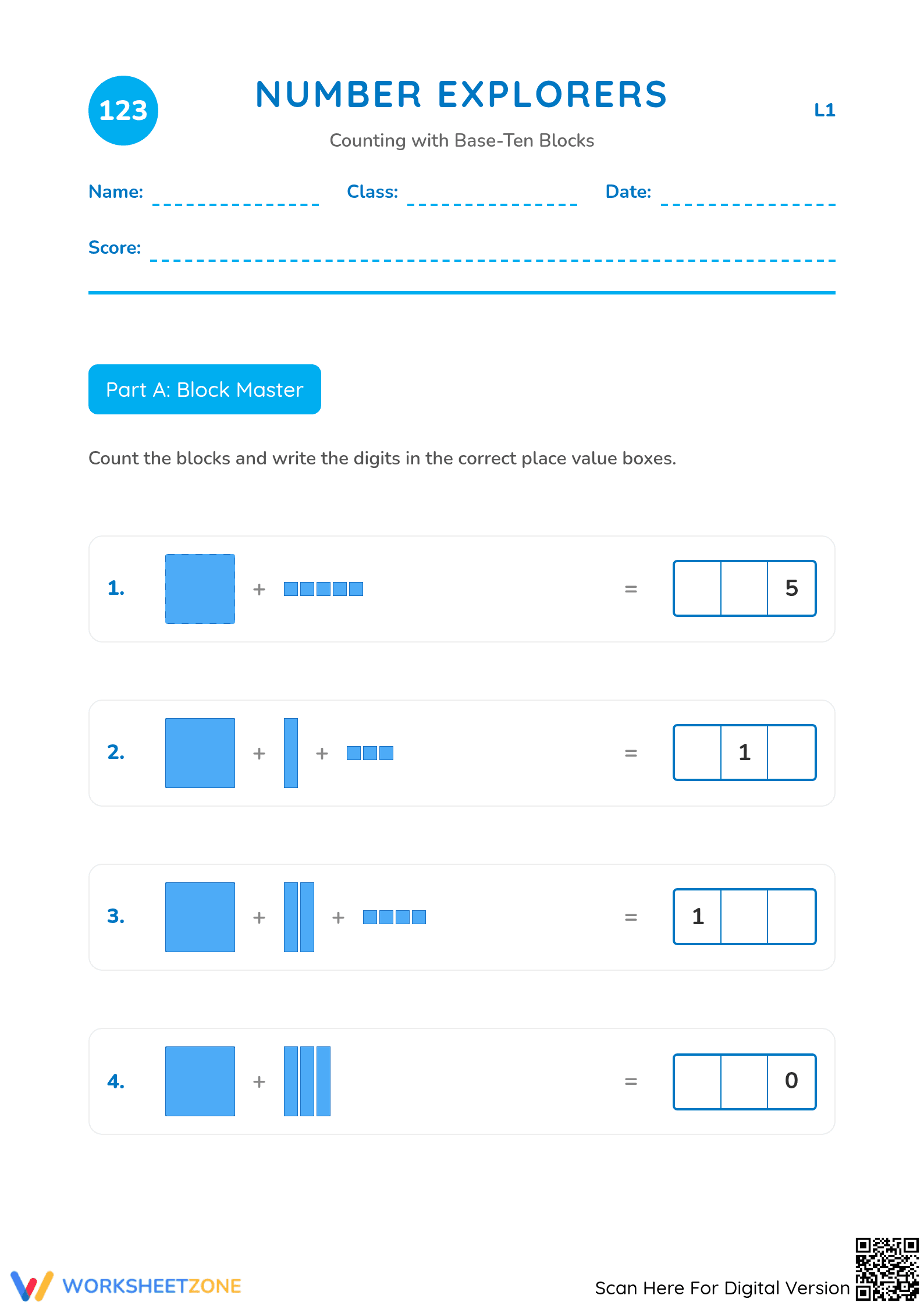
The "Number Explorers" pack includes three distinct pages focused on mathematical fluency. Students engage with visual base-ten block counting in Part A and C, fill in hundred-block sequences in Part B, and solve mixed skip counting patterns (5s, 10s, 100s) in Part D. The 10 numbered tasks offer a logical progression from concrete visualization to mental math, supported by a full answer key.
Zero-Prep Workflow
This resource is designed for immediate classroom deployment with a total teacher prep time of under 2 minutes. Step 1: Print the three-page PDF for your class (30 seconds). Step 2: Distribute the worksheets as a morning warm-up or independent station activity (30 seconds). Step 3: Use the provided answer key for rapid whole-class review or student self-correction (1 minute). Its clear headers make it ideal for sub plans.
Standards Alignment
The primary focus is CCSS.MATH.CONTENT.2.NBT.A.1, requiring students to understand the relative value of hundreds, tens, and ones. It also supports CCSS.MATH.CONTENT.2.NBT.A.2 through targeted skip-counting sequences. Both standard codes can be copied directly into lesson plans, IEP goals, or district curriculum mapping tools to ensure instructional coherence and rigorous data tracking.
How to Use It
Assign this worksheet during the independent practice phase of a gradual release lesson to verify student grasp of three-digit composition. Teachers can use the "Mixed Skip Counting" section as a high-leverage formative assessment; if students struggle with the backward patterns, it indicates a need for targeted re-teaching. Expect most second-grade students to complete the full pack in 25 minutes.
Who It's For
This material is optimized for second-grade students building core fluency and third-grade students requiring a refresh on place value foundations. It pairs naturally with physical base-ten blocks or a digital number line for students needing additional scaffolding. The layout is intentionally clean to support learners who benefit from reduced visual clutter and clear section breaks.
According to research highlighted by Fisher & Frey (2014), the use of visual representations like base-ten blocks is critical for bridging the gap between concrete understanding and abstract mathematical reasoning. This worksheet aligns with the "Number Explorers" philosophy by requiring students to interact with CCSS.MATH.CONTENT.2.NBT.A.1 in multiple formats, including block counting and place value box entry. Mastering these skills is essential for subsequent operations involving multi-digit addition and subtraction. By integrating skip counting patterns (2.NBT.A.2), the resource builds the numerical flexibility required for future algebraic thinking. Teachers utilizing this tool are providing evidence-based practice that facilitates the gradual release of responsibility. This structured approach ensures that Grade 2 students develop a durable mental model of the base-ten system, which is a significant predictor of long-term mathematical success in later elementary grades and beyond.


