


























Views
Downloads
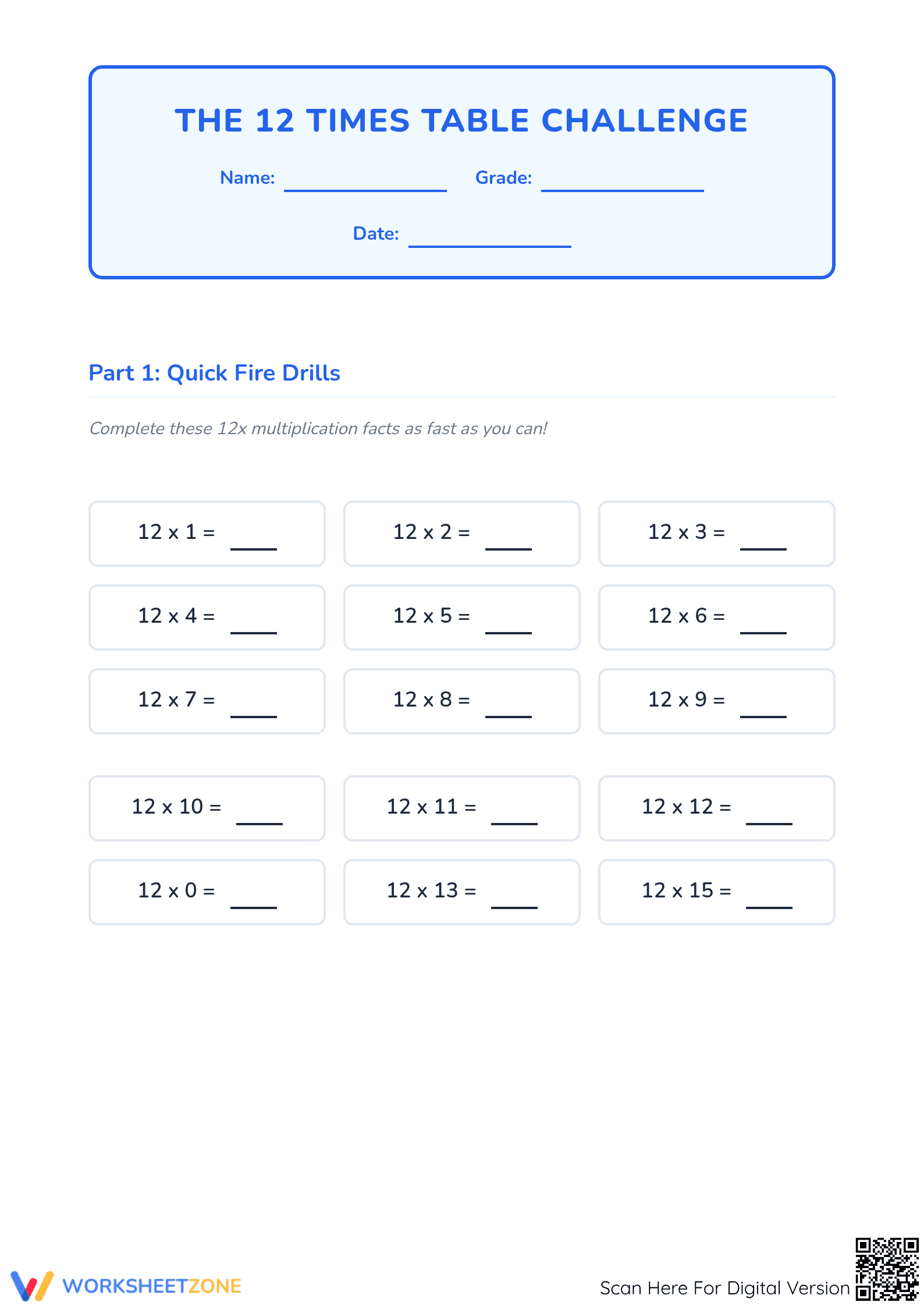


Printable 12 Times Table Challenge Worksheet — Grade 3
Paste this activity's link or code into your existing LMS (Google Classroom, Canvas, Teams, Schoology, Moodle, etc.).
Students can open and work on the activity right away, with no student login required.
You'll still be able to track student progress and results from your teacher account.
Mastering the 12 times table is a critical milestone for developing mathematical fluency and confidence in upper elementary grades. This comprehensive practice pack provides structured drills, missing-factor equations, and real-world word problems designed to move students from basic recognition to automatic recall of multiplication facts through twelve.
At a Glance
- Grade: 3 · Subject: Math
- Standard:
3.OA.C.7— Fluently multiply within 100 and know all products of two one-digit numbers- Skill Focus: 12 Times Table Fluency
- Format: 3 pages · 33 problems · Answer key included · PDF
- Best For: Daily multiplication drills or sub plans
- Time: 15–20 minutes
What's Inside
This three-page challenge set is logically organized into four distinct parts to support cognitive growth. Page one features fifteen quick-fire drills. Page two introduces algebraic thinking with six "missing link" equations and three contextual word problems. The final page concludes with a multiplication square row and a high-interest "Mega Challenge" to test extended recall skills.
Zero-Prep Workflow
The zero-prep workflow for this resource is designed for maximum efficiency in busy classrooms. First, print the three pages for your cohort, taking only thirty seconds. Second, distribute the packets as a "Multiplication Minute" or timed morning challenge. Finally, use the included answer key for immediate self-correction or rapid grading, ensuring total teacher prep time stays under two minutes.
Standards Alignment
The primary focus of this worksheet is 3.OA.C.7, targeting the fluency of multiplication facts. It also provides supporting practice for 3.OA.A.3 through its real-world word problem applications. Both standard codes can be copied directly into lesson plans, IEP goals, or district curriculum mapping tools to ensure instructional compliance and tracking.
How to Use It
Incorporate this worksheet during the "Independent Practice" phase of a multiplication unit to solidify memory. It also serves as an excellent "Mad Minute" style challenge to build speed. A great formative-assessment tip is to observe which students use repeated addition versus automatic recall. Students should typically complete the entire three-page set within a twenty-minute block during math centers.
Who It's For
This resource is ideal for Grade 3 students mastering their facts or Grade 4 students requiring remediation. The clear layout supports diverse learners, including those with IEPs needing uncluttered visual spaces. It pairs naturally with multiplication anchor charts or interactive number lines to provide scaffolding during the initial learning stages for struggling learners.
Research conducted by Fisher & Frey (2014) emphasizes the importance of the gradual release of responsibility in mathematics instruction. By transitioning students from basic "Quick Fire Drills" to more complex "Real World Math" applications, this resource aligns with best practices for cognitive scaffolding. Systematic practice of the 12 times table is essential, as these facts serve as the building blocks for multi-digit multiplication, division, and future fractional reasoning. Educational data suggests that students who achieve automaticity with multiplication facts by the end of third grade are significantly more likely to succeed in middle school algebraic concepts. The standard code 3.OA.C.7 represents a pivotal gateway in the Common Core State Standards, moving students beyond additive reasoning into multiplicative thinking. This worksheet provides the repeated exposure necessary for students to move facts from short-term working memory into long-term storage, ensuring lasting mathematical proficiency and readiness for complex Grade 4 arithmetic.


