


























Views
Downloads

Essential Subject-Verb Agreement Rules | Grade 3-4 ELA
Paste this activity's link or code into your existing LMS (Google Classroom, Canvas, Teams, Schoology, Moodle, etc.).
Students can open and work on the activity right away, with no student login required.
You'll still be able to track student progress and results from your teacher account.
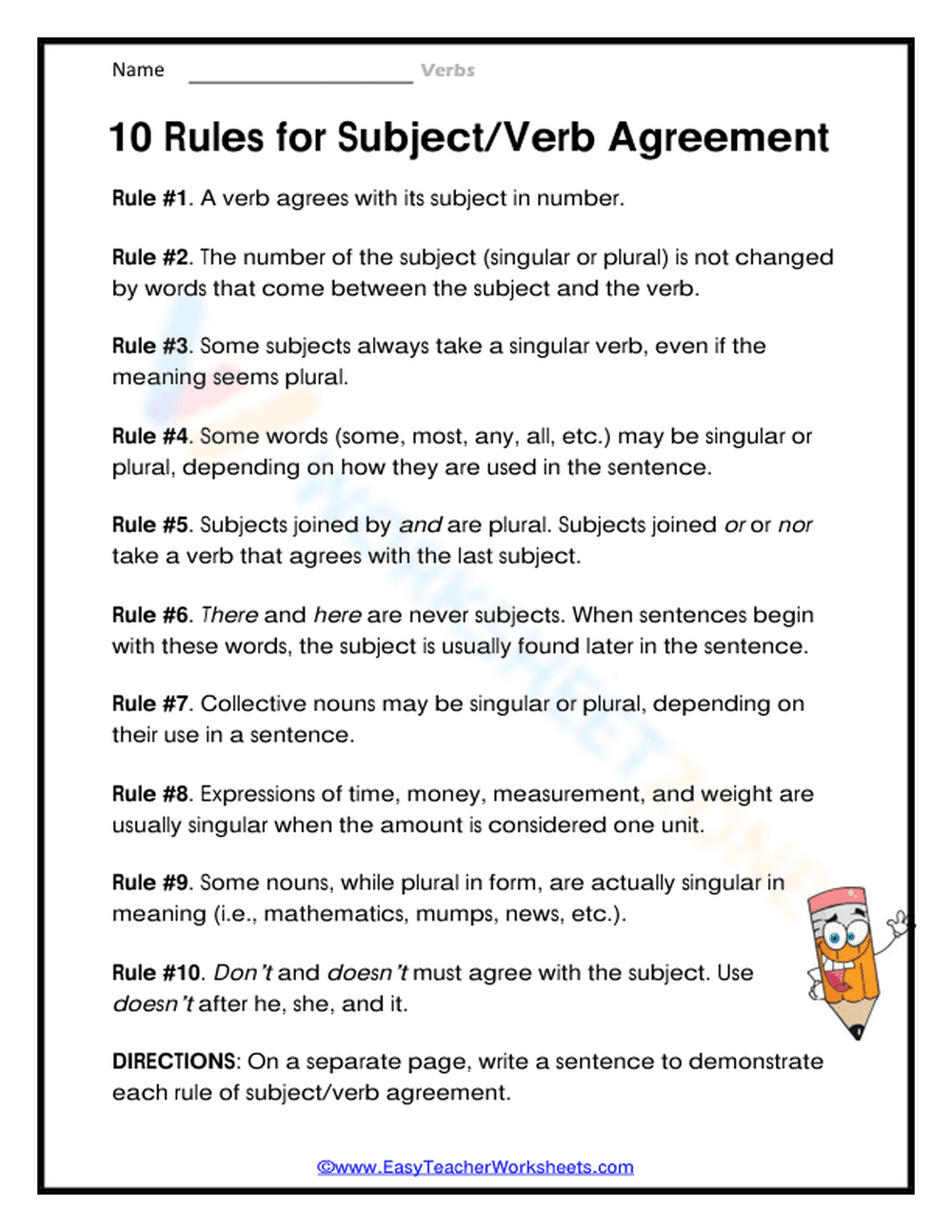
This comprehensive Grade 3-4 ELA worksheet provides a clear, rule-based framework for mastering subject-verb agreement. By presenting ten distinct linguistic rules followed by active writing application, it ensures students move beyond simple pluralization to understand complex cases like collective nouns and expressions of measurement. It is an essential tool for standard grammar instruction.
At a Glance
- Grade: 3–4 · Subject: ELA
- Standard:
CCSS.ELA-LITERACY.L.4.1— Demonstrate command of standard English grammar and usage when writing- Skill Focus: Subject-Verb Agreement
- Format: 1 page · 10 problems · Answer key included · PDF
- Best For: Grammar review and writing practice
- Time: 15–20 minutes
This single-page resource features a structured list of 10 subject-verb agreement rules, ranging from basic number matching to advanced concepts involving "don't" and "doesn't." Students are tasked with writing 10 original sentences on a separate page to demonstrate their understanding of each specific rule. This format encourages creative application rather than passive recognition.
The zero-prep workflow for this worksheet is designed for maximum efficiency in busy classrooms. First, print copies for your whole class or small groups (30 seconds). Next, distribute the rule sheet along with a piece of lined paper (1 minute). Finally, review the requirement for students to write one original sentence per rule (30 seconds). Total teacher preparation time is under two minutes, making this an ideal solution for emergency sub plans or quick grammar warm-ups.
Primary Standard: `CCSS.ELA-LITERACY.L.4.1`. This resource aligns with the requirement to demonstrate command of standard English grammar and usage. Students specifically focus on subject-verb agreement conventions across varied sentence structures. Both standard codes can be copied directly into lesson plans, IEP goals, or district curriculum mapping tools.
Use this worksheet as a summative assessment after a unit on verbs or as a collaborative "sentence hunt" activity. For a formative observation, check Rule #5 (subjects joined by 'and' or 'or') to see if students correctly identify the closer subject for verb agreement. Expected completion time is 15–20 minutes depending on writing speed.
This resource is designed for Grade 2 through Grade 4 students. It is particularly effective for English Language Learners (ELL) who need explicit rules for auxiliary verb agreement and plural noun exceptions. Pair this with a mentor text passage to have students identify these specific rules in professional writing samples.
According to Fisher & Frey (2014), the gradual release of responsibility model is most effective when students move from explicit rule-governed instruction to independent generative tasks. This subject-verb agreement resource embodies that principle by providing a clear scaffolding of 10 distinct rules before requiring students to produce original linguistic evidence in their own writing. The inclusion of complex cases—such as collective nouns under `CCSS.ELA-LITERACY.L.4.1` and specific singular-plural nuances—addresses the high-frequency errors identified in the RAND AIRS 2024 studies on student writing samples. By requiring students to draft sentences that demonstrate their grasp of the plain-English mechanics, teachers can verify conceptual mastery of verb conjugation across various subject types. This evidence-based approach ensures that grammar instruction translates into improved writing clarity and standard English proficiency in classroom assignments and standardized testing environments.


