


























Views
Downloads

Homework Debate Printable Worksheet | Grade 8 ELA
Paste this activity's link or code into your existing LMS (Google Classroom, Canvas, Teams, Schoology, Moodle, etc.).
Students can open and work on the activity right away, with no student login required.
You'll still be able to track student progress and results from your teacher account.
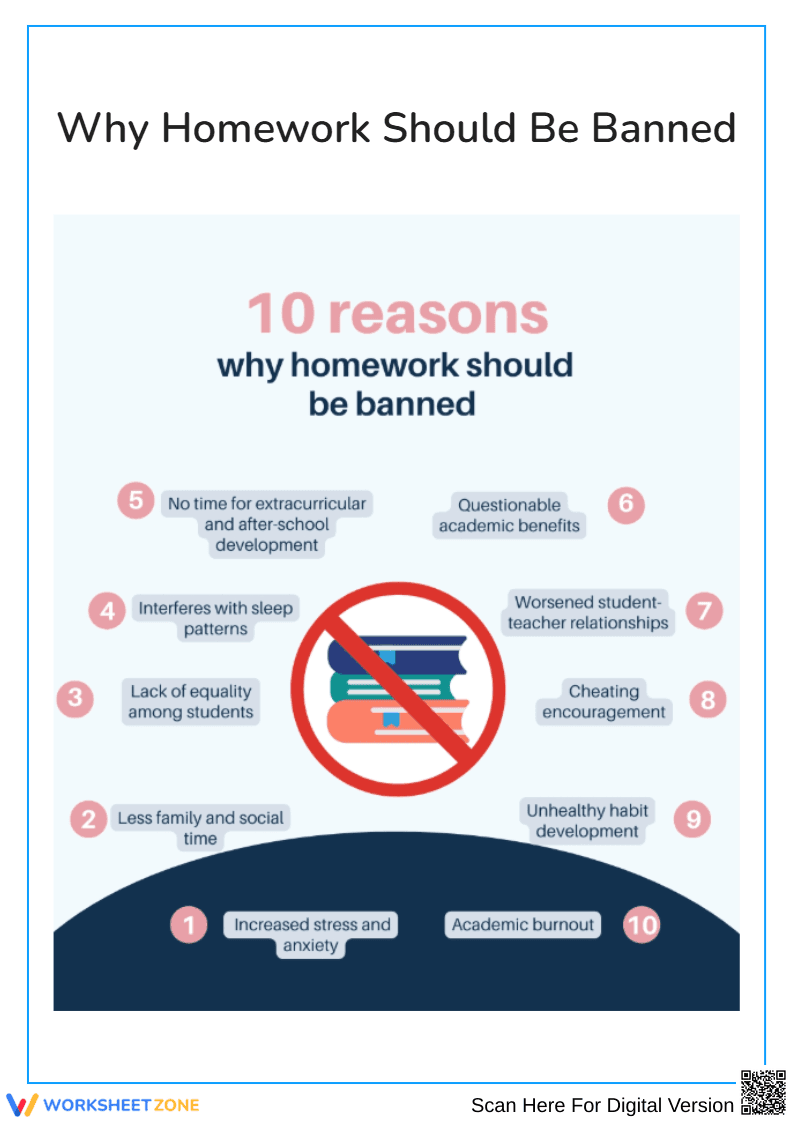
This Grade 8 argumentative reading and debate worksheet provides students with a high-interest infographic detailing ten distinct claims against assigning homework. By analyzing these specific reasons, students practice evaluating arguments and gathering evidence for their own persuasive writing pieces. The visual format makes complex debate topics highly accessible.
At a Glance
- Grade: 8 · Subject: ELA
- Standard:
CCSS.ELA-LITERACY.RI.8.8— Evaluate arguments and specific claims in a text- Skill Focus: Argument analysis
- Format: 1 page · 10 discussion points · No answer key · PDF
- Best For: Debate prep and writing stimulus
- Time: 15–30 minutes
Inside this single-page resource, educators will find a clearly structured infographic presenting ten numbered arguments against homework. The claims range from mental health concerns, such as increased stress and academic burnout, to equity issues and questionable academic benefits. The visual layout serves as an excellent stimulus for classroom discussion, requiring no answer key as it is designed to prompt student-led debate and critical thinking rather than rote memorization.
Enjoy a streamlined zero-prep workflow:
- Print (1 minute): Simply download the PDF and print a class set, or project it directly onto your smartboard for a paperless lesson hook.
- Distribute (1 minute): Hand out the infographic as students enter the room to immediately spark engagement and peer discussion.
- Review (15 minutes): Facilitate a whole-class debate where students select one of the ten claims to defend or refute using their own experiences.
With under two minutes of prep, this is perfect for sub plans.
This material is directly aligned with CCSS.ELA-LITERACY.RI.8.8, requiring students to delineate and evaluate the argument and specific claims in a text, assessing whether the reasoning is sound and the evidence is relevant and sufficient. It also supports foundational skills for argumentative writing. Both standard codes can be copied directly into lesson plans, IEP goals, or district curriculum mapping tools.
Use this infographic before argumentative writing instruction to help students brainstorm thesis statements. Alternatively, use it during a speaking and listening unit by assigning small groups one specific claim from the page to research and present to the class. For formative assessment, observe if students can supply real-world examples to back up the claims. Expected completion time ranges from a quick 15-minute warm-up to a full 30-minute structured debate.
This resource is ideal for middle school ELA students, particularly those in seventh and eighth grade who are developing their persuasive communication skills. The visually broken-down text provides excellent differentiation for English Language Learners and students with reading accommodations, as the concise bullet points reduce cognitive load compared to dense articles. It pairs perfectly with a direct instruction lesson on thesis generation or a structured classroom debate rubric.
Teaching students to evaluate arguments and specific claims in a text requires engaging, highly relevant stimulus materials that connect directly to their daily lives. According to Fisher & Frey (2014), utilizing high-interest, visually accessible texts significantly increases student participation in rigorous academic discourse and critical thinking tasks. By analyzing the ten distinct claims presented in this homework debate infographic, students actively practice the skills outlined in CCSS.ELA-LITERACY.RI.8.8. They learn to differentiate between emotional appeals and logical reasoning, a crucial step in developing their own argumentative writing capabilities. Providing structured, relatable debate topics allows learners to build confidence in their analytical skills before tackling more complex, abstract texts. This approach not only supports standard mastery but also fosters a classroom environment where students feel their perspectives are valued and academically relevant.


