


























Views
Downloads
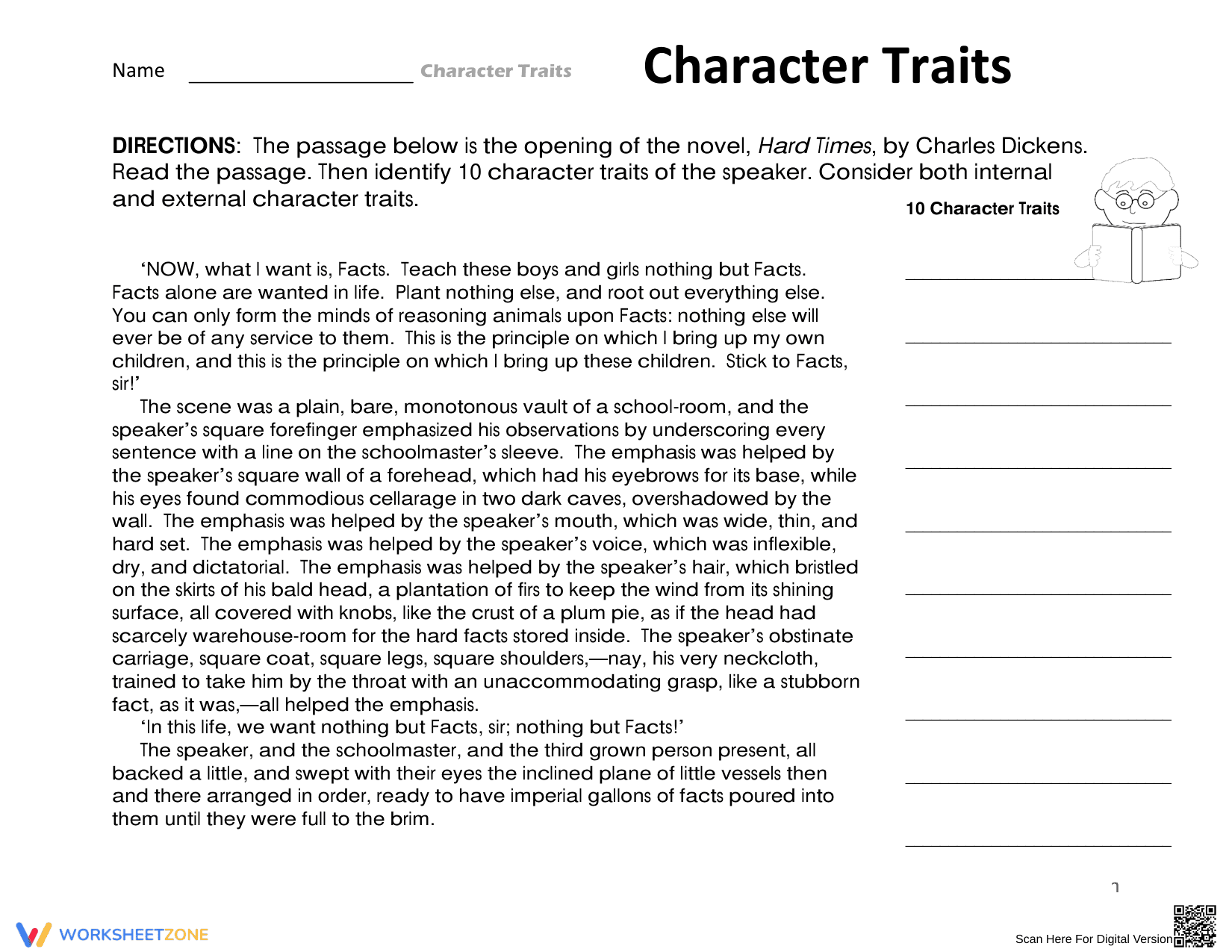

Essential Character Traits Worksheet | Grade 4 ELA
Paste this activity's link or code into your existing LMS (Google Classroom, Canvas, Teams, Schoology, Moodle, etc.).
Students can open and work on the activity right away, with no student login required.
You'll still be able to track student progress and results from your teacher account.
This Grade 4 ELA worksheet focuses on deep character analysis using a classic literary excerpt from Charles Dickens. Students analyze the speaker's words and physical descriptions to identify ten distinct character traits. By distinguishing between internal motivations and external appearances, learners build a comprehensive profile of a literary figure while practicing evidence-based reasoning.
At a Glance
- Grade: 4 · Subject: ELA
- Standard:
CCSS.ELA-LITERACY.RL.4.3— Describe in depth a character drawing on specific details in the text- Skill Focus: Internal and external character traits
- Format: 1 page · 10 problems · Open-ended response · PDF
- Best For: Close reading and character analysis practice
- Time: 20–30 minutes
Inside this resource, you will find a carefully selected passage from the opening of Hard Times by Charles Dickens. The text is rich with descriptive language, focusing on the character Thomas Gradgrind. Students are provided with ten numbered lines to record their observations, encouraging them to look beyond the surface and infer personality through dialogue and physical imagery.
- Guided Practice: The introductory paragraph and directions establish a clear goal, prompting students to look for both internal feelings and external physical markers as they begin their reading.
- Supported Practice: The passage itself acts as a scaffold, providing dense, high-quality vocabulary that gives students multiple opportunities to find evidence for at least five distinct traits before moving to more abstract inferences.
- Independent Practice: Students complete the final set of observations independently, synthesizing the speaker's rigid philosophy with his physical "obstinate carriage" to form a complete character portrait.
This approach follows a gradual-release model, moving from identifying explicit physical details to inferring complex personality characteristics.
The primary alignment for this resource is CCSS.ELA-LITERACY.RL.4.3, which requires students to describe a character in depth by drawing on specific details such as thoughts, words, or actions. By requiring ten unique traits, the worksheet ensures students engage in the "in-depth" analysis required by the standard. This standard code can be copied directly into lesson plans, IEP goals, or district curriculum mapping tools.
To use this worksheet effectively, assign it as a close-reading exercise during a unit on literary elements. Teachers should observe how students handle the archaic vocabulary; if a student struggles, point them toward the physical descriptions of the speaker's forehead and voice as a starting point. This serves as an excellent formative assessment for identifying a student's ability to move from literal comprehension to inferential thinking within a 25-minute window.
This resource is designed for Grade 4 students but is suitable for Grade 3 students ready for a challenge or Grade 5 students reviewing characterization. It pairs naturally with an anchor chart on character traits or a direct instruction lesson on the difference between physical descriptions and personality. It is particularly effective for high-ability learners who benefit from analyzing complex, high-level text structures.
Research from Fisher & Frey (2014) emphasizes close reading of complex texts is essential for analytical skills required by modern standards. This worksheet applies those findings by utilizing a Dickensian passage that requires students to synthesize 10 character traits from a single scene. By focusing on CCSS.ELA-LITERACY.RL.4.3, the activity ensures students move beyond simple identification into character depth and motivation analysis. Educators can use these ten data points to track student progress in evidence-based citation and inferential reasoning, providing a clear metric for growth in literary analysis. The inclusion of both internal and external traits reflects current pedagogical shifts toward holistic character understanding as a prerequisite for more advanced theme analysis in later grades. This structured approach to evidence extraction is a proven method for preparing students for high-stakes assessments that demand text-dependent responses.


