


























Views
Plays

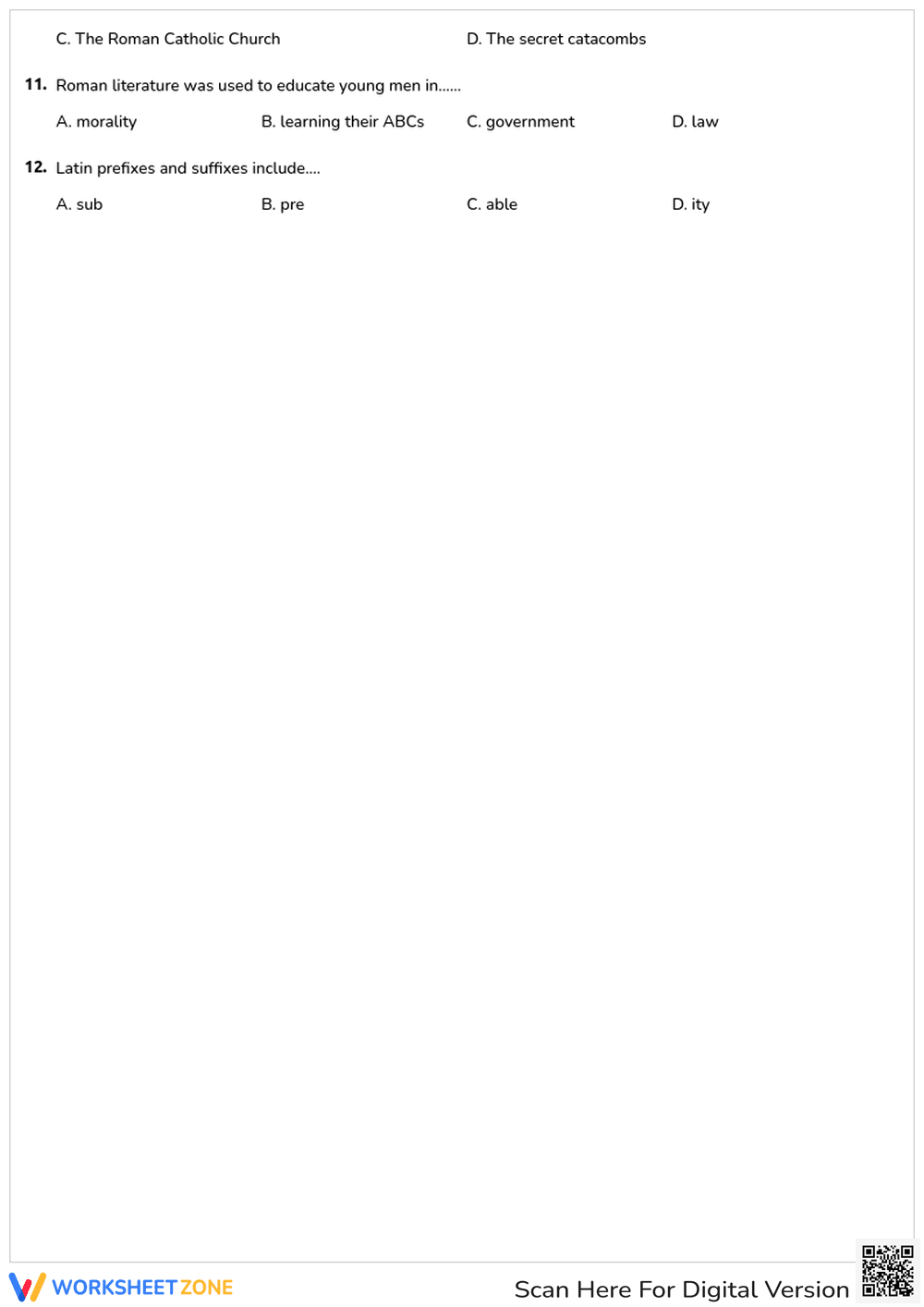

Grade 3 Ancient Rome & Latin — Printable No-Prep Worksheet
Paste this activity's link or code into your existing LMS (Google Classroom, Canvas, Teams, Schoology, Moodle, etc.).
Students can open and work on the activity right away, with no student login required.
You'll still be able to track student progress and results from your teacher account.
This Grade 3 history and language worksheet gives students a straightforward way to review key facts about Ancient Rome, the Latin language, and classical literature. By completing this multiple-choice quiz, learners will demonstrate their understanding of foundational historical concepts and domain-specific vocabulary.
At a Glance
- Grade: 3 · Subject: Social Studies
- Standard:
CCSS.ELA-LITERACY.RI.3.4— Determine the meaning of domain-specific words- Skill Focus: Ancient Roman History & Latin
- Format: 2 pages · 12 problems · Answer key included · PDF
- Best For: End-of-unit review or independent practice
- Time: 15–20 minutes
What's Inside
Inside this resource, educators will find a two-page assessment featuring 12 multiple-choice questions. The task types focus on factual recall and vocabulary identification, covering topics like Romance languages, Virgil's Aeneid, and Stoic philosophy. The clear, uncluttered layout ensures students can focus entirely on the content without visual distractions.
Zero-Prep Workflow
- Print (1 minute): Simply download the PDF and print a class set. No special formatting or cutting is required.
- Distribute (1 minute): Hand out the two-page quiz to students as a standalone assignment or alongside a reading passage.
- Review (3 minutes): Use the included answer key to quickly grade submissions or conduct a whole-class review session.
Total teacher prep time is under two minutes, making this an ideal resource for emergency sub plans.
Standards Alignment
Aligned to CCSS.ELA-LITERACY.RI.3.4, this worksheet requires students to determine the meaning of general academic and domain-specific words and phrases in a text relevant to a grade 3 topic or subject area. It also supports broader historical comprehension skills. Both standard codes can be copied directly into lesson plans, IEP goals, or district curriculum mapping tools.
How to Use It
This worksheet serves perfectly as a formative assessment after direct instruction on Ancient Rome. Alternatively, assign it as independent seatwork while you conduct small group reading sessions. As an observation tip, watch to see if students can use process of elimination on the multiple-choice options for unfamiliar terms like "oratory" or "philosophy." Expected completion time is 15 to 20 minutes.
Who It's For
This resource is designed for third-grade students in general education classrooms, though it can easily be adapted for older students needing a foundational review. For differentiation, teachers can read the questions aloud to support developing readers. It pairs naturally with introductory reading passages about the Roman Empire or classical civilizations.
Integrating domain-specific vocabulary practice into history lessons significantly enhances reading comprehension across all subjects, providing a critical foundation for young learners. By aligning with CCSS.ELA-LITERACY.RI.3.4 to determine the meaning of domain-specific words, this worksheet reinforces essential academic language and historical concepts. According to a RAND AIRS 2024 study, students who engage in regular, structured vocabulary assessments within content areas like social studies show marked improvements in their ability to decode complex informational texts. The research emphasizes that explicit instruction and assessment of terms like "oratory" and "philosophy" bridge the gap between basic reading skills and advanced content mastery. This targeted practice ensures learners build the robust background knowledge necessary for advanced historical analysis, cross-curricular success, and long-term academic achievement. Consistent exposure to these classical concepts ultimately prepares students for more rigorous middle school humanities curricula.


