


























Views
Downloads
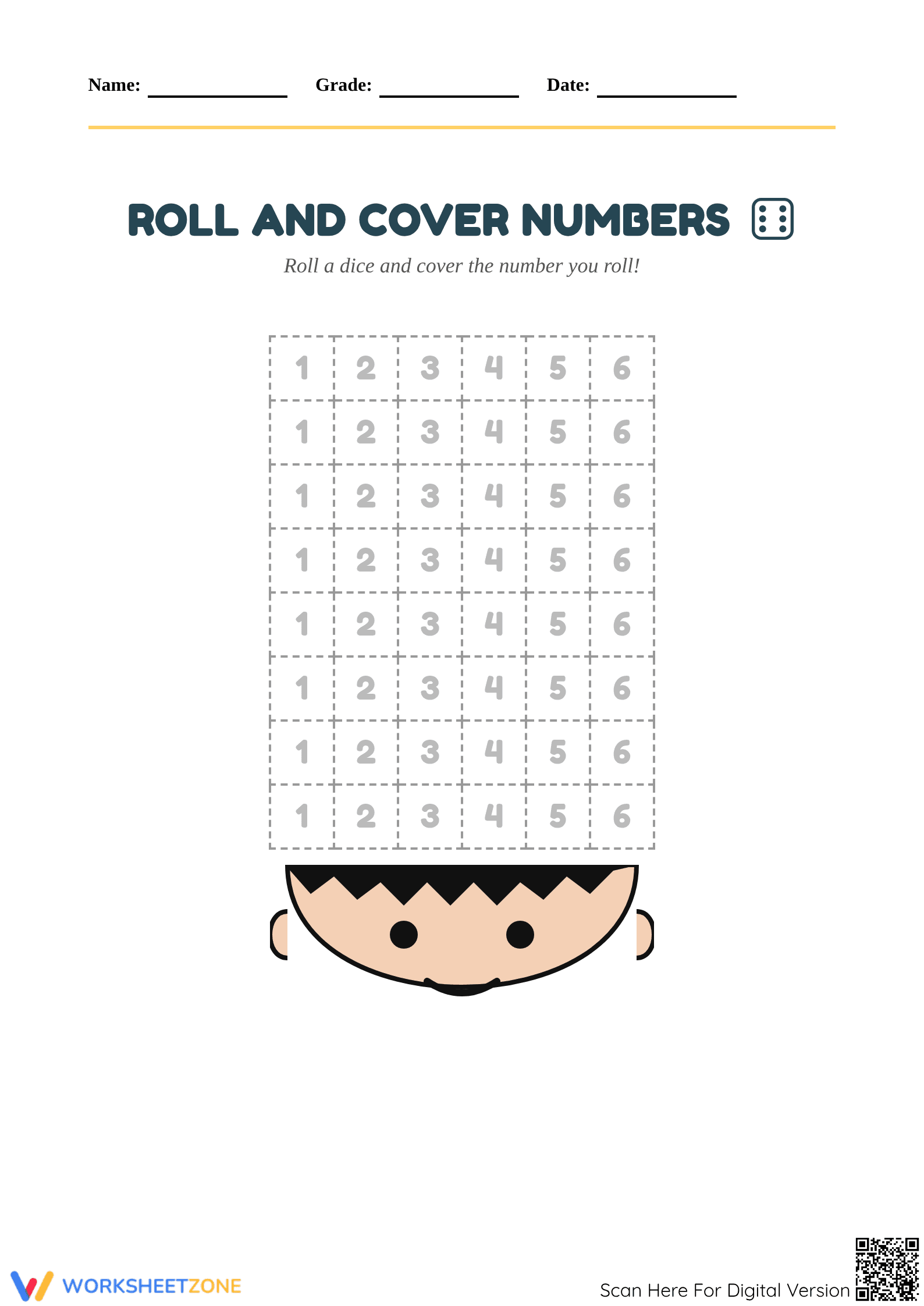

Grade 1 Number Recognition — Printable No-Prep Worksheet
Paste this activity's link or code into your existing LMS (Google Classroom, Canvas, Teams, Schoology, Moodle, etc.).
Students can open and work on the activity right away, with no student login required.
You'll still be able to track student progress and results from your teacher account.
This Grade 1 math worksheet helps students build foundational number recognition and counting skills through a fun format. By rolling a die and matching the quantity to the numeral, young learners strengthen number sense and fine motor skills.
At a Glance
- Grade: 1 · Subject: Math
- Standard:
CCSS.MATH.CONTENT.1.NBT.A.1— Read and write numerals to represent quantities- Skill Focus: Number Recognition
- Format: 1 page · 36 problems · No answer key needed · PDF
- Best For: Independent math centers
- Time: 10–15 minutes
This single-page printable features a clear grid containing 36 dashed-line squares, each displaying a number from one to six. A cheerful character illustration adds visual appeal. The activity requires only a standard die and small manipulatives or crayons to cover the numbers, making it a straightforward resource for busy classrooms.
Zero-Prep Workflow
This resource is designed for immediate implementation:
- Print (1 min): Generate the PDF for your class.
- Distribute (1 min): Hand out sheets, dice, and counters.
- Review (1 min): Model how to roll, count, and find the matching number.
With under three minutes of prep, this activity is excellent for sub plans or spontaneous math centers.
Standards Alignment
This activity aligns with CCSS.MATH.CONTENT.1.NBT.A.1, requiring students to read numerals and represent objects with a written numeral. By translating the quantity of dots on a die to the printed number, students reinforce this cognitive link. Both standard codes can be copied directly into lesson plans, IEP goals, or district curriculum mapping tools.
How to Use It
This roll and cover activity functions perfectly as an independent math center during guided math blocks. Students can work individually or in pairs, taking turns rolling the die and covering their respective boards. Alternatively, use it as an engaging morning work task to settle students into the academic day. As a formative assessment tip, observe students while they play: note whether they must count the dots on the die one-by-one or if they can subitize (instantly recognize the quantity) before finding the number. Expected completion time ranges from 10 to 15 minutes.
Who It's For
This worksheet is primarily designed for first-grade students developing their early numeracy skills, though it serves as excellent review for kindergarteners or targeted intervention for second graders needing foundational support. To differentiate, provide dot markers for students developing fine motor control, or have advanced students roll two dice and add them together (modifying the board numbers accordingly). It pairs wonderfully with hands-on counting manipulatives and introductory lessons on subitizing.
Developing rapid number recognition and subitizing skills is a critical milestone in early childhood mathematics. According to research from the RAND AIRS 2024 initiative, students who engage in game-based, repetitive numerical matching activities demonstrate significantly higher fluency in later arithmetic operations. This specific activity targets CCSS.MATH.CONTENT.1.NBT.A.1 by requiring learners to read and write numerals to represent quantities, bridging the gap between concrete physical counting and abstract numerical representation. By utilizing a standard die, the exercise naturally encourages subitizing—the ability to quickly identify the number of items in a small set without counting. This foundational skill reduces cognitive load during more complex mathematical tasks in subsequent grades. Incorporating tactile elements, such as placing counters or using dot markers, further solidifies the neural pathways associated with number sense, ensuring a robust mathematical foundation for young learners.


