


























Views
Plays
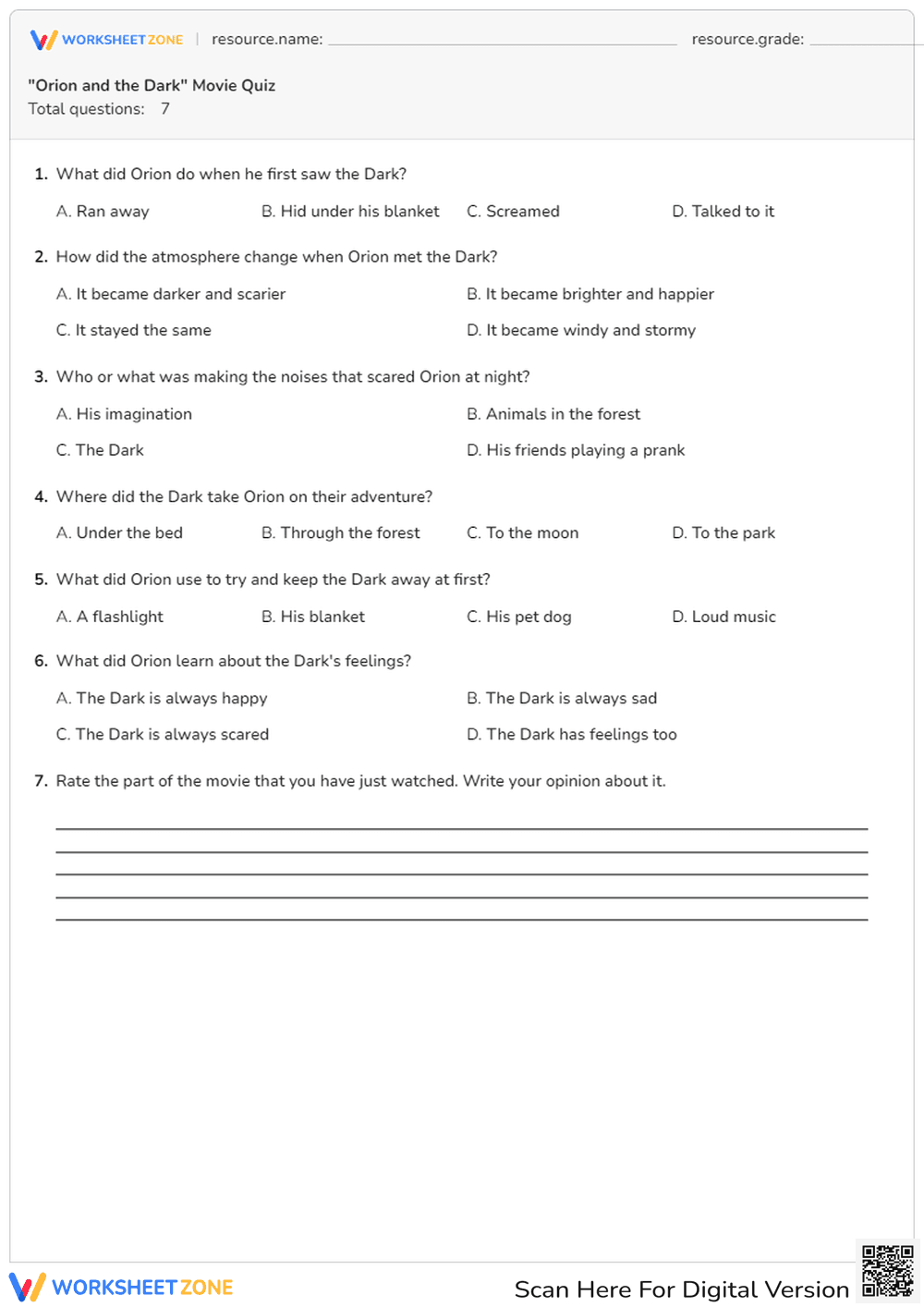

Printable Orion and the Dark Movie Quiz | Grade 5
Paste this activity's link or code into your existing LMS (Google Classroom, Canvas, Teams, Schoology, Moodle, etc.).
Students can open and work on the activity right away, with no student login required.
You'll still be able to track student progress and results from your teacher account.
This engaging movie quiz tests viewing comprehension and critical thinking for the animated film Orion and the Dark. Students recall key plot details, analyze character emotions, and articulate their own opinions about the story. This resource provides a structured way to assess active listening and media literacy skills.
At a Glance
- Grade: 5 · Subject: ELA
- Standard:
CCSS.ELA-LITERACY.SL.5.2— Summarize information presented in diverse media formats.- Skill Focus: Viewing Comprehension
- Format: 1 page · 7 problems · PDF
- Best For: Friday activities or sub plans
- Time: 15–20 minutes
This single-page assessment features a mix of question types designed to evaluate student understanding of the film. The worksheet includes six multiple-choice questions that target specific plot points, character interactions, and atmospheric changes within the story. It concludes with an open-ended prompt requiring students to rate a movie segment and justify their opinion.
This activity requires zero teacher preparation.
- Print (1 minute): Simply download the PDF and print a class set. The single-page layout conserves paper and requires no stapling.
- Distribute (1 minute): Hand out the quiz immediately after viewing the film or a specific segment of it.
- Review (5 minutes): Go over the multiple-choice answers as a class and invite students to share their written opinions from the final question.
With a total prep time of under two minutes, this worksheet is an ideal, stress-free addition to any substitute teacher plan or pre-holiday schedule.
This resource is directly aligned to CCSS.ELA-LITERACY.SL.5.2, requiring students to summarize a written text read aloud or information presented in diverse media and formats, including visually, quantitatively, and orally. It also supports narrative comprehension by asking students to identify key details. Both standard codes can be copied directly into lesson plans, IEP goals, or district curriculum mapping tools.
This quiz serves as an excellent post-viewing assessment to ensure active engagement. Alternatively, it can be used as a guided viewing tool where students answer the multiple-choice questions as the events unfold on screen. As a formative assessment observation tip, monitor the final open-ended question to evaluate how well students can construct a basic argument and support their personal rating with specific examples from the film. Expect students to complete this task within 15 to 20 minutes.
This worksheet is designed primarily for fifth-grade students developing their media literacy and viewing comprehension skills. The multiple-choice format provides scaffolding for students who struggle with open-ended recall, making it accessible. It pairs perfectly with a broader narrative writing unit, allowing students to analyze professional storytelling techniques before attempting to draft their own fictional narratives.
Assessing comprehension through multimedia formats is a critical component of modern literacy instruction in the elementary classroom. This worksheet targets CCSS.ELA-LITERACY.SL.5.2, challenging students to summarize information presented in diverse media formats. According to Fisher & Frey (2014), integrating visual media with structured accountability tasks significantly improves overall narrative comprehension and active listening skills. When students are prompted to recall specific plot details and articulate their opinions about a film, they transition from passive consumers of media to active, critical thinkers. This targeted assessment ensures that classroom movie viewing retains strong educational value by requiring students to process character development and thematic elements. By combining multiple-choice recall with an open-ended evaluation task, educators can effectively measure both basic understanding and higher-order analytical skills in a highly engaging, student-friendly format.


