


























Views
Downloads
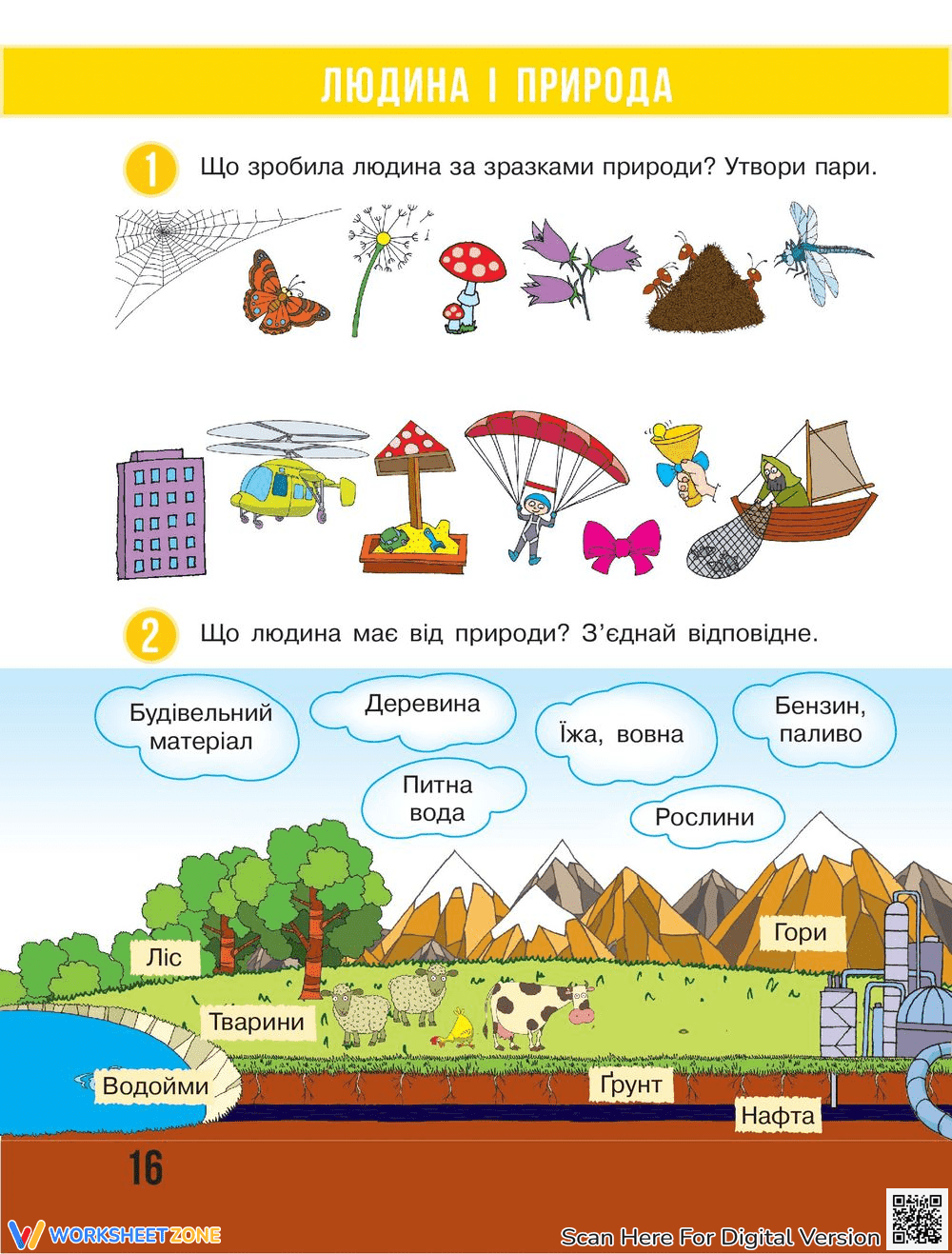

Man and Nature Worksheet | Grade 2 Essential Science
Paste this activity's link or code into your existing LMS (Google Classroom, Canvas, Teams, Schoology, Moodle, etc.).
Students can open and work on the activity right away, with no student login required.
You'll still be able to track student progress and results from your teacher account.
This Grade 2 Man and Nature worksheet helps students identify how human inventions are inspired by the natural world and how we utilize resources. By connecting biological structures to engineering solutions, students develop a foundational understanding of biomimicry. It provides a clear, visual framework for understanding the relationship between humans and the planet.
At a Glance
- Grade: 2 · Subject: Behavior Worksheets · Science
- Standard:
K-2-ETS1-2— Illustrate how the shape of an object helps it function to solve problems- Skill Focus: Biomimicry and Resource Identification
- Format: 1 page · 2 tasks · Answer key included · PDF
- Best For: Introduction to engineering and environmental science
- Time: 15–20 minutes
Inside this resource is a single-page activity with two visual matching tasks. The first features 7 pairs focusing on biomimicry, linking natural items like spider webs to human-made tools like nets. The second section uses a landscape illustration to help students categorize 6 primary natural resources and their corresponding human uses, such as timber and fuel.
This worksheet is designed for a zero-prep workflow. First, print the single-page PDF (30 seconds). Second, distribute the sheets and provide a brief overview of the matching instructions (1 minute). Finally, review the answers as a group to reinforce the connection between nature and technology (5 minutes). Total teacher prep time is under 2 minutes, making it an ideal sub plan.
This activity aligns with K-2-ETS1-2, requiring students to understand how the shape of objects—often inspired by nature—solve human problems. It also supports 2-ESS1-1 by highlighting natural resources like water and oil. Both standard codes can be copied directly into lesson plans, IEP goals, or district curriculum mapping tools.
Use this during the "Explore" phase of a science lesson on engineering. It serves as a formative assessment to gauge if students recognize patterns between biological structures and mechanical functions. Assign this after a short walk outside or a video on adaptations. Completion typically takes 15 to 20 minutes depending on the depth of discussion.
This resource is perfect for second-grade students, including ELLs who benefit from heavy visual scaffolding. It pairs naturally with an anchor chart on natural resources. The worksheet is also suitable for special education settings where clear, discrete tasks help maintain student focus and reduce cognitive load during independent work time.
According to Fisher & Frey (2014), visual non-linguistic representations are critical for helping primary students bridge the gap between abstract scientific concepts and real-world applications. This worksheet utilizes that research by providing 13 distinct visual cues that prompt students to categorize information based on functional relationships. By identifying how a dandelion's structure informs parachute design or how oil becomes fuel, students engage in higher-order relational thinking. The inclusion of the K-2-ETS1-2 standard ensures that the activity remains focused on core engineering practices rather than just simple identification. This structured approach to biomimicry and resource management provides the necessary scaffolding for Grade 2 learners to master complex environmental interactions. Educators can rely on this evidence-based design to support curriculum goals while minimizing instructional friction in the classroom.


