


























Views
Downloads
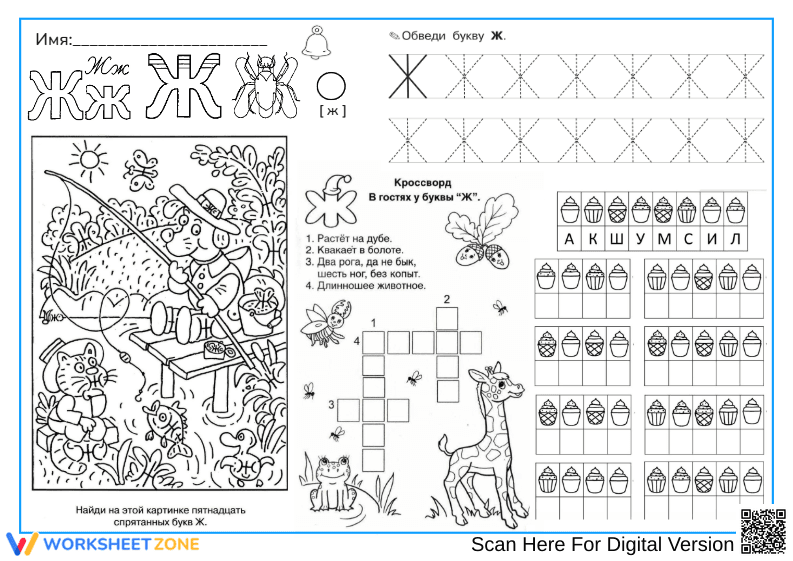


Russian Letters Ж and Ш | Essential Practice
Paste this activity's link or code into your existing LMS (Google Classroom, Canvas, Teams, Schoology, Moodle, etc.).
Students can open and work on the activity right away, with no student login required.
You'll still be able to track student progress and results from your teacher account.
This Kindergarten Russian alphabet worksheet provides comprehensive practice for the Cyrillic letters Ж and Ш. Students engage in multi-sensory activities including tracing, visual discrimination, and vocabulary building to ensure letter mastery. By combining fine motor skills with phonemic awareness, learners develop a solid foundation for reading and writing in a second language.
At a Glance
- Grade: Kindergarten · Subject: Other Behaviors
- Standard:
CCSS.ELA-LITERACY.RF.K.1.B— Recognize and name all upper- and lowercase letters of the alphabet- Skill Focus: Cyrillic Letter Recognition
- Format: 2 pages · 10 problems · Answer key included · PDF
- Best For: Introductory Russian phonics and letter formation
- Time: 20–30 minutes
The 2-page PDF features dedicated sections for letters Ж and Ш. Each page includes large-format tracing lines for proper stroke order, a "hidden letter" visual search puzzle containing 15 targets, and vocabulary-based logic puzzles like crosswords and word-building grids. The layout uses engaging illustrations of animals and objects to provide context for the sounds.
- Guided Practice: Students begin with large-scale letter tracing, following dotted paths to establish correct muscle memory for the complex Cyrillic shapes of Ж and Ш.
- Supported Practice: Learners transition to visual discrimination tasks, searching for hidden letters within detailed illustrations to sharpen their recognition skills in varied contexts.
- Independent Practice: The final stage involves solving crosswords and filling in missing letters in words, requiring students to apply their knowledge of letter-sound correspondence independently.
This sequence follows the gradual-release model, moving from high-support tracing to independent application.
This resource aligns with CCSS.ELA-LITERACY.RF.K.1.B, which requires students to recognize and name all upper- and lowercase letters. While specifically designed for the Cyrillic alphabet, it mirrors the foundational literacy requirements for phonemic awareness and grapheme recognition. Both standard codes can be copied directly into lesson plans, IEP goals, or district curriculum mapping tools.
Use this worksheet during the independent practice phase of a Russian language lesson after introducing the sounds of Ж and Ш. It serves as an excellent formative assessment tool; observe students during the hidden letter search to identify those struggling with visual discrimination. Completion typically takes 25 minutes, making it ideal for center rotations or independent desk work.
This is designed for Kindergarten students or early elementary learners beginning their journey with the Russian alphabet. It is particularly effective for heritage learners or students in dual-language immersion programs. Pair this with a physical alphabet anchor chart or a letter-sound song to reinforce the auditory component of the lesson.
According to the RAND AIRS 2024 report on early literacy, multi-sensory engagement with letter forms—combining tracing with visual search—significantly increases long-term retention of new graphemes. This worksheet utilizes these proven strategies by requiring students to identify the letters Ж and Ш across 10 distinct tasks, ranging from fine motor tracing to cognitive word-building. By integrating visual discrimination within complex illustrations, the resource challenges students to move beyond rote memorization toward functional recognition. Research from Fisher & Frey (2014) supports this gradual-release approach, noting that scaffolded practice is essential for mastering non-Latin scripts. This Grade K resource provides the necessary repetition and variety to ensure students meet the requirements of CCSS.ELA-LITERACY.RF.K.1.B while building a robust foundation for bilingual literacy and phonological awareness in a classroom setting.


