


























Views
Downloads


Essential Area of Polygons Worksheet | Grade 6 Math
Paste this activity's link or code into your existing LMS (Google Classroom, Canvas, Teams, Schoology, Moodle, etc.).
Students can open and work on the activity right away, with no student login required.
You'll still be able to track student progress and results from your teacher account.
Overview
This Grade 6 Math worksheet provides a comprehensive mid-unit review for calculating the area of various polygons, including parallelograms, triangles, and trapezoids. Students apply geometric formulas to determine total area and solve for missing dimensions using given area values. This resource is designed to solidify foundational geometry skills before introducing complex volume concepts.
At a Glance
At a Glance
- Grade: 6 · Subject: Math
- Standard:
CCSS.MATH.CONTENT.6.G.A.1— Find the area of triangles and special quadrilaterals by decomposing shapes- Skill Focus: Area of parallelograms, triangles, and trapezoids
- Format: 2 pages · 6 problems · Answer key included · PDF
- Best For: Mid-unit assessment, homework, and geometry skill reinforcement during a sixth-grade unit
- Time: 25–35 minutes
What's Inside
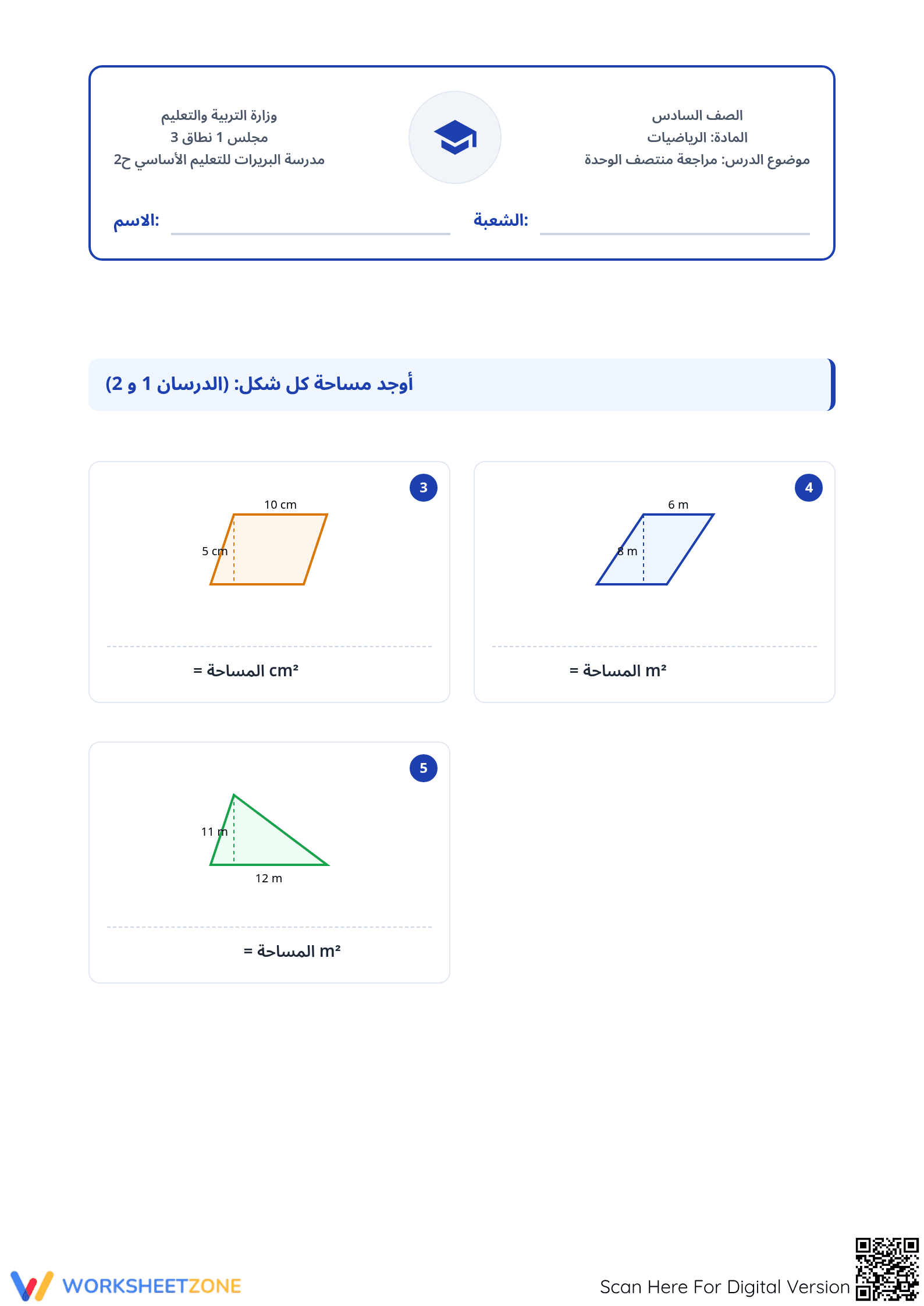
This two-page review features six high-quality problems challenging students to apply their knowledge of area formulas. The first page focuses on direct calculations for parallelograms and triangles with clearly labeled dimensions. The second page increases the rigor by requiring students to solve for missing bases or heights and culminates in a real-world word problem involving a trapezoidal table surface area calculation.
Skill Progression
- Guided Practice: The worksheet begins with basic shape identification and direct formula application for parallelograms and triangles using two clear visual diagrams to build confidence.
- Supported Practice: Students transition to finding missing dimensions, where they must rearrange area formulas like A=bh to solve for a specific variable using algebraic logic.
- Independent Practice: The final task is an un-scaffolded word problem requiring students to extract data from a text description to model a trapezoid surface area calculation.
This sequence follows a gradual-release model, moving from basic computational fluency to analytical problem-solving.
Standards Alignment
Aligned to `CCSS.MATH.CONTENT.6.G.A.1`, this resource requires students to find the area of right triangles, other triangles, and special quadrilaterals by composing into rectangles or decomposing into triangles and other shapes. Supporting standards include algebraic reasoning for missing dimensions. Both standard codes can be copied directly into lesson plans, IEP goals, or district curriculum mapping tools.
How to Use It
Use this worksheet as a formal mid-unit assessment to identify students who may need additional intervention before the final geometry exam. It also serves as an excellent partner activity during independent practice rotations; observe how students handle the missing dimension problems to gauge their algebraic reasoning. The expected completion time is approximately 30 minutes, fitting well within a standard class period.
Who It's For
This resource is tailored for sixth-grade students mastering the Geometry domain of the Common Core Standards. It is particularly beneficial for learners bridging the gap between simple area calculation and algebraic variable manipulation. Pair this worksheet with a reference anchor chart showing formulas for parallelograms and triangles to support students who are still memorizing geometric properties.
Geometric reasoning in the middle grades is a critical precursor to high-school trigonometry and calculus. According to research published by Fisher & Frey (2014) on the gradual release of responsibility, students who engage with structured practice that moves from direct computation to solving for unknown variables demonstrate higher retention of mathematical concepts. By requiring students to calculate the area of diverse polygons and then reverse the process to find missing dimensions, this worksheet aligns with the instructional framework that promotes mastery through varied application. This approach ensures that learners do not simply memorize a standard formula but instead understand the relationship between the base, height, and total area within a given polygon. Standard `CCSS.MATH.CONTENT.6.G.A.1` focuses on this exact decomposition and composition of shapes, providing the necessary mathematical scaffolding for students to master two-dimensional space measurement effectively and confidently in any educational setting.


