


























Views
Plays


Realism in Literature Worksheet | Grade 9 Essential
Paste this activity's link or code into your existing LMS (Google Classroom, Canvas, Teams, Schoology, Moodle, etc.).
Students can open and work on the activity right away, with no student login required.
You'll still be able to track student progress and results from your teacher account.
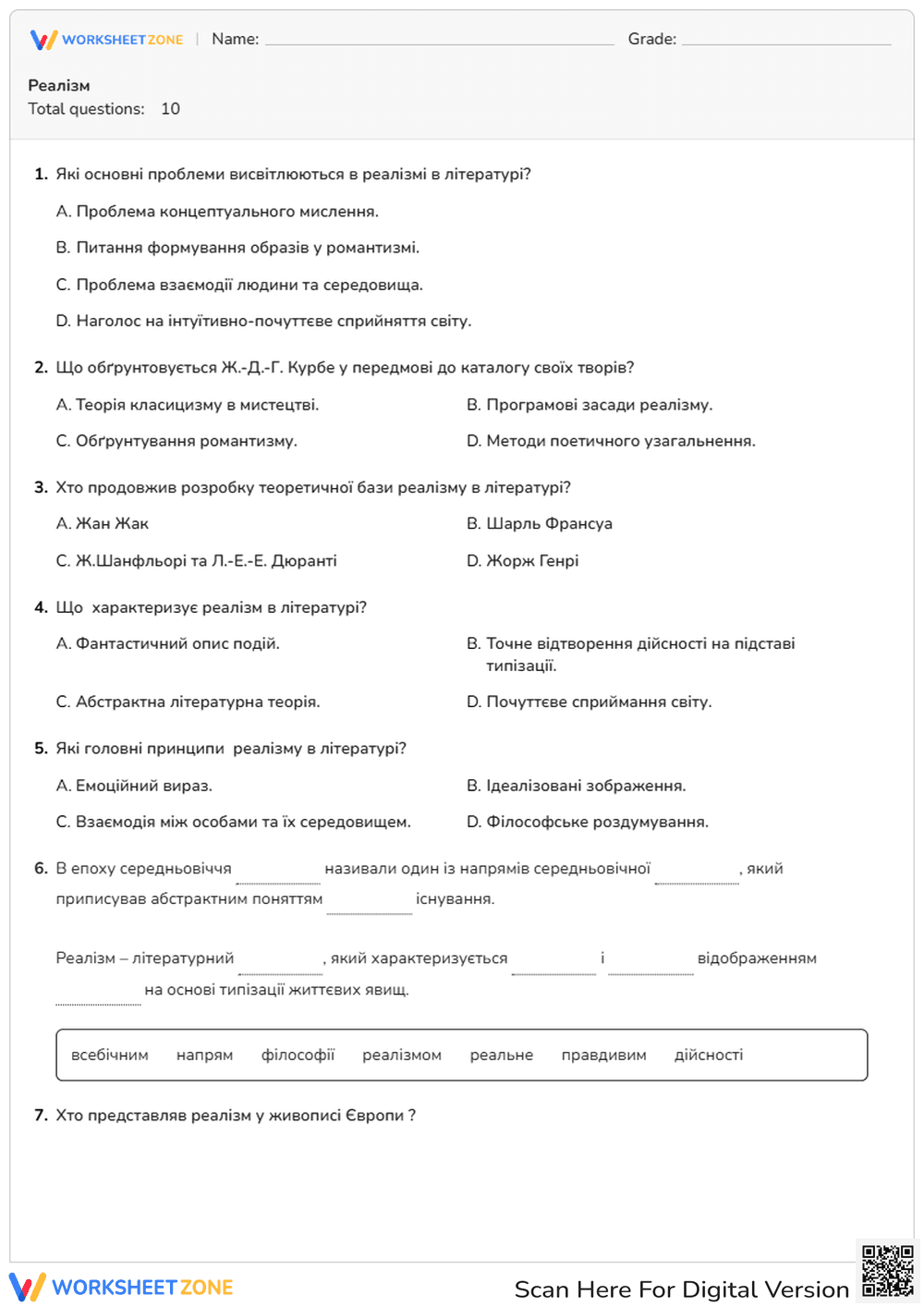
This Grade 9 Realism worksheet helps students identify and analyze the core tenets of the 19th-century literary movement. By examining the interaction between characters and their environments, learners develop a sophisticated understanding of how realism differs from romanticism. Students will demonstrate mastery through objective identification and critical written reflection.
At a Glance
- Grade: 9 · Subject: World Literature
- Standard:
CCSS.ELA-LITERACY.RL.9-10.3— Analyze how complex characters develop and interact with their environment- Skill Focus: Literary Realism Characteristics
- Format: 2 pages · 10 problems · Answer key included · PDF
- Best For: Formative assessment and movement review
- Time: 20–30 minutes
The resource contains 10 structured tasks across two pages. It begins with five multiple-choice questions targeting key theoretical foundations and historical figures like Courbet. This is followed by a contextual fill-in-the-blank exercise to reinforce vocabulary and three open-ended prompts that require students to synthesize their knowledge and provide synonyms for the movement's core concepts.
Skill Progression
- Guided Practice: 5 multiple-choice questions isolate specific facts about the movement's origins and key theorists.
- Supported Practice: A cloze-style paragraph uses a word bank to ensure technical accuracy while defining the movement.
- Independent Practice: 3 open-ended prompts challenge students to apply the concept of realism to their own reading and modern contexts.
This structure follows the gradual release of responsibility model to ensure student confidence before moving to higher-order analysis.
Standards Alignment
This resource aligns with `CCSS.ELA-LITERACY.RL.9-10.3`, focusing on how characters are shaped by and interact with their settings—a hallmark of realist prose. It also supports RL.9-10.4 by requiring students to determine the meaning of movement-specific terminology. Both standard codes can be copied directly into lesson plans, IEP goals, or district curriculum mapping tools.
How to Use It
Use this worksheet as a mid-unit check after introducing the transition from Romanticism to Realism. It works effectively as a quiet individual activity following a lecture. Teachers should observe student responses to the open-ended questions to gauge their ability to connect historical literary theory to contemporary observations. Completion typically takes 25 minutes.
Who It's For
This is designed for Grade 9 students in World Literature or English Language Arts courses. It is particularly useful for students who need structured scaffolds to understand abstract literary theories. It pairs naturally with an introductory slide deck on 19th-century art and literature or a primary source excerpt from a realist novel.
According to Fisher & Frey (2014), the use of structured scaffolds like the ones found in this CCSS.ELA-LITERACY.RL.9-10.3 worksheet is essential for helping secondary students transition from literal comprehension to thematic analysis. By isolating the specific skill of identifying Realism, the worksheet provides the necessary repetition for students to internalize the movement's characteristics. Research indicates that when students can categorize literature into specific movements, their ability to predict character motivations and plot structures increases significantly. This resource bridges the gap between historical context and textual evidence, ensuring that Grade 9 learners can articulate the nuances of human-environment interaction. The inclusion of multiple task types—from recognition to synthesis—aligns with best practices for formative assessment in the ELA classroom, providing teachers with clear data on student mastery of complex literary concepts.


